
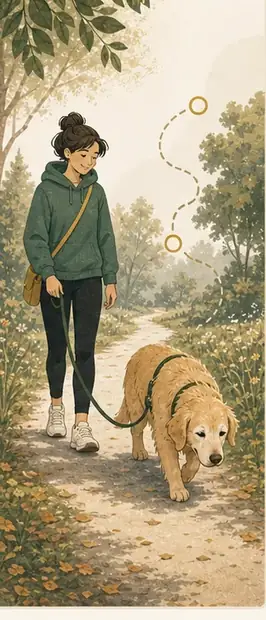
- Miles are a blunt tool for senior dogs.
- Measure comfort, willingness, pace, stopping points, and recovery instead.
- A shorter walk that repeats well is better than a longer walk that costs tomorrow.
Turn this senior-dog answer into a gentler walking routine.
A senior dog walking app should make gentle movement visible: shorter walks, slower routes, willingness changes, recovery signals, and the patterns you may want to discuss with your veterinarian.
Build a senior walk limit from recovery
Choose what the last easy walk looked like. The result gives you a repeatable next step, not a diagnosis or a fixed distance target.
PDSA advises exercising senior dogs at their own pace, allowing rest, adapting to weather, and speaking with a veterinarian about mobility or enjoyment changes.
What should I measure instead of distance?
Instead of distance, measure how willingly your old dog starts, how often they stop, whether they limp or lag, how they handle surfaces and weather, and how they recover after rest. These signals are more useful than miles for senior dogs.
A mile can be easy on cool grass and brutal on hot pavement. A block can be simple in spring and too much after a bad night.
Senior dog walking is less about hitting distance and more about finding repeatable comfort.
GetWalkBuddy can track the numbers, but the real value is pairing those numbers with what you see in your dog.
How do I find my old dog's comfortable walking distance?
Find your old dog's comfortable walking distance by starting shorter than you think, choosing an easy route, watching willingness and gait, then checking recovery later that day and the next morning. Increase only when the current route is comfortable and repeatable.
The baseline should feel almost too easy. That is the point.
Pick a route your dog can finish without bargaining. Repeat it for several days. If recovery is clean, add a little. If recovery is rough, shrink it.
This is how you avoid the senior dog trap: one good day convincing you to overdo the next one.
When should an old dog's walk be shorter?
An old dog's walk should be shorter in heat, after poor sleep, during pain flare-ups, after illness, on slippery or hard surfaces, after a long inactive period, or when the dog hesitates, limps, pants unusually, seems confused, or cannot recover normally afterward.
Shorter is not failure. Shorter is listening.
Some days the right walk is a bathroom break plus five minutes of sniffing. Some days your dog has more in the tank.
The skill is not always doing more. The skill is changing the dose before your dog pays for it.
Questions owners ask when the leash is already in their hand
-
Is a mile too far for an old dog?
A mile may be fine for some senior dogs and too far for others. Breed, size, joint health, weather, surface, fitness, and recovery decide. Watch the dog, not the number.
-
How long should an old dog walk for?
There is no universal time. Many older dogs do better with shorter, gentler outings that can be repeated comfortably. Ask your veterinarian for limits if your dog has health concerns.
-
Should old dogs walk slower?
Often, yes. A slower pace can reduce strain and allow sniffing. Sudden slowing, stiffness, limping, or reluctance should be tracked and discussed with a veterinarian.
Track comfort, not just distance.
GetWalkBuddy helps you see how far your older dog walked, then connect that distance to recovery, routine, and the next gentle step.