
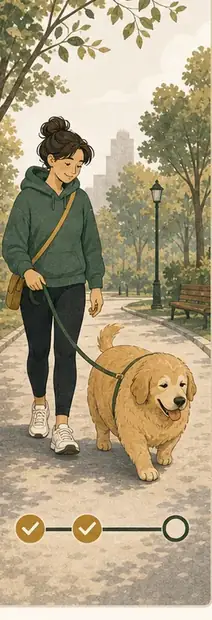
- Walking helps, but it is rarely the whole weight loss plan.
- A repeatable walk routine is more valuable than occasional long routes.
- If the scale stalls, check treats, portions, health, and plan consistency before simply pushing harder.
Turn this answer into a walk you can actually track.
GetWalkBuddy is a dog walking app for owners who want a simple route tracker, timer, distance view, and daily walk log without turning the walk into a spreadsheet.
Why is walking not helping my dog lose weight?
Walking may not help your dog lose weight if food intake, treats, medical issues, inconsistent walks, or low-intensity routines cancel out the activity. Weight loss needs an overall plan, not just a few extra routes when motivation appears.
This is the part nobody likes: one extra biscuit can be louder than a walk.
That does not make walking useless. Walking builds the habit, protects muscle, improves stamina, and gives you a daily lever.
But if the food plan is not part of the equation, the math can get rude.
What kind of walking helps an overweight dog lose weight?
Walking helps an overweight dog most when it is consistent, gentle, long enough to matter, short enough to repeat, and adjusted for recovery. Flat routes, sniff breaks, steady pace, and gradual increases often work better than erratic long walks.
The best walk is not always the hardest walk. It is the walk your dog can do again.
Use pace when it is safe. Use sniffing when the body needs lower impact. Use frequency when one longer walk creates soreness.
GetWalkBuddy tracks the daily target so you know whether the routine actually happened.
How do I know walking is working for dog weight loss?
Walking is working for dog weight loss when your dog recovers well, moves more willingly, builds consistency, and veterinarian-guided weigh-ins trend in the right direction. Improvement may first appear as easier starts and better stamina before the scale changes.
Do not make the scale the only witness. Watch stairs, starts, panting, recovery, and willingness to go out.
A dog who used to resist and now trots to the door is giving you useful evidence.
Then use weigh-ins to confirm the plan is moving in the right direction.
Questions owners ask when the leash is already in their hand
-
Can dogs lose weight by walking?
Yes, walking can support dog weight loss when paired with a veterinarian-guided food plan and consistent routine. Walking alone may not overcome too many calories or medical issues.
-
How much walking burns calories for dogs?
Calorie burn varies by size, pace, terrain, fitness, and health. Instead of chasing an exact number, build a repeatable walking routine and monitor weight with your veterinarian.
-
Should overweight dogs do hills?
Hills can be too demanding at first for some overweight dogs. Start with easier flat routes unless your veterinarian says the dog can safely handle inclines.
Track the routine, not just the hope.
GetWalkBuddy helps you see whether today's movement target happened, then keeps the next small win close enough to repeat.