
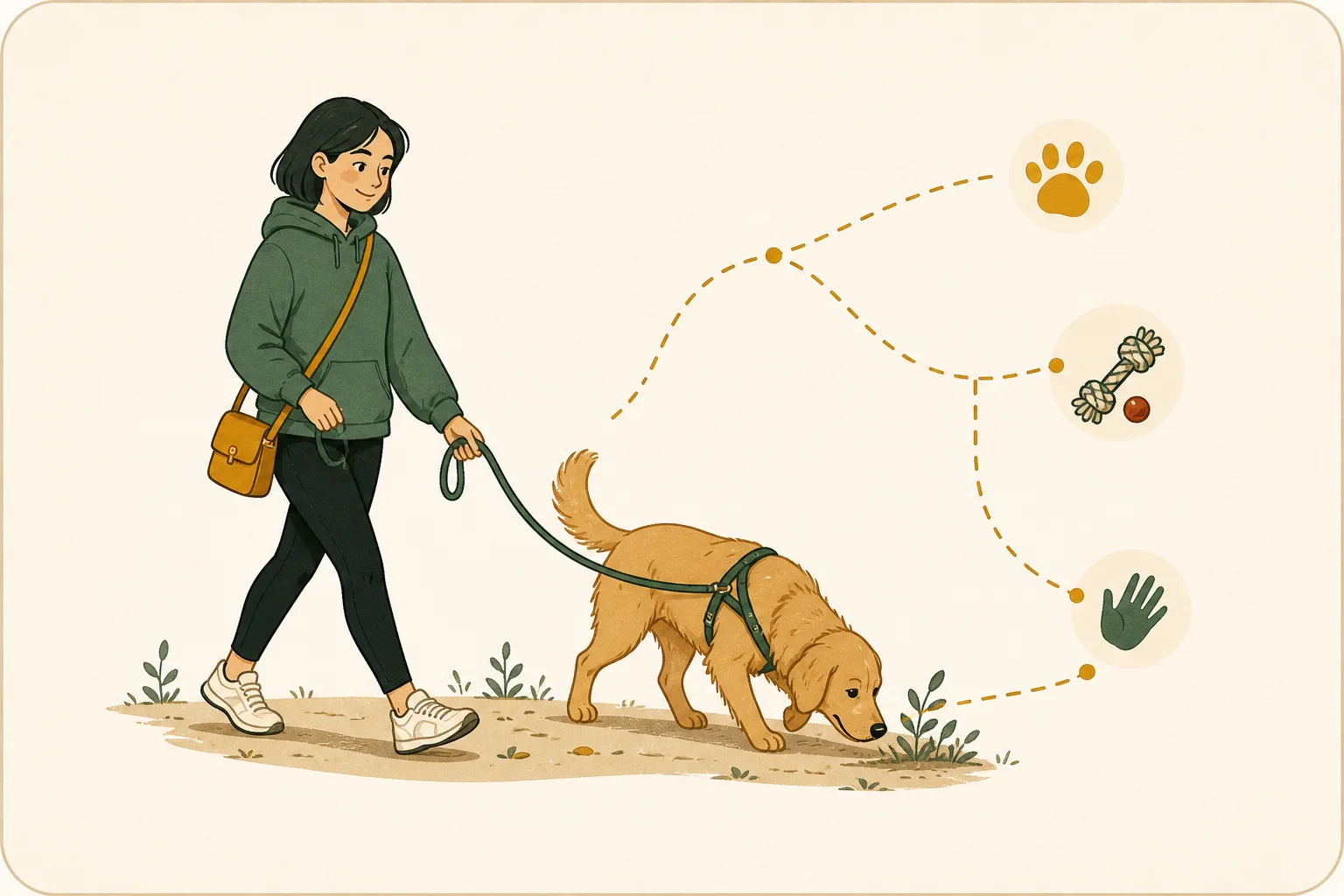
- Audit the quality and recovery of current walks before automatically adding more mileage.
- Add one short mental or play activity and compare the dog's seven-day pattern.
- Separate unmet needs from pain, anxiety, or medical change with professional help when needed.
Turn this answer into a walk you can actually track.
GetWalkBuddy is a dog walking app for owners who want a simple route tracker, timer, distance view, and daily walk log without turning the walk into a spreadsheet.
The 7-day “are walks enough?” test
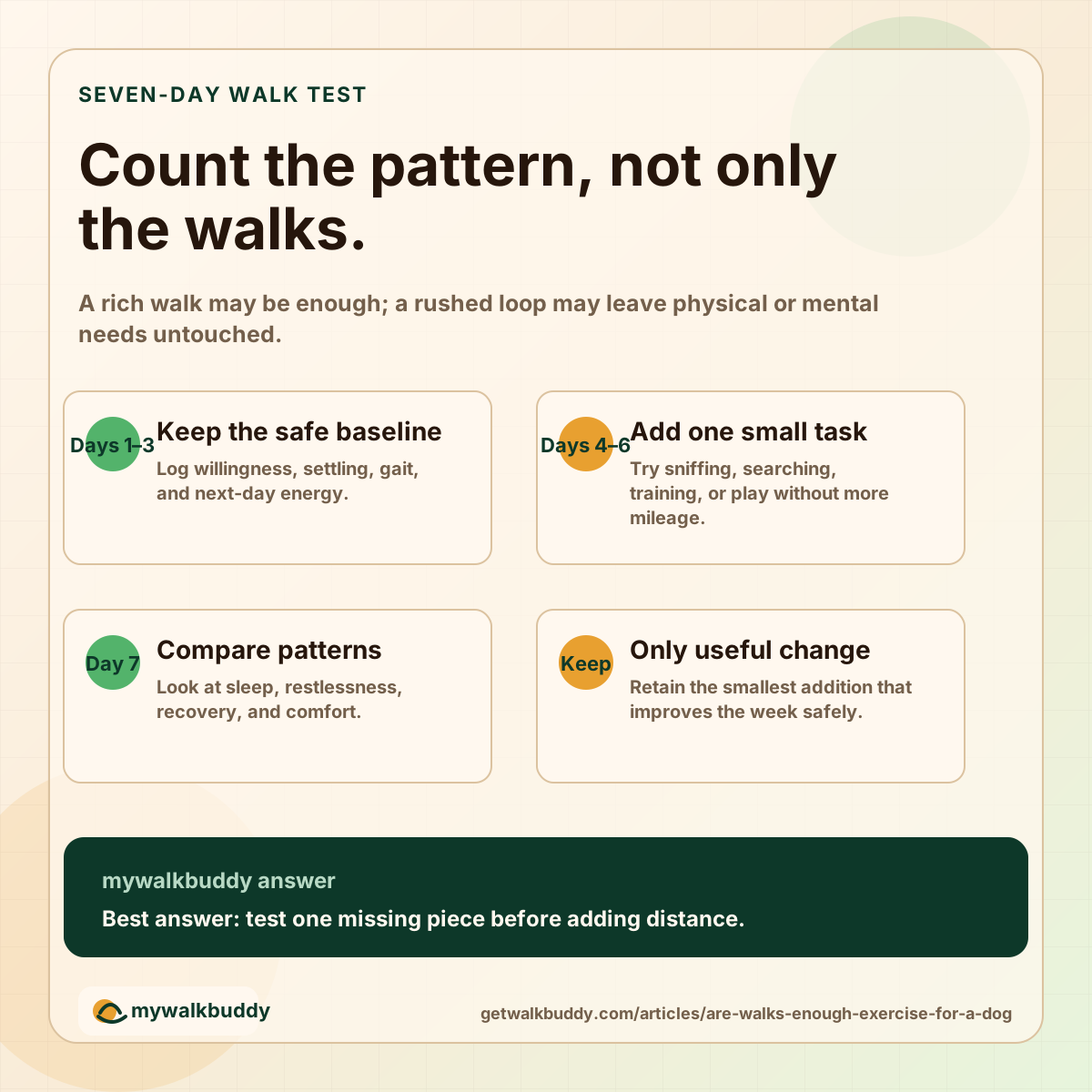
Keep the safe baseline first, then add one small missing skill without adding mileage. The comparison stays useful because only one variable changes.
| Day | Plan | Record | Decision |
|---|---|---|---|
| 1 | Usual safe walks | Settling + gait | Establish baseline |
| 2 | Repeat | Sleep + restlessness | Do not change yet |
| 3 | Repeat | Next-day willingness | Choose one missing skill |
| 4 | Add 5-minute sniff, search, play, or training task | Settling + recovery | Keep mileage stable |
| 5 | Repeat the same addition | Behavior pattern | Make it easier if frustrated |
| 6 | Repeat | Gait + next morning | Stop for worse recovery |
| 7 | Compare days 1–3 with 4–6 | Whole-week pattern | Keep only a safe useful change |
Sudden restlessness, pain, limping, weakness, breathing trouble, or inability to settle can need veterinary or behavior support rather than more exercise.
What suggests your dog's walks may be enough?
Walks may be meeting the dog's needs when participation is willing, body condition is appropriate, movement stays comfortable, the dog can settle afterward, sleep is normal, and destructive or restless behavior is not persistent. The routine should remain repeatable across the week without soreness, escalating arousal, repeated refusal, or a major drop in next-day energy.
A slow scent-rich walk may satisfy one dog more than a longer fast pavement loop.
Track patterns for seven days because one quiet or chaotic evening does not define the routine.
What might be missing even when a dog walks daily?
Daily walks can still leave gaps in problem-solving, social contact, safe play, scent work, training, or breed-related behavior. Add one small activity that uses a different skill instead of only extending the route. A five-minute search, calm tug session, simple cue practice, or choice-led sniff section can reveal whether variety was the missing piece.
Do not assume every restless dog needs harder exercise. Fear, frustration, pain, and poor sleep can look like excess energy.
Use the dog exercise-by-breed planner for ideas, then let individual engagement and recovery decide.
How do you run a seven-day walk sufficiency test?
Keep the usual safe walk schedule for three days while recording settling and recovery. For the next three days, add one brief mental or play activity without increasing mileage. On day seven, compare sleep, restlessness, destructive behavior, willingness, and next-morning movement. Keep the smaller routine change only if the pattern improves without worse recovery.
Change one thing so the result remains interpretable. Do not add distance, intensity, and several games together.
Seek veterinary advice for sudden behavior change, pain, limping, weakness, breathing trouble, or persistent inability to settle.
Questions owners ask when the leash is already in their hand
-
Are two walks a day enough for every dog?
No. Two walks can suit some dogs, but duration, quality, age, health, breed traits, home environment, and additional activity determine whether the full routine fits.
-
Does sniffing count as exercise?
Sniffing provides mental and sensory work and can enrich a walk. It complements physical movement rather than making the dog's health, conditioning, and mobility needs irrelevant.
Turn the answer into a routine you can see.
Use GetWalkBuddy to log the walk, route, duration, and recovery note that make this guidance useful for your individual dog.