
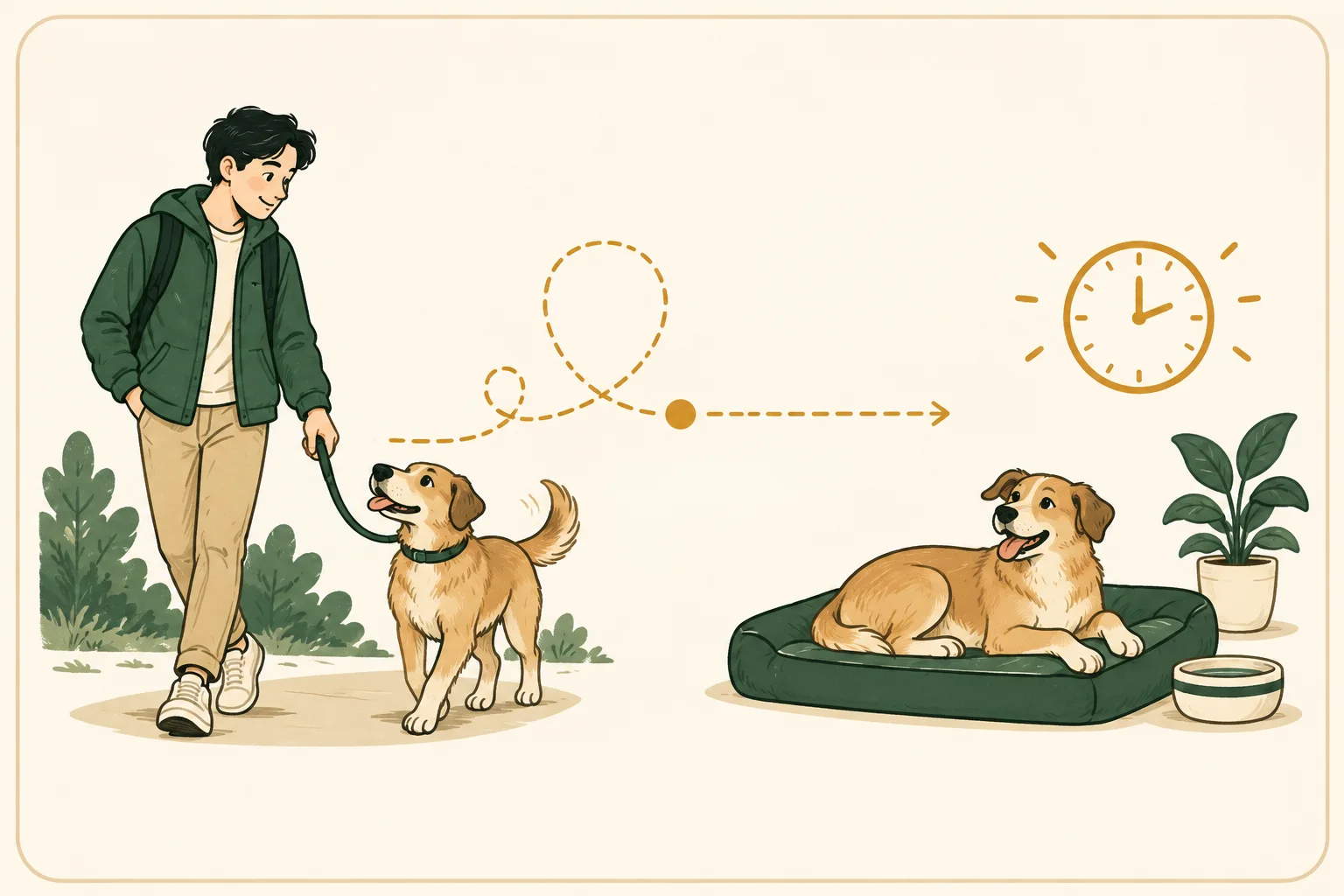
- Plan the whole workday: activity before leaving, safe rest, a suitable break, and time together afterward.
- Keep DIY enrichment supervised; no toy is safe for every dog or a substitute for care.
- Observe what happens after departure. Separation distress needs a different response from ordinary under-stimulation.
Turn this answer into a walk you can actually track.
GetWalkBuddy is a dog walking app for owners who want a simple route tracker, timer, distance view, and daily walk log without turning the walk into a spreadsheet.
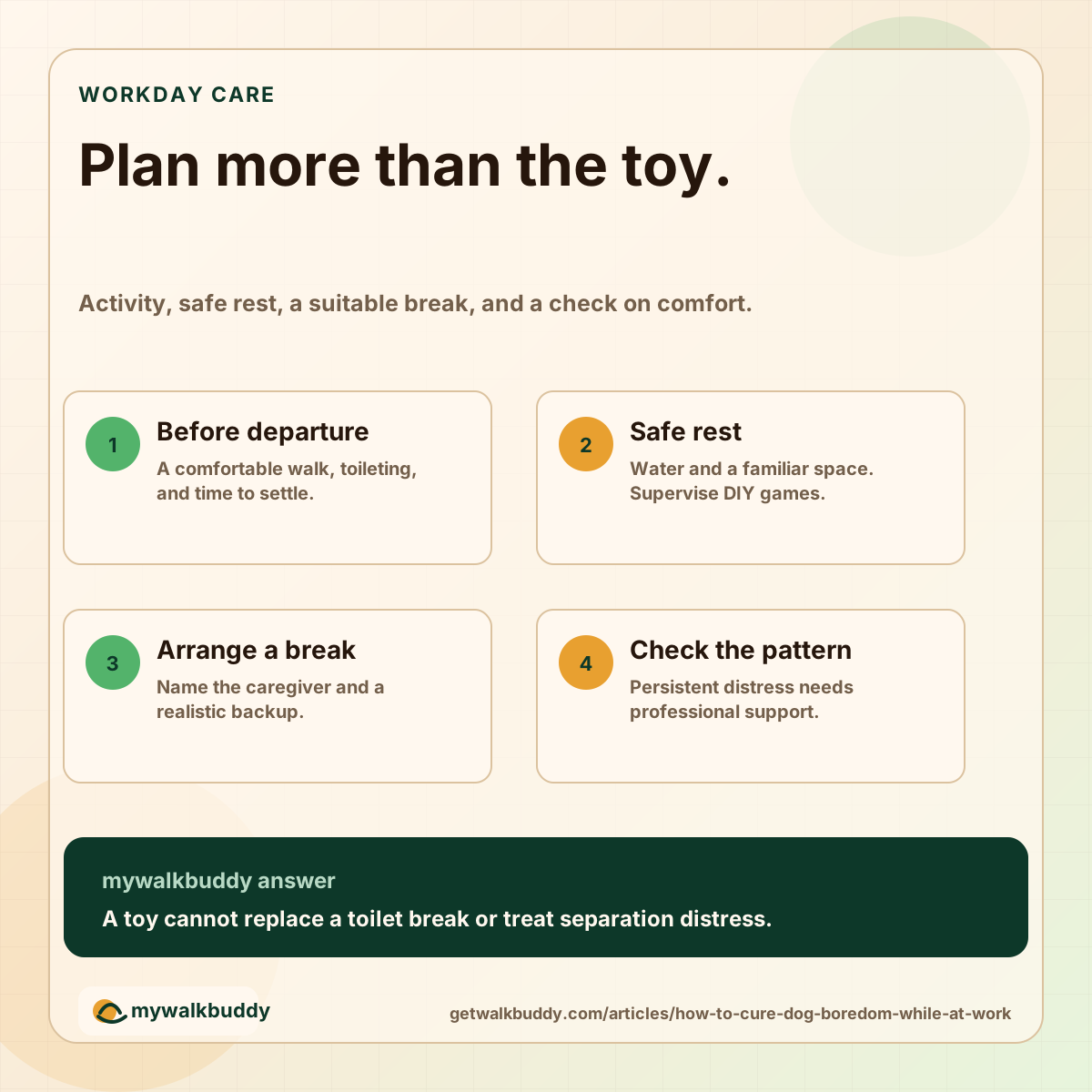
Is your dog bored or distressed when left alone?
Look at timing and the whole pattern rather than one chewed object. Under-stimulation is one possible explanation for unwanted activity. Persistent vocalizing, pacing, drooling, attempts to escape, or distress around departure may point toward a separation-related problem. A veterinarian can assess medical contributors and help direct appropriate behavior support when the pattern is worrying.
If you use a camera, observe a normal departure and write down what actually happens: when the dog starts pacing, whether they eat, whether they settle, and whether distress continues. A recording is useful context, not a diagnosis. Do not deliberately prolong an absence to see how much distress the dog can tolerate.
ASPCA describes separation anxiety as distress linked to separation and explains why punishment can worsen the problem. Coming home to damage is not evidence that the dog acted out of spite. If the dog panics, injures themselves, or repeatedly tries to escape, arrange help rather than adding harder toys.
Sudden house-soiling, appetite changes, or a new inability to settle can also warrant veterinary attention. Keep observations factual so the professional can distinguish possibilities instead of starting from the assumption that more exercise will solve everything.
Sources: ASPCA: Separation Anxiety
What should you do with your dog before leaving for work?
Leave room for a walk or comfortable activity, toileting, sniffing or familiar training, and time to settle before departure. Match the workload to age, health, weather, and normal recovery. The goal is a repeatable morning that meets needs, not an exhausting session intended to make the dog sleep through any length of absence.
Choose a route you can genuinely complete on a workday. Let safe sniffing be part of it rather than rushing every stop. A predictable, manageable outing is easier to repeat than a demanding route you can only fit in occasionally.
Add one easy activity while you are still home, such as finding a familiar toy or practicing a known cue for a small food reward. Then put the activity materials away and allow a quiet transition. Count food rewards within the usual feeding plan.
If mornings are repeatedly too compressed, solve the schedule problem directly: prepare walking gear the night before or arrange help. A new puzzle cannot create a toilet break or human availability later in the day.
Sources: ASPCA: Canine DIY Enrichment
Which enrichment can a dog have while you are at work?
Choose only items appropriate for your individual dog's size, chewing habits, health, and experience, and follow their supervision instructions. Test unfamiliar items while you are present. Keep cardboard puzzles, fabric searches, and anything the dog tears or swallows for supervised time. When unsure, a hazard-free resting space is safer than leaving a risky project behind.
The ASPCA's DIY enrichment page explicitly requires close, active supervision while DIY items are accessible. That matters for workday advice: an activity that is useful with you beside the dog does not automatically become suitable for an empty house.
Inspect any item before use and remove damaged pieces. Previous uneventful use is not a guarantee that a toy will always be safe. A dog who destroys or ingests items needs an individual plan, not an online list labeled indestructible.
Do not keep increasing difficulty to occupy more hours. Frustration is not the objective. Make safe rest a planned part of the day, with water and a familiar space. If the dog cannot settle during absence, reassess the cause.
Sources: ASPCA: Canine DIY Enrichment; ASPCA: Separation Anxiety
How do you make a realistic workday plan for your dog?
Write down departure, return, toileting opportunities, activity, rest, and who will provide a break when needed. Fit the plan to the dog instead of assuming every adult can manage a full shift alone. Puppies, seniors, dogs with medical needs, and dogs struggling with separation may need substantially different support and more frequent human availability.
Use this planning card with anyone sharing care. It is an illustrative template, not a claim that a particular number of hours alone is safe for every dog. If the gap between departure and return exceeds what your dog can comfortably handle, arrange a trusted person or suitable care before relying on enrichment.
- Before departure: who provides the comfortable walk, toilet opportunity, water check, and settling time?
- During work: when is the next care visit, who is responsible, and what is the backup if they cannot come?
- At the visit: check comfort, offer toileting and suitable activity, and note anything unusual.
- After work: make time for connection and an appropriate outing, then review what the dog actually did during the day.
How can you tell whether the new routine helps?
Keep a brief record of the morning activity, time alone, care breaks, observed behavior, and evening recovery. Change one part at a time for a useful comparison. Look for comfortable settling and needs being met, not simply silence. Persistent or worsening distress calls for professional help rather than a longer trial of the same approach.
A useful entry could read: familiar morning sniff walk; neighbor provided the planned break; dog rested between visits; no change in appetite or movement. This is an example of how to record observations, not a result from a tested case.
GetWalkBuddy can help track the walks within that routine. Keep any home-alone observations alongside the walking record. Do not infer that a longer recorded distance caused an improvement from a single day; timing, company, health, and the environment also matter.
For separation distress, ASPCA describes gradual work within the dog's tolerance and professional support for more difficult cases. Exercise and enrichment can be parts of care, but neither justifies leaving a panicking dog to endure the full shift.
Sources: ASPCA: Separation Anxiety
Questions owners ask when the leash is already in their hand
-
Can you cure dog boredom while at work with toys?
Toys may contribute to an appropriate routine, but they cannot guarantee a cure or replace walks, toileting, company, and care. First check whether the behavior reflects under-stimulation, separation distress, or a medical issue.
-
Should I leave homemade puzzle toys with my dog?
Keep DIY puzzles for closely supervised time. Cardboard, fabric, and small parts can be ingested. Follow product guidance for commercial items and choose for the individual dog; no material is universally safe unattended.
-
Will a longer morning walk fix separation anxiety?
No. Appropriate activity may support the routine, but separation anxiety is not simply excess energy. Ask a veterinarian or qualified behavior professional for a plan if departure triggers persistent distress.
-
Is a quiet dog necessarily happy alone?
Silence alone does not show comfort. Look at resting, movement, appetite, willingness to engage, and the whole pattern. A dog that freezes or remains distressed without barking still needs help.
Make the walking part of the workday easier to track.
Use GetWalkBuddy to record the morning and later walks. Compare the routine with your observations of comfort, rest, and care breaks.