
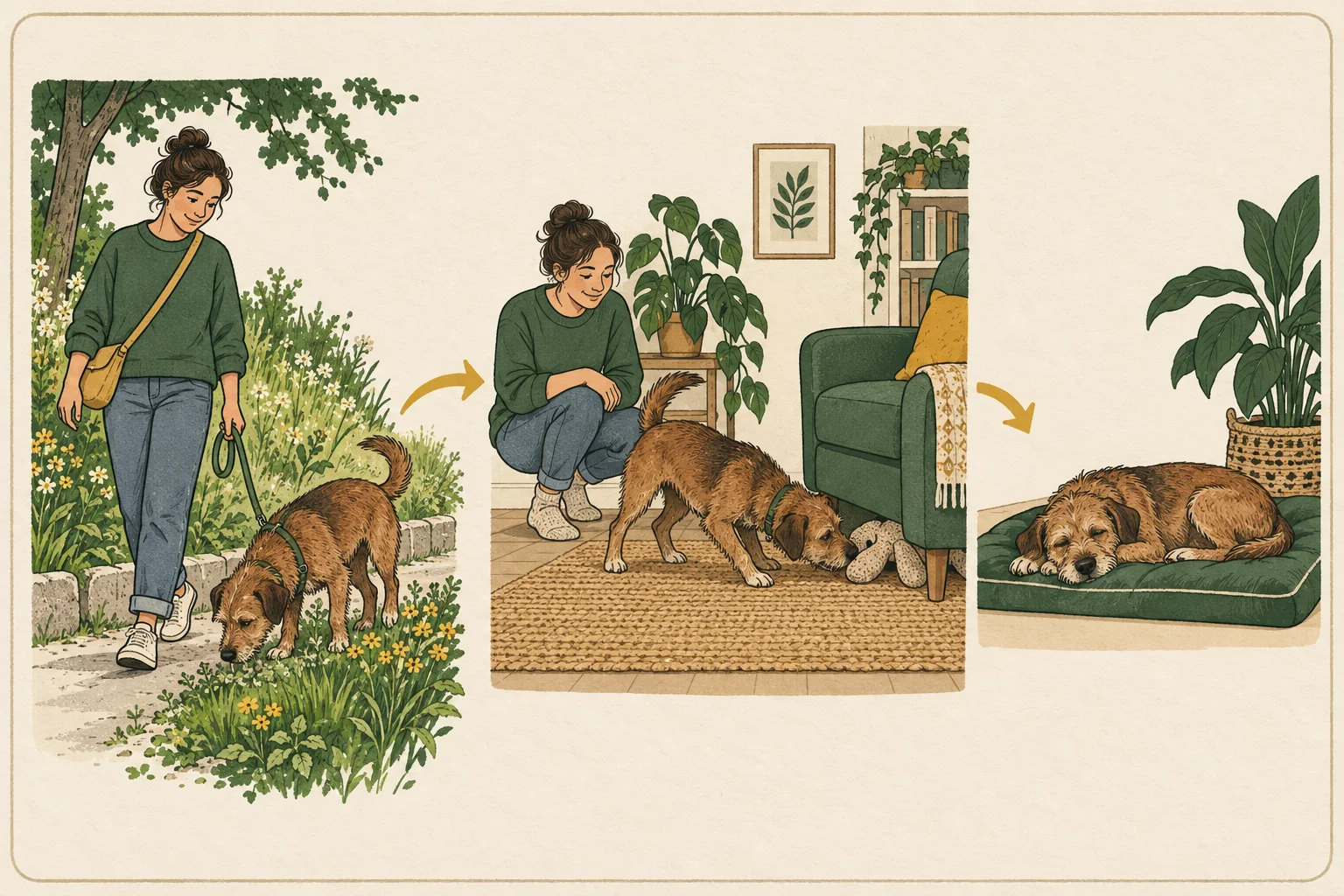
- Put normal care and rest on the calendar before adding optional activities.
- Use the seven-day rotation as a menu; repeat favorites and skip unsuitable activities.
- Review willingness, access and comfort, not just completed boxes or activity minutes.
Turn this answer into a walk you can actually track.
GetWalkBuddy is a dog walking app for owners who want a simple route tracker, timer, distance view, and daily walk log without turning the walk into a spreadsheet.
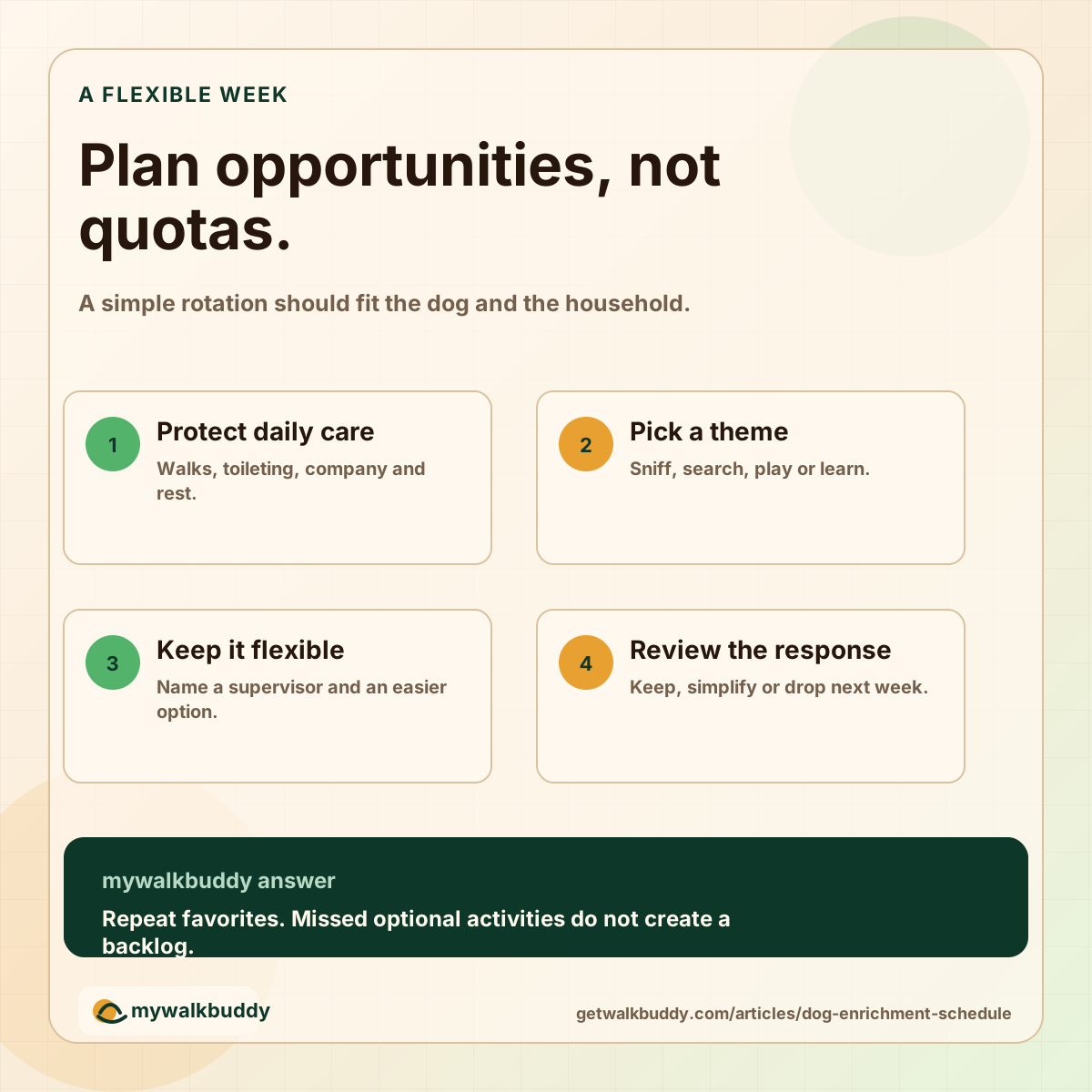
What could a seven-day dog enrichment schedule look like?
Use one optional theme each day: sniffing, an easy puzzle, familiar play, a toy search, reward-based learning, a gentle change of scene, and a favorite repeat. Keep normal care and appropriate walks throughout. The sequence below is an adaptable household planning template, not a veterinary prescription or a scientifically tested weekly dose.
This plan is for an owner choosing suitable activities for their own dog, not a shelter staffing schedule or a treatment program. The ASPCApro publishes enrichment schedules specifically for shelters, including special needs. That supports the usefulness of making opportunities visible; it does not validate this home rotation or require seven different games.
Start at any point in the week. If your dog enjoys a familiar activity and remains comfortable, repeating it is a legitimate choice. If health guidance limits movement or food, adapt the theme with the veterinary team instead of improvising around the restriction.
- Before the week: write down walks, toileting, meals, care arrangements and protected rest; choose a person who can supervise each optional activity.
- Monday — sniffing: allow unhurried investigation along a safe part of the usual walk. Fallback: investigate a familiar safe spot close to home.
- Tuesday — easy puzzle: introduce an accessible food puzzle using suitable food from the normal allowance. Fallback: a few visible pieces on a safe clean surface.
- Wednesday — familiar play: offer a suitable toy and let the dog choose whether to join. Fallback: quiet social time if play is not welcome.
- Thursday — toy search: let the dog see a favorite toy placed partly in view on the floor, then invite a search. Fallback: return the toy to plain sight.
- Friday — learning: practice a familiar reward-based cue in an easy setting. Fallback: reward a simple behavior the dog already offers comfortably.
- Saturday — small variation: investigate a quiet alternative part of a familiar route if suitable. Fallback: keep the usual route and allow a different safe sniff stop.
- Sunday — repeat and review: offer the week's most comfortably enjoyed activity, then choose what to keep, simplify or drop next week.
Sources: ASPCApro: Enrichment schedules for shelters; ASPCA: Canine DIY Enrichment
How do you fit enrichment into an ordinary day?
Attach an optional activity to a point when you can supervise, while preserving normal care and sleep. A morning walk may include sniffing, a home activity can fit around an available break, and an evening can remain quiet. Choose reliable opportunities in your actual day instead of filling every hour with tasks.
Write the fixed commitments first. Who provides the next toilet opportunity? When can someone supervise a puzzle? Where can the dog rest without being disturbed? An attractive calendar cannot compensate for a missing caregiver or a day that leaves essential needs unmet.
Then choose one convenient anchor for the optional theme. For example, a household might use the time after the owner finishes lunch for a toy search. This is an illustrative scheduling choice, not a recommended interval or a claim that every dog needs a midday game.
The RSPCA recommends regular exercise and opportunities to play, along with access to a safe place to retreat. These needs are broader than keeping a dog occupied. A sleeping dog does not need to be woken simply because a box on the enrichment calendar is empty.
What should you write on your enrichment plan?
For each planned activity, record the opportunity, the responsible person, an easier alternative and one observation afterward. Keep the record short enough to use consistently. This makes the schedule useful when plans change and helps you notice preferences, while avoiding the assumption that completing a longer or harder session means a better day.
Copy this planning line into a note: Day and care anchor; activity; supervisor; easier alternative; dog's response; next choice. You do not need a rating scale. Write what you observed, such as approached willingly, needed an open compartment, or walked away.
An illustrative entry could read: Tuesday after lunch; open puzzle board; Alex supervising; visible-food search if the board is awkward; dog ate from open wells and left the covered one; keep all wells open next time. It records a useful adjustment without labeling the dog lazy or claiming a health benefit.
Keep GetWalkBuddy's walk log for route, time and distance. The separate activity note adds context rather than turning the app into a medical assessment. For this plan, success means offering a suitable opportunity and responding to the dog, including choosing to stop.
How do you adapt the schedule for different dogs?
Change access and activity before increasing effort. A cautious dog may prefer familiar surroundings; a dog with limited mobility may need a stationary floor-level activity; a dog who swallows materials needs a different setup. Choose food within the existing diet, separate pets around resources, and follow veterinary guidance for health-related restrictions.
For a new game, make the reward or toy easy to find and keep distractions low. Do not add a new room, hidden reward and unfamiliar object all at once. You want to learn whether this activity suits the dog, not how much uncertainty they will tolerate.
For dogs who ingest fabric or cardboard, replace material-based puzzles with a safer supervised activity. The ASPCA's DIY guide explicitly calls for close, active supervision. Something made from household items is not automatically harmless, and a calendar entry does not make it appropriate to leave out unattended.
For a puppy, senior dog or dog recovering from illness, use the care plan already agreed with the veterinarian. No theme requires jumping, stairs, running or a particular walking distance. Sudden changes in movement, appetite or behavior warrant advice rather than a more demanding schedule.
Sources: ASPCA: Canine DIY Enrichment; RSPCA: Understanding and supporting dog behaviour
How do you know whether the schedule is working?
Review whether the dog willingly joins, can access the activity safely, and remains comfortable afterward. Also check whether the household can supervise reliably. Keep successful options, simplify difficult ones, and remove unsuitable setups. A weekly review organizes observations; it cannot prove that enrichment caused a behavior change or diagnose anxiety, pain or illness.
At the end of the week, choose a keep list and a change list. Keep could mean the familiar sniff stop and easy toy search. Change could mean a quieter location, an open puzzle or a different time when supervision is practical. Make the next week simpler if the plan became a source of pressure.
If a busy day disrupts the plan, meet essential care needs and use a familiar suitable alternative when possible. Do not stack missed activities into the next day. The rotation is there to reduce decisions, not to create a backlog the dog must complete.
Repeated fear, guarding, distress when alone or a marked behavior change needs professional assessment. The RSPCA recommends contacting a veterinarian about changed behavior and seeking qualified behavior support when needed. More novelty or exercise is not a substitute for understanding the problem.
Questions owners ask when the leash is already in their hand
-
Does my dog need a new enrichment activity every day?
No. Familiar activities can remain worthwhile. The weekly themes are optional prompts; repeat suitable favorites and change the setup when the dog needs easier access or shows less interest.
-
How many enrichment activities should a dog do daily?
There is no universal number. Consider normal walks, social contact, care, rest and the individual dog's response. A quota can distract from whether the activity is safe and welcome.
-
Can this schedule replace dog walks?
No. Indoor activities can add interest but do not replace appropriate outdoor opportunities, toileting and care. Adapt walks to health and conditions rather than exchanging puzzle minutes for walking minutes.
-
What if I miss a day on the enrichment schedule?
Keep essential care in place and return to a suitable activity when you can supervise. Do not double the next day's workload to make up a missed optional game.
Make the walking part of your week visible.
Use GetWalkBuddy to record your walks, then keep the optional enrichment plan alongside that routine. Adjust from comfort and practical care needs.