
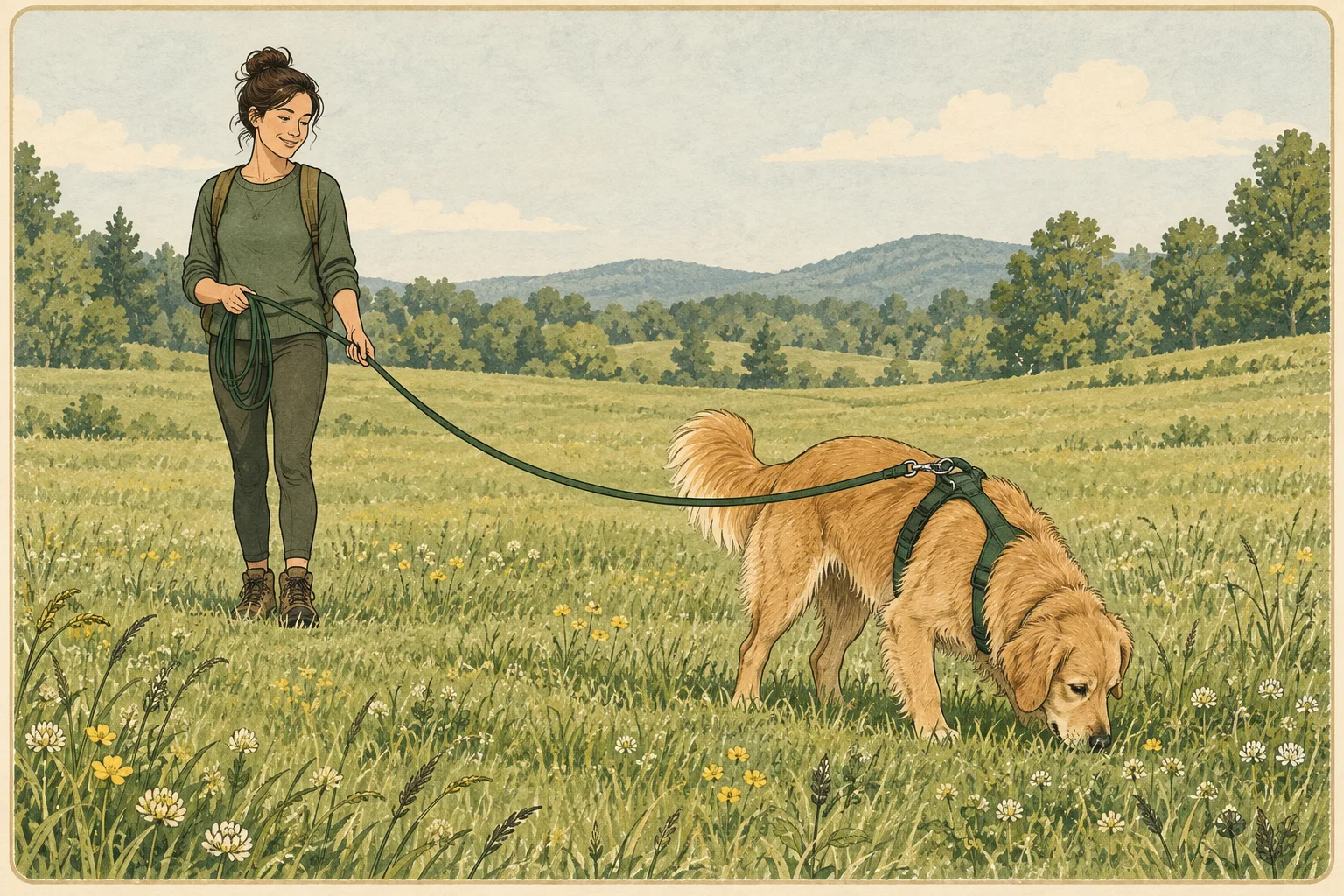
- Choose the location before choosing how much line to release.
- Attach a long line to an appropriate harness, not a neck or head collar.
- Start with calm exploration; a long line is not a device for stopping a sprint.
Turn this answer into a walk you can actually track.
GetWalkBuddy is a dog walking app for owners who want a simple route tracker, timer, distance view, and daily walk log without turning the walk into a spreadsheet.
What is a long line dog leash used for?
A long line is an extended training lead that lets a handler manage more distance for activities such as sniffing and recall practice. Unlike a retractable leash, it has no reel that automatically stores spare length. You manage the line yourself, including where it lies and how much distance the dog can use.
Think of it as another walking setup with extra handling work. It may suit a quiet grassy area but be inconvenient on the sidewalk you cross to reach it. Plan for both parts of the outing instead of assuming one length will work everywhere.
Dogs Trust’s recall guidance uses a long line attached to a harness while distance and distractions increase gradually. That supports controlled practice; it does not mean a dog who comes back once is ready to run loose around every distraction.
This page covers selecting a workable setup and a first supervised session. It is not a product comparison or a complete recall-training program. If your dog repeatedly bolts or is difficult to hold, get practical help before adding distance.
Sources: Dogs Trust: Recall training
Where is a long line suitable for a dog walk?
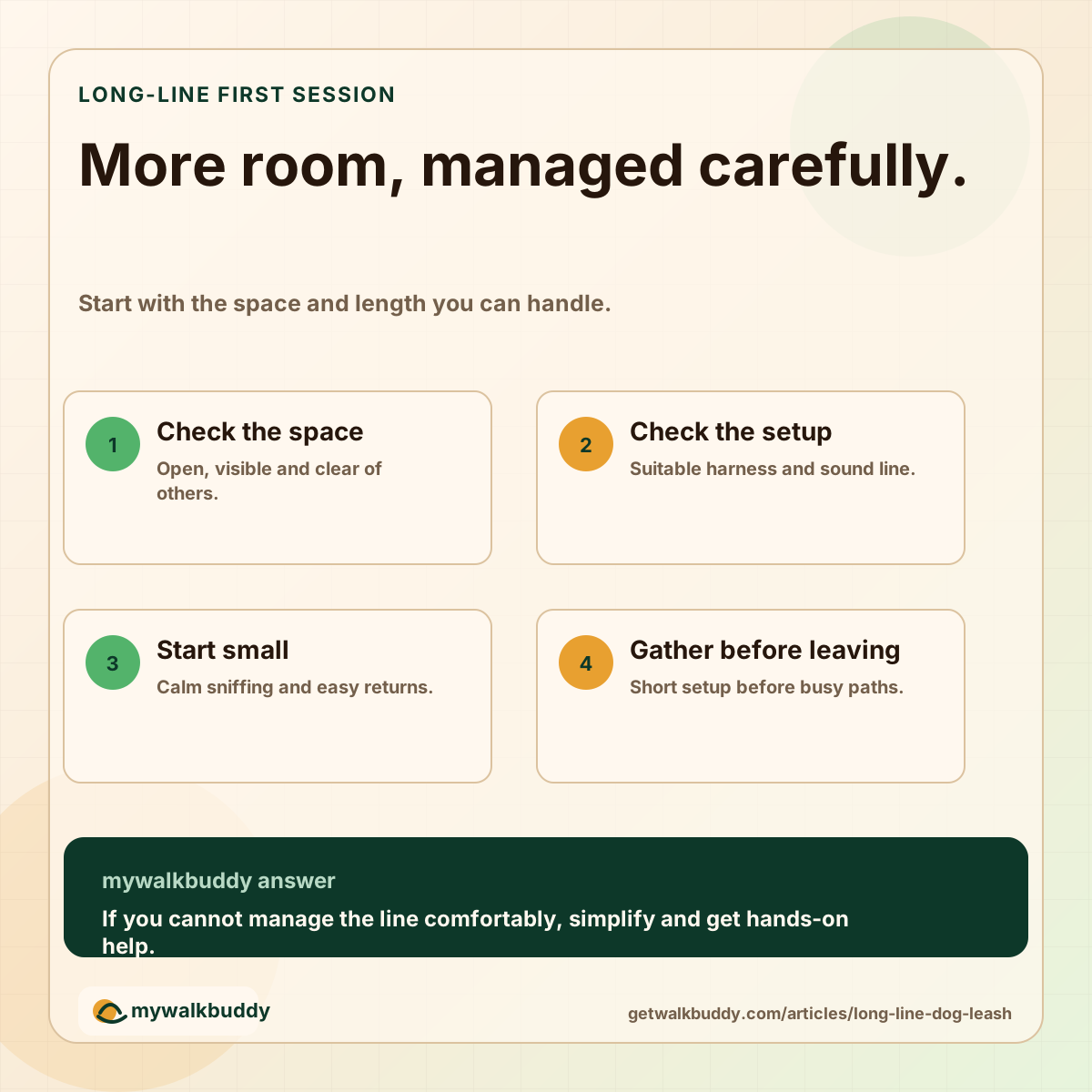
Choose an open area where you can see the dog, the full line and approaching activity. Avoid places where spare line can cross a path, wrap around obstacles or reach traffic. Check the site’s current access and lead requirements. If you cannot keep the working area clear, use a shorter setup elsewhere.
Make a small space audit before unclipping or changing anything: where would the dog go if they moved sideways, what could the line catch on, and where can you retreat when someone arrives? Do not judge the area only by the distance straight in front of you.
For example, an empty patch of grass beside a cycle path may look generous but still allow the line to reach passing wheels. A smaller area set well away from the path can be the more workable choice. This is a planning example, not a universal minimum distance.
Dogs Trust advises avoiding likely chase triggers and checking the area for hazards. If wildlife, livestock or approaching dogs make the setup difficult, reduce distance or leave. Extra line is not permission to let a dog approach another animal.
Sources: Dogs Trust: Managing chasing safely
How long should a dog training line be?
Choose a length you can control in the intended area, then begin using only part of it. The longest available line is not automatically the most useful. Dog size, speed, handler strength, terrain and other users all affect the decision. There is no single length that is appropriate for every dog and location.
Read the manufacturer’s guidance for intended use, attachment and the dog’s size. Check clip operation, stitching and material condition before every session. If you cannot comfortably manage the weight and spare line when stationary, choose a simpler setup before involving the dog.
Use a back attachment on a well-fitting harness appropriate for the activity. Dogs Trust warns against attaching a long line to a neck or head collar because a sudden stop can cause injury. A harness also does not make a fast end-of-line stop harmless.
Keep spare length in loose, manageable folds rather than wrapping it around fingers, wrists or your body. Avoid loops near your feet. Ask a qualified reward-based trainer to show you handling in person if feeding out and gathering the line feels awkward.
Sources: Dogs Trust: Managing chasing safely
What should the first long-line session look like?
Start in a quiet area with a small amount of usable line. Let the dog explore at an easy pace while you practice keeping the line clear and gathering spare length. Offer a familiar invitation to return before the dog reaches the end. Reward willing returns and increase distance only when the current setup is manageable.
Separate your handling practice from your dog’s training challenge. First check that you can gather and release line without tangles; then use a familiar cue at an easy distance. Do not add a new location, maximum length and difficult distractions at the same time.
For recall practice, Dogs Trust recommends building gradually and rewarding returns. If the dog does not respond, avoid shouting or hauling them toward you. Make the next attempt easier and seek individual training help when progress stalls.
For a sniffing outing, there is no need to call the dog back every few steps. Let them investigate within the space you can manage, and move so that the line does not wind around you. If they repeatedly accelerate toward the end, shorten the session and reconsider the location and training plan.
Finish by bringing the dog close in a calm, clear area and restoring the normal walking setup before reaching the path or road. Maintain a secure connection while changing equipment; follow its instructions rather than briefly letting the dog loose.
Sources: Dogs Trust: Recall training
What is a practical long-line safety checklist?
Check equipment and space before starting, keep attention on the line while moving, and change the plan when the area becomes busy. Stop for tangles, damaged equipment or handling you cannot comfortably control. Afterward, inspect and clean the line as directed and record what made the session easier or harder.
Keep this checklist with the equipment so the next outing starts with the same checks.
- Before: inspect harness and line, review local site rules and identify a clear working area and exit.
- During: keep the line clear of legs and other people; gather spare length before moving toward a path or obstacle.
- Change the plan: use a shorter lead or leave when approaching activity, tangles or repeated rushing make control difficult.
- After: check the equipment for wear, clean as instructed and note the space and length that were manageable.
Questions owners ask when the leash is already in their hand
-
Can a long line attach to a normal collar?
Use a suitable well-fitting harness for long-line work. Dogs Trust advises against a neck or head collar because sudden force at the end of the line can cause injury.
-
Is a long line the same as a retractable leash?
No. A long line has loose length that you gather and release manually. A retractable leash stores line in a reel. Their handling differs; follow the specific equipment instructions.
-
Can I use two long lines while walking two dogs?
That adds line and dog movements to manage at once. For a first long-line session, work with one dog and one attentive handler in a clear space. Use a simpler setup for shared walks.
-
Will a long line teach recall by itself?
No. It helps manage distance while you train. Reward-based practice, suitable distractions and gradual progression still matter. Repeatedly pulling a dog back is not the same as teaching a willing return.
Make room for a slower, more interesting walk.
Record the outing in GetWalkBuddy. Keep handling observations separately so you can repeat a comfortable location and setup.