
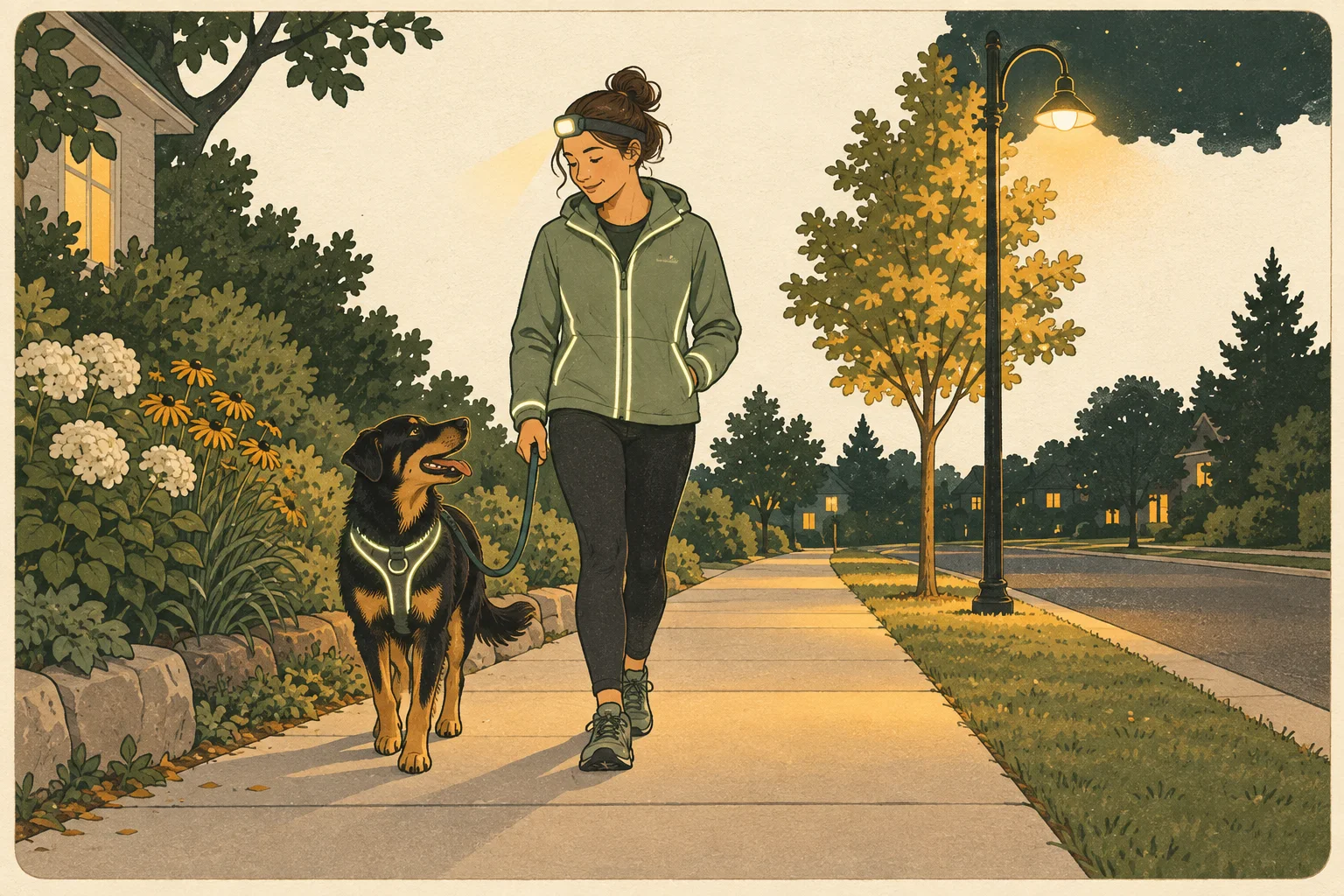
- Audit the actual evening route; a daytime memory is not enough.
- Help others see both dog and handler, and light the surface you need to see.
- Keep the leash manageable at driveways and crossings without pulling it tight.
Turn this answer into a walk you can actually track.
GetWalkBuddy is a dog walking app for owners who want a simple route tracker, timer, distance view, and daily walk log without turning the walk into a spreadsheet.
How do you choose a route for walking a dog at night?
Prefer a familiar route with continuous sidewalks, useful lighting, clear sightlines and places to turn home. Check crossings and driveways as well as the path itself. Choose a shorter clear loop over a longer route that depends on unlit shortcuts, narrow road edges or areas you cannot confidently assess.
Walk the candidate route in daylight first if it is new to you. Notice where the sidewalk ends, hedges block driveways, and bins or parked vehicles narrow the path. Then check how those specific points look after dark before making the whole route routine.
NHTSA recommends sidewalks where available, crossings at intersections or crosswalks, and particular care around vehicles entering and leaving driveways. Applying that to a dog walk means allowing space for the leash and dog, not just room for your own feet.
Choose an exit point before the most difficult segment. For example, turn home at the lit corner rather than entering an unlit park to complete a loop. This is an illustrative planning choice, not a claim that every illuminated street is safe.
Sources: NHTSA: Pedestrian safety
What visibility equipment helps on a night dog walk?
Use visibility aids for both you and the dog, plus a light that helps you see the ground. Reflective material and active lights serve different purposes: reflectors need incoming light, while a lamp emits it. Check fit, battery and attachment before leaving. Equipment supports attention and route choice; it does not guarantee drivers see you.
Inspect what remains visible from the front, back and sides once clothing and the harness are on. A reflective strip hidden under a coat is not doing the job you intended. Follow the equipment instructions and avoid loose attachments the dog can reach or catch on objects.
Aim a torch or headlamp low enough to inspect the pavement without shining it into the dog’s or another person’s eyes. A decorative glowing collar should not be your only way to see broken paving or objects on the ground.
Make the check at the door: switch on, inspect the beam, check the fastening, then leave. If the light fails and the route depends on it, shorten the outing to a lit area or return home. Carrying a light that does not work offers no practical benefit.
How should you handle the leash near roads after dark?
Keep enough leash for comfortable movement while preventing the dog from reaching the roadway ahead of you. Stop in a clear position before crossing, check all traffic directions and turning vehicles, and cross together when safe. Avoid a long trailing line where it can reach traffic, bicycles or another pedestrian.
NHTSA advises waiting for a clear, complete stop before stepping in front of a vehicle and continuing to watch traffic while crossing. Eye contact can help, but do not treat a glance, reflective gear or a walk signal as proof every driver has noticed you.
Before you approach the curb, gather the leash to a manageable length without winding it tightly around your hand or dragging the dog. Give a sniffing break away from the crossing so you are not trying to negotiate a road while the dog is absorbed in a scent.
Keep the dog on the side away from traffic where practical. If a narrow section leaves no comfortable passing room, wait in a wider place or use another route. Avoid changing sides abruptly in front of other walkers.
Sources: NHTSA: Pedestrian safety
What should you check before leaving for a night walk?
Check the route, working lights, secure gear and the dog’s comfort before leaving. During the walk, keep attention on the environment and review blind corners before entering them. On return, note the specific dark or crowded spot that changed the outing so the next person walking the dog can choose more easily.
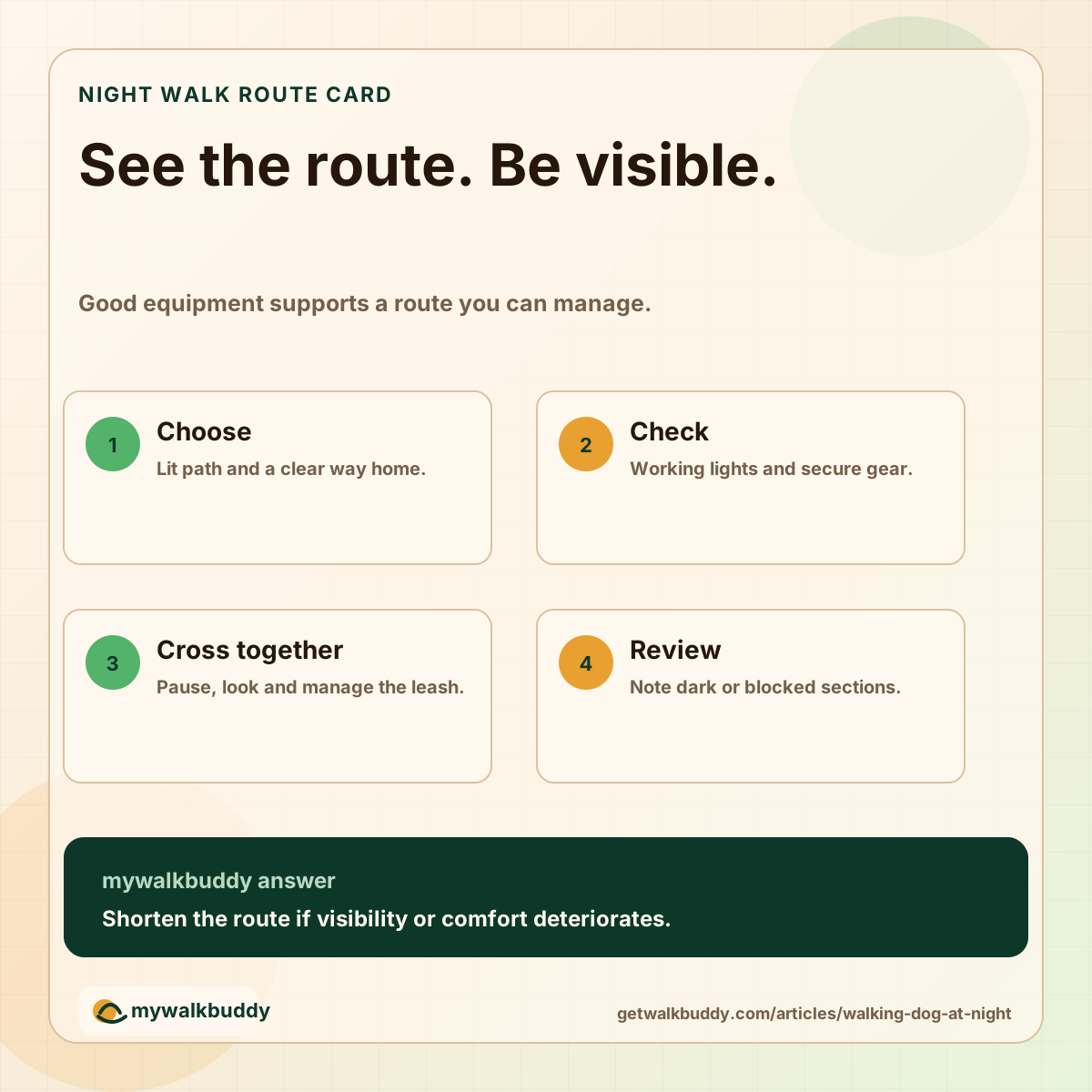
Use this short route card for shared household walks. It records practical observations rather than assigning a safety score.
- Before: choose a lit route and turnaround, test lights, inspect leash attachments and make sure both dog and handler are visible.
- At corners: pause where you can see, gather spare leash and check for approaching people, bicycles and vehicles.
- During: keep your phone put away while moving; stop in a suitable place if you need to check directions.
- After: record a concrete route issue, such as a broken streetlight or blocked sidewalk, and adjust the next outing.
What if your dog seems worried after dark?
Choose a quieter, more familiar route and allow more space from things the dog finds difficult. Keep the first outing modest and return when needed. Do not force a close encounter to make the dog get used to darkness. A new or persistent behavior change deserves veterinary advice rather than an assumption about its cause.
A bin that was harmless in daylight can look different in shadow. Let the dog observe from a comfortable distance while you assess the route. You do not need to approach every unfamiliar shape to complete the walk.
RSPCA advises using rewards, allowing dogs to avoid frightening situations, and seeking veterinary advice when behavior changes. If the evening environment repeatedly causes distress, get qualified help building an individual plan.
Keep a useful note: location, what was visible, and what allowed a comfortable return. Avoid labeling every hesitation as a vision problem or every bark as aggression. The observation is what you can reliably share with a professional.
This guide concerns outdoor night walks. Repeated pacing or circling inside at night is a different question. Use the appropriate behavior or veterinary guidance instead of assuming another late walk is the solution.
Sources: RSPCA: Understanding dog behaviour
Questions owners ask when the leash is already in their hand
-
Is it safe to walk a dog at night?
It depends on the route, conditions, handling and visibility. Use a familiar lit path and change plans when you cannot assess the surroundings comfortably. No piece of gear makes every route appropriate.
-
Is a reflective collar enough for night dog walking?
Do not rely on one small reflective item. Consider visibility for the handler and dog from multiple directions, and use a suitable light to see the path. Reflective material needs incoming light to work.
-
Should I use a long leash after dark?
Use a length you can manage for the location. Near roads, crossings, cyclists and other pedestrians, prevent spare line and the dog from entering their path. More space may be possible in a suitable clear area.
-
How late should the last dog walk be?
There is no single clock time for every household. Plan toileting and activity around the dog’s needs and a route you can use comfortably. Late-night exercise is not an automatic remedy for restlessness.
Build a repeatable evening walking routine.
Record completed walks in GetWalkBuddy. Keep practical route observations alongside the routine so the next outing is easier to plan.