
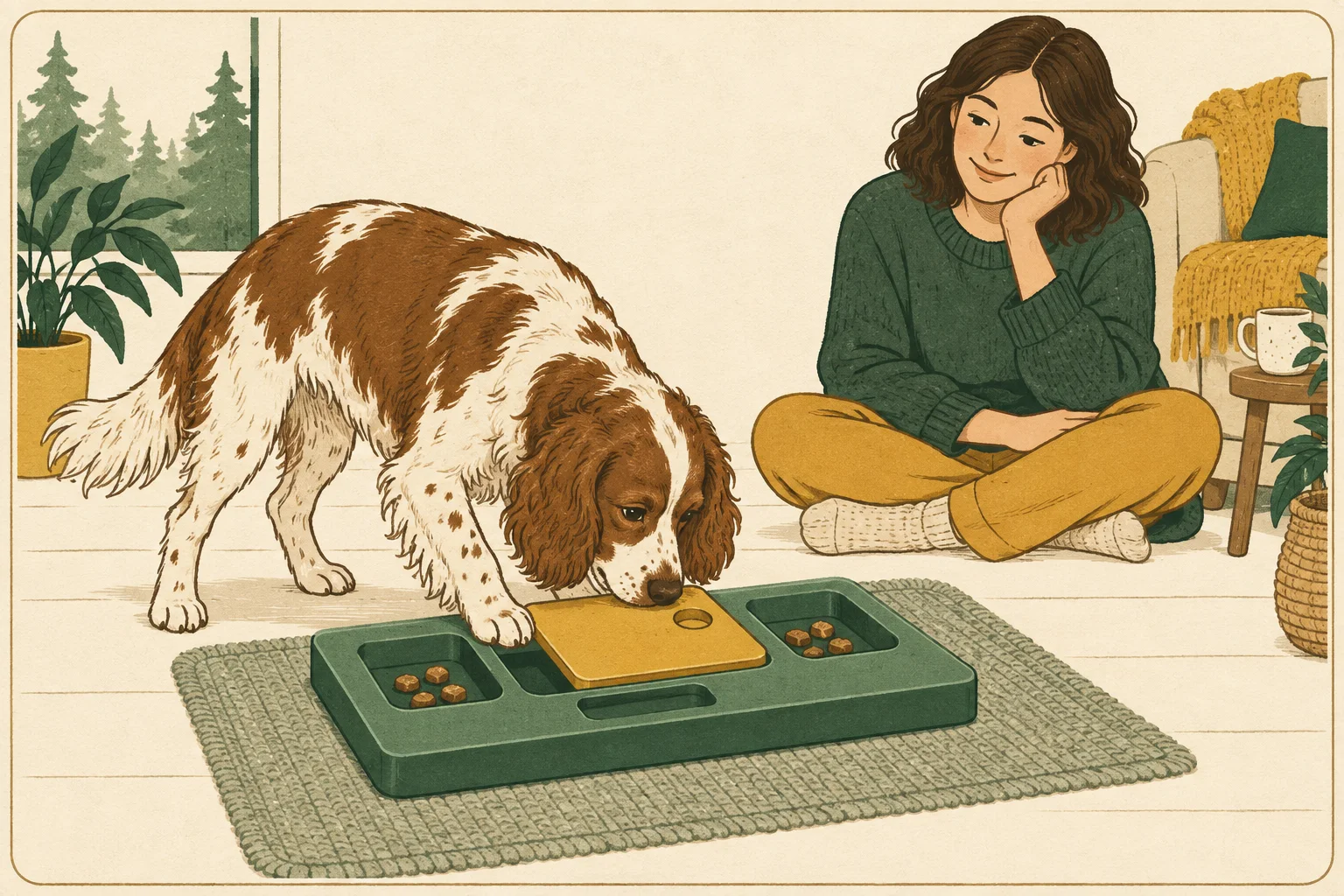
- Choose for the dog's mouth, movement and experience before choosing a difficulty label.
- Introduce one easy action; do not make the dog struggle to reach an essential meal.
- Watch how the dog engages, not how many minutes the puzzle keeps them occupied.
Turn this answer into a walk you can actually track.
GetWalkBuddy is a dog walking app for owners who want a simple route tracker, timer, distance view, and daily walk log without turning the walk into a spreadsheet.
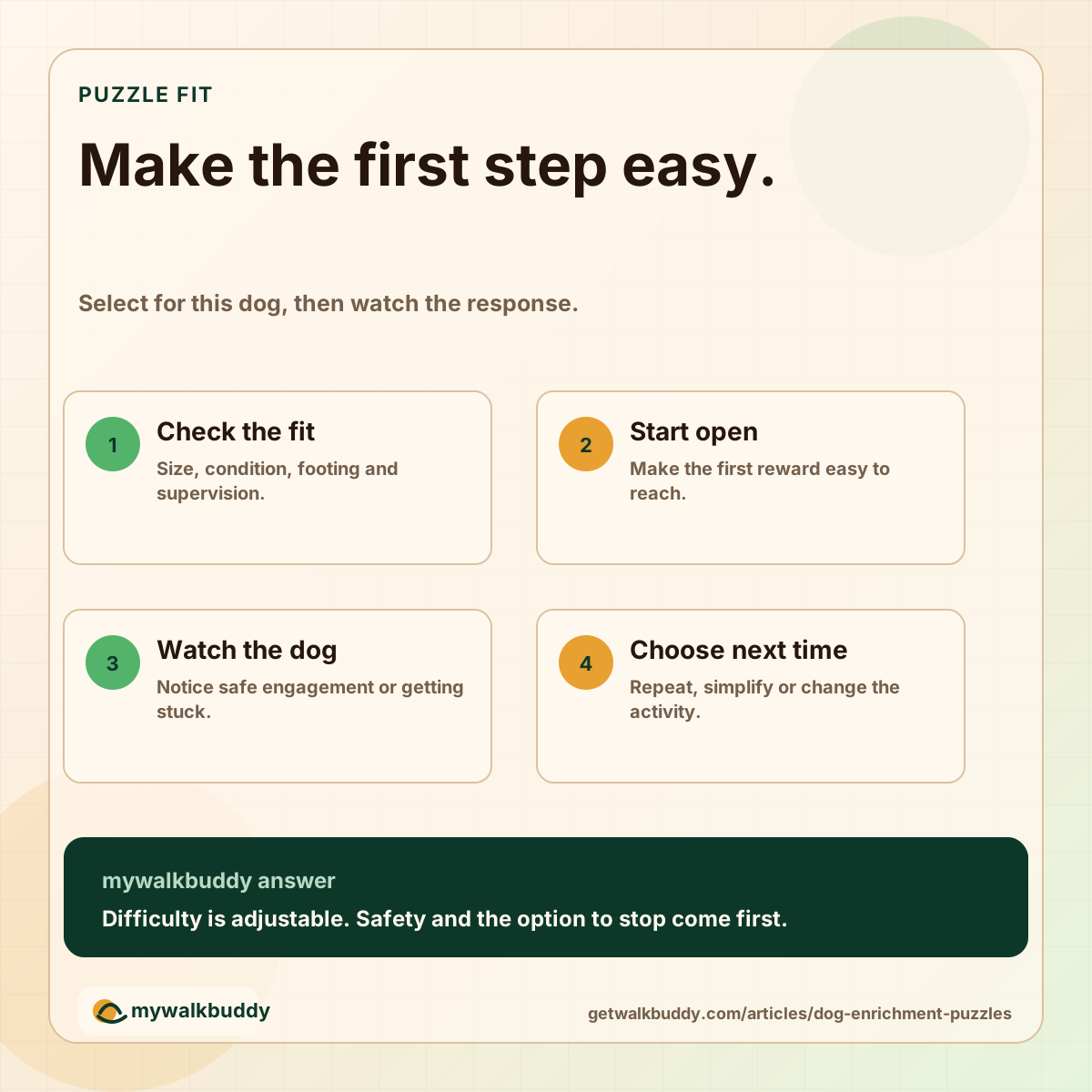
How do you choose a suitable dog enrichment puzzle?
Check three things before buying or setting up a puzzle: whether the dog can use it safely, whether the reward is accessible, and whether the first action is easy to understand. A stable puzzle with an obvious starting point is often a more useful introduction than several hidden mechanisms presented together.
Use this fit check with the actual dog in mind. A small opening may be difficult for a broad muzzle. A rolling object may be awkward for a dog who moves cautiously. A fabric activity can be unsuitable for a dog who eats fabric, however appealing the label looks.
Read the manufacturer's sizing, cleaning and supervision instructions. Inspect edges and moving parts; reject anything damaged or with pieces the dog may detach and swallow. Choose a stable surface with enough room to approach and leave. A puzzle is an activity to supervise, not a durability test.
The ASPCA describes food puzzles as one way to provide mental stimulation and opportunities for natural behavior. It also requires close, active supervision of DIY setups. The checklist below is our practical selection aid, not a certification that any particular toy is safe.
- Before: check size, condition, loose parts, footing and whether you can supervise throughout.
- Access: make the first food easy to reach without forcing the muzzle, neck or paws into position.
- Mechanism: begin with one simple movement or an open compartment, following product instructions.
- Exit: leave space to walk away and plan to put the puzzle away once the dog has disengaged.
Sources: ASPCA: Canine DIY Enrichment
How do you introduce a puzzle to a dog?
Offer the puzzle in a quiet space with a little familiar food visible and easy to reach. Let the dog approach voluntarily and discover the reward. If the mechanism blocks success, simplify it according to the instructions. Finish while engagement is comfortable; do not hold the dog's paws or muzzle against the puzzle.
Start with part of the dog's usual food allowance if suitable for their feeding plan. Keep another normal way to eat available; a beginner should not have to solve a difficult task to obtain the whole meal. Check dietary restrictions before adding a filling or treat.
For a board with attached sliding covers, an illustrative first session might leave the wells open. Later, you could partly close one cover while keeping the others easy. If the product cannot be simplified safely, choose a different starting activity. This example is a setup suggestion, not a tested training protocol.
Stay nearby without repeatedly tapping, moving the dog or adding commands. Give space to investigate. A dog who eats the visible food and walks away has given you useful information; there is no need to keep resetting the board until the dog looks tired.
Sources: ASPCA: Canine DIY Enrichment
How can you tell whether a puzzle is too difficult?
Look for the difference between exploring and getting stuck. Repeatedly biting the board, increasingly forceful pawing, barking, abandoning attempts, or needing constant help can mean the setup needs changing. These observations do not diagnose frustration on their own. Check the surface, access, appetite and surrounding distractions before raising the difficulty again.
Use a repeat, simplify or switch decision. Repeat when the dog engages willingly and can reach the reward through a safe action. Simplify when the dog wants the food but cannot operate the mechanism. Switch activities when the dog is uninterested or the material encourages unsafe chewing.
Record three facts rather than assigning a score: what was open, what the dog did, and what you will change next time. For example: one lid partly closed; dog nudged twice then bit the edge; next time return to an open well. The purpose is to make your next decision clearer, not to rank the dog's intelligence.
A sudden change in appetite, movement or willingness across familiar activities needs a different response from changing a toy. The RSPCA advises veterinary advice for changes in behavior or regular signs of stress or fear. Do not explain every new difficulty as boredom.
Which puzzle format should you try first?
Choose the format around an action your dog can perform comfortably. An accessible board offers a defined starting point; a food search uses the nose; a rolling dispenser adds movement and requires suitable space. Each format has different hazards. Your dog's response and the product instructions matter more than a universal beginner ranking.
Board: look for stability, reachable compartments and a way to introduce only one action. It may be easier to observe exactly where the dog gets stuck. Avoid loose pieces when those create an ingestion risk.
Search setup: a few visible pieces of suitable food on a clean, safe surface can introduce finding before hiding. If you use fabric or cardboard, supervise actively and choose another setup for a dog who tears off or eats the material. DIY is not automatically safer than a commercial product.
Rolling dispenser: check that the dog can follow it without slipping, colliding with furniture or trapping it under a cabinet. A quiet stationary activity may be a better fit for limited space or mobility. These are selection tradeoffs, not product reviews; we have not tested or ranked individual brands.
Sources: ASPCA: Canine DIY Enrichment
How should puzzles fit alongside walks and rest?
Use puzzles as one optional part of the day alongside appropriate walks, social contact, toileting and undisturbed rest. They do not replace care or become a fixed equivalent of walking minutes. Repeat a suitable favorite when it remains interesting, and choose a different activity when the dog prefers sniffing, play or quiet company.
Put the activity where supervision is realistic. An easy puzzle after you have finished a household task may work better than a complicated one just as you leave. Keep children and other pets away from a dog using food; separate activities prevent competition over the same reward.
If the dog stiffens, growls or guards the puzzle, avoid reaching in or taking it by force. Keep people and animals at a safe distance and seek qualified behavior support. Persistent distress when alone also needs assessment; buying a harder puzzle is not a treatment plan.
Use GetWalkBuddy to record the walking part of the routine. Keep a separate brief note about puzzle setup and response if useful. Comparing both helps you describe the day without pretending that a puzzle session can be converted into distance or calories burned.
Questions owners ask when the leash is already in their hand
-
Are harder dog puzzles better?
No. A puzzle is useful when the dog can engage safely and willingly. Increase difficulty only when the existing setup is comfortable; an easy familiar activity may remain worthwhile.
-
How long should a dog spend on a puzzle?
There is no universal session length. Watch safe engagement, the dog's choice to stop, and the supervision available. Finishing quickly is not a reason to keep adding food or difficulty.
-
Can I leave a new puzzle with my dog while I work?
Introduce it while you can actively supervise. Follow the manufacturer's instructions and the individual dog's chewing behavior. Keep DIY items supervised; no puzzle is safe for every dog unattended.
-
What if my dog bites the puzzle instead of solving it?
Stop the unsafe setup, check for damage, and make the task easier or choose another format. Do not hold the dog's mouth or paws in place. Seek help if guarding or persistent distress is involved.
Keep the whole routine in view.
Record walks in GetWalkBuddy and keep puzzle observations alongside them. Look for a routine your dog can comfortably repeat.