
- Check the whole object, including pieces that can come loose.
- Leave room for a large dog to approach, turn and step away.
- Choose the behavior opportunity first; then decide whether equipment is needed.
Turn this answer into a walk you can actually track.
GetWalkBuddy is a dog walking app for owners who want a simple route tracker, timer, distance view, and daily walk log without turning the walk into a spreadsheet.
What matters when choosing enrichment toys for a large dog?
Look at usable dimensions, detachable parts, access and the dog’s way of playing, not just the advertised size category. Follow the manufacturer’s sizing and supervision instructions. Rule out an item if its fit or construction is unsuitable. There is no single measurement that makes every toy appropriate for every large dog.
Start with the job: searching, licking, gentle manipulation or shared play. A broad shallow feeder and a throwable toy solve different problems. Buying the largest version of either will not compensate for choosing an activity your dog does not enjoy.
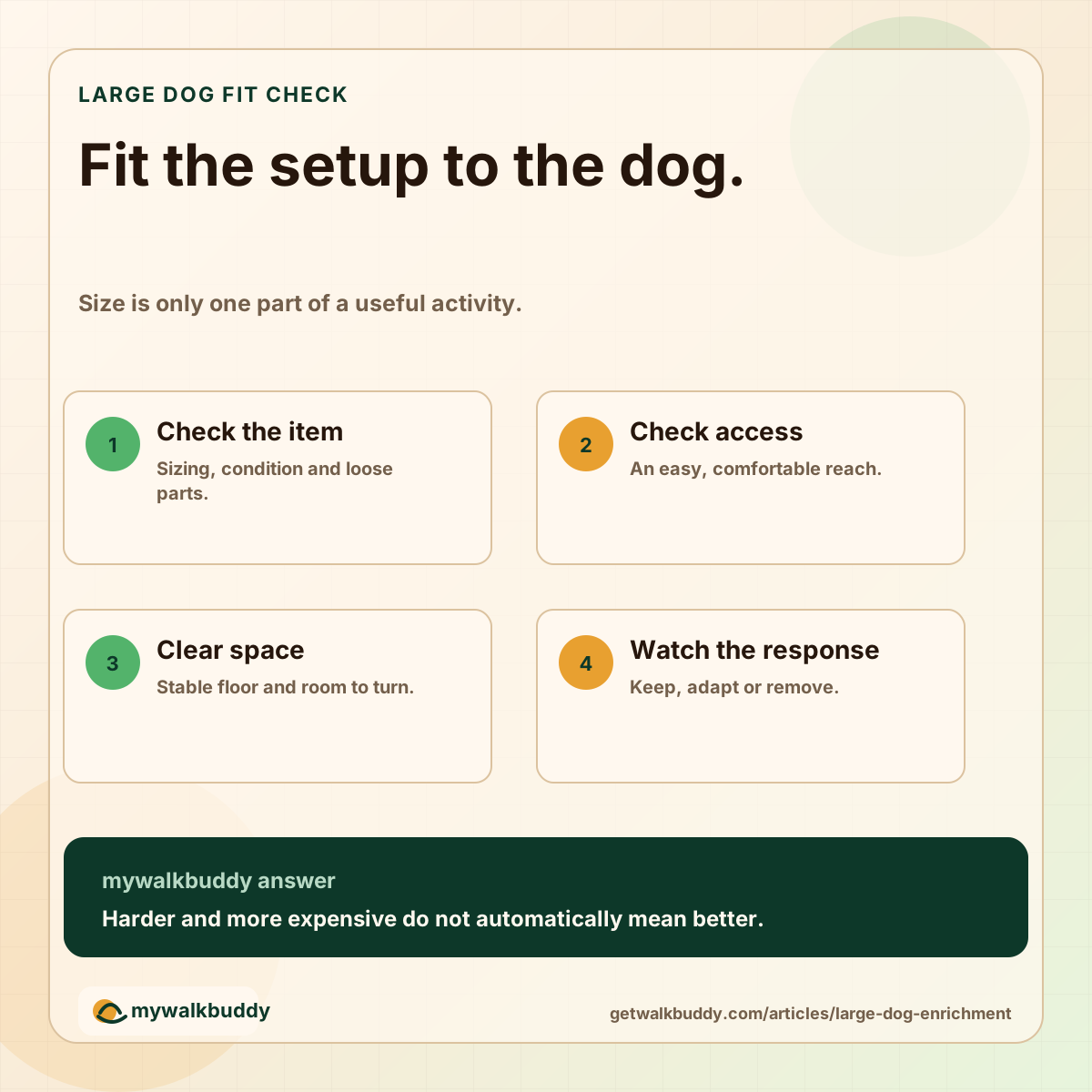
Ask four questions before buying: Can the dog access the intended reward without struggling? Are there components they could remove? Will the base stay stable on your floor? Can you clean and inspect the whole item? If the listing does not answer these, ask the manufacturer rather than guessing from a photo.
No product is assessed or ranked here. This is a selection checklist, not an indestructible-toy claim. A toy’s apparent sturdiness does not establish suitability for a dog who bites off or swallows material.
How do you set up enrichment for a large dog indoors?
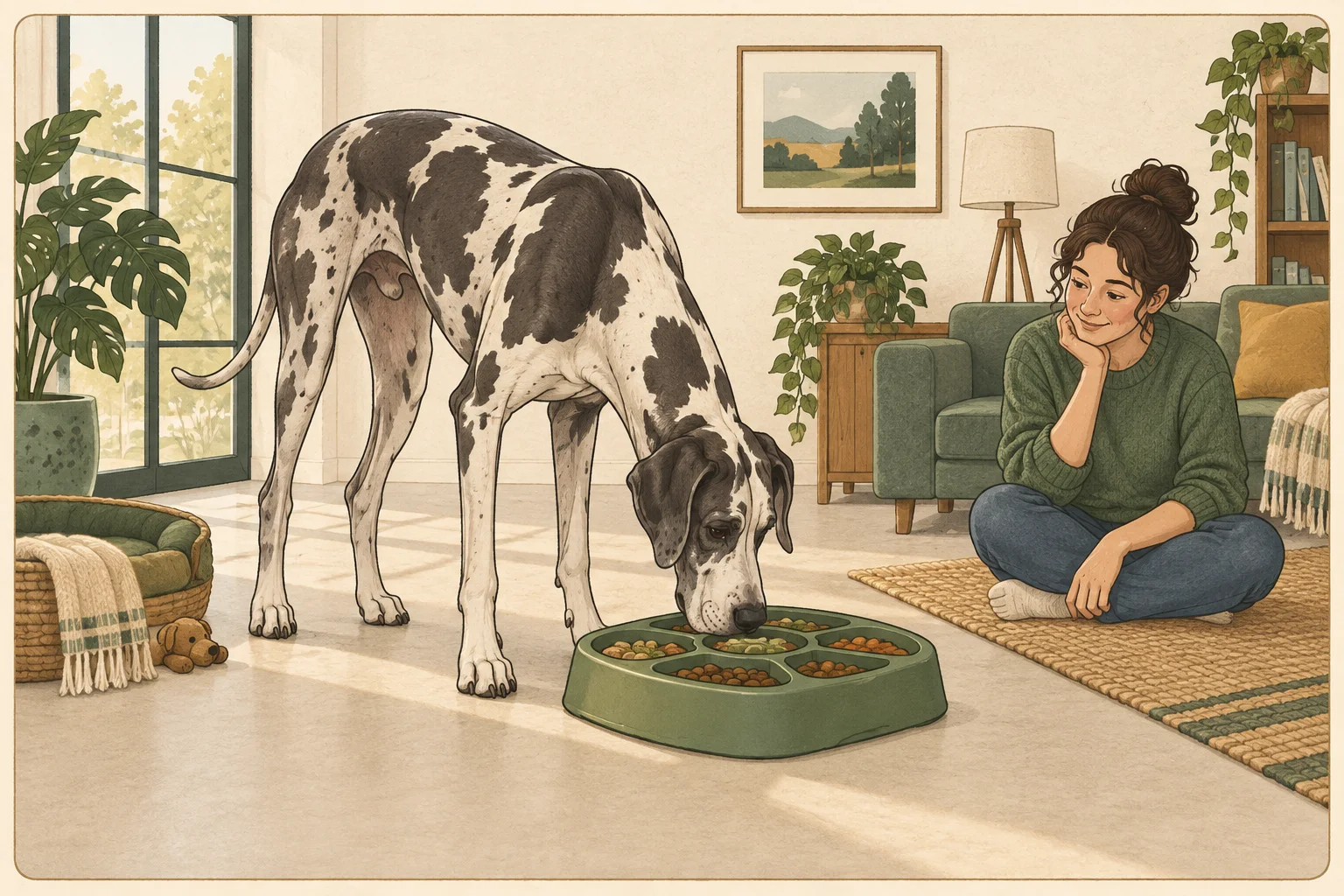
Clear enough level floor space for the dog to approach, use the activity and turn away without being trapped between furniture. Choose secure footing and keep the task within comfortable reach. Watch the whole body during the first attempt; a dog can reach a reward while still looking awkward or struggling.
Before placing anything, imagine the dog turning around with their tail and shoulders included. A corner that looks empty to a person can become a narrow channel for a tall or long-bodied dog. Put the setup where you can supervise without blocking the exit.
Keep other pets apart for food or valued-toy activities. Space should let the dog disengage, not require them to pass another animal to leave. Remove household breakables from the working area before you invite the dog in.
If your dog has mobility restrictions, use the veterinarian’s instructions when deciding where and how to offer an activity. Do not improvise a raised feeding station or obstacle course as a treatment. The aim here is practical access, not correcting posture or prescribing exercise.
What are three practical large dog enrichment setups?
Try a broad accessible food activity, a familiar-toy search in a clear room, or a slow sniffing route with enough space to move comfortably. Choose one that fits the dog’s preferences. Introduce it simply, supervise and adjust the setup from what you observe rather than starting with the hardest version.
Food setup: use an appropriately sized, stable item according to its instructions, with the reward easy to access at first. Portion food from the established feeding plan rather than adding a second meal. If the dog cannot use it comfortably, change the equipment instead of increasing hunger or frustration.
Search setup: place a suitable familiar toy in view on a clear floor. Once that is understood, move it beside a low object without wedging it underneath. A big dog should not have to squeeze behind a sofa to complete a small search.
Outdoor setup: choose a familiar wide path with permission to pause and investigate safe smells. Build the route around room to pass others and turn home. There is no requirement to add sprinting, jumping or pulling to make it count.
These are example configurations, not tested doses. ASPCA describes sniffing, play and searching as useful behavior opportunities and calls for active supervision of DIY enrichment.
Sources: ASPCA: Canine DIY Enrichment
How can you tell whether the setup is working?
Look for voluntary participation, accessible rewards and comfortable movement. Difficulty should come from an understandable task, not unstable equipment or cramped space. Stop to change the setup when it slides, breaks or makes the dog struggle. A shorter successful attempt is more useful than leaving a poor fit in place.
Use this inspection card for new equipment and repeat it as the item wears.
- Before: check sizing instructions, condition, removable components, reach and room to turn.
- During: watch for slipping, repeated repositioning, biting off material or abandoning the activity.
- Adjust: simplify access, stabilize the approved setup, or remove the item and choose another activity.
- After: collect equipment, inspect for damage, clean as directed and record whether the dog chose to return.
Does a large dog need more difficult or expensive enrichment?
Size alone does not determine experience, interest or confidence. An easy search or a familiar sniffing route can still be worthwhile for a large dog. Buy equipment to solve a specific practical need, such as safe fit or accessible cleaning, rather than assuming a higher difficulty label will produce a better result.
Separate a shopping problem from a teaching problem. If the item fits but the dog has never learned the task, simplify the game. If the item does not fit, training is not a reason to keep using it. If the dog simply prefers another activity, that is useful information for the next purchase.
Avoid reaching into the dog’s space to force a toy exchange. RSPCA advises professional help for aggression and veterinary advice for behavior changes. Guarding, distress or an abrupt change in engagement needs a different response from buying a harder puzzle.
Keep enrichment alongside ordinary walks and rest. The related puzzle guide covers mechanism choice; the search-game guide explains teaching; the weekly schedule helps share household responsibilities.
Sources: RSPCA: Understanding dog behaviour
Questions owners ask when the leash is already in their hand
-
What size enrichment toy should I buy for a large dog?
Follow the product’s sizing instructions and check the individual dog’s mouth, reach and play style. Inspect removable parts as well as the outside dimensions. Ask the manufacturer if fit is unclear.
-
Are small-dog puzzle toys suitable for large dogs?
Do not assume they are. Check the manufacturer’s guidance and whether every component is appropriate for your dog. A dog solving the mechanism once does not establish safe fit.
-
Can a large dog do enrichment in an apartment?
Yes, suitable activities can use a clear room or a comfortable outdoor sniffing route. Avoid setups that require tight turns, furniture climbing or high-speed indoor chasing.
-
Does enrichment need to tire out a large dog?
Exhaustion is not the goal. Offer an activity the dog chooses to engage with, then allow rest. Physical activity needs still depend on the individual dog and any veterinary restrictions.
Plan around the dog in front of you.
Use GetWalkBuddy to record the walking routine. Keep equipment-fit observations alongside your enrichment plan so everyone uses the same setup.