
- Suspected ingestion warrants prompt veterinary advice.
- Report what you know and what remains uncertain.
- Prevent access on future walks instead of relying on a safe-dose estimate.
Turn this answer into a walk you can actually track.
GetWalkBuddy is a dog walking app for owners who want a simple route tracker, timer, distance view, and daily walk log without turning the walk into a spreadsheet.
What should you do if your dog ate an acorn?
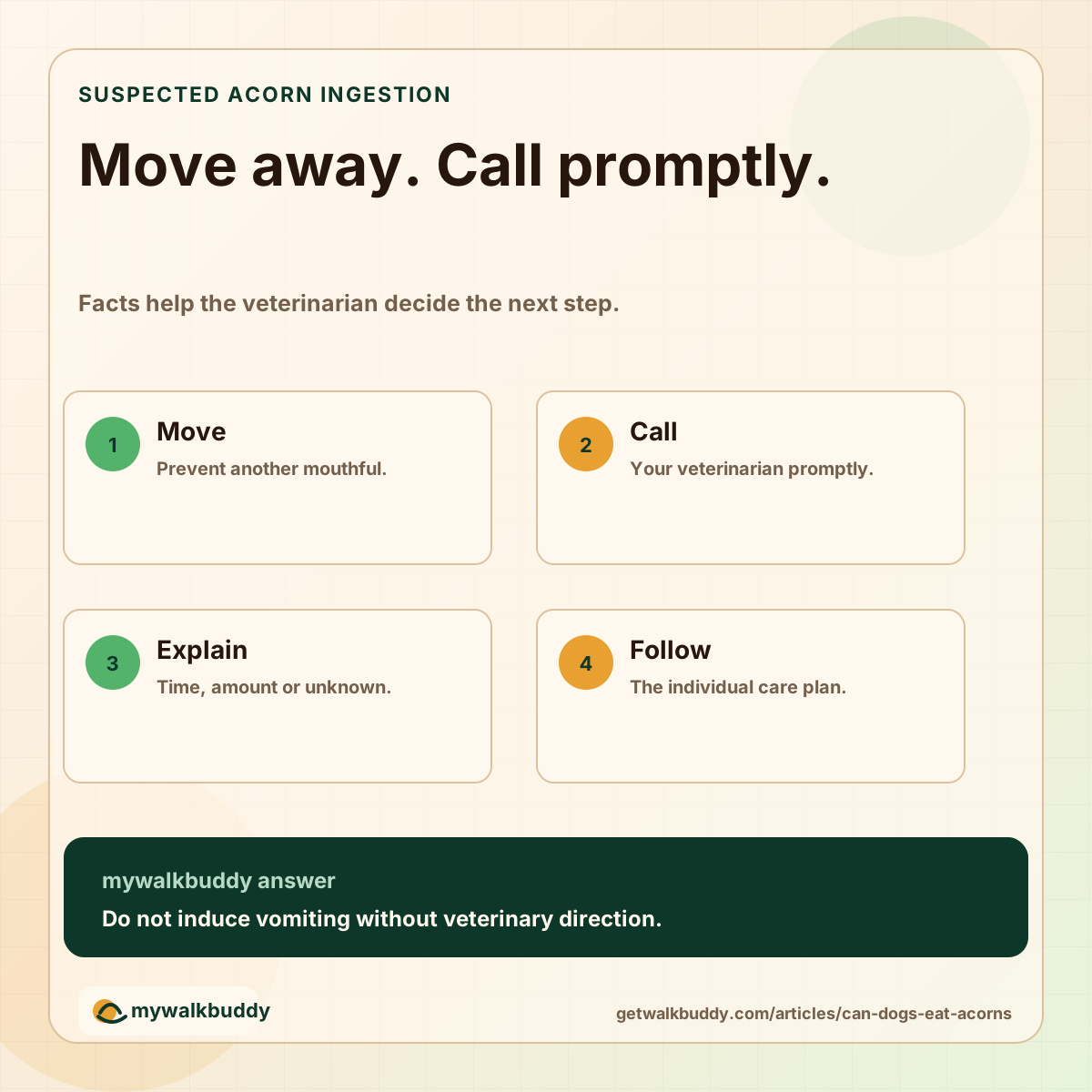
Blue Cross advises contacting your vet straight away after suspected acorn ingestion. Do not wait for the dog to look ill before asking for advice.
First, prevent another mouthful by moving the dog away from the fallen nuts. Keep your attention on the dog while arranging the call. If another person is present, they can help collect the details without delaying contact.
Say whether you saw an acorn swallowed, saw chewing, or only found the dog near fallen acorns. These are different observations. You do not need to turn uncertainty into a definite story before calling.
If your dog collapses or has difficulty breathing, seek emergency veterinary help immediately. Tell the clinic that you suspect an ingestion while arranging care.
Why are acorns unsafe?
Blue Cross explains that acorns contain tannins that are toxic to dogs. They can also cause injury or blockage in the digestive tract.
This creates two different concerns: the material eaten and the physical object swallowed. An online answer about toxicity alone cannot rule out an obstruction.
Do not use another dog’s experience as a dose guide. “My dog ate one and seemed fine” does not establish what happened in your case or what your veterinarian will recommend.
Our practical rule for route planning is simpler than identifying a harmless quantity: keep acorns out of the dog’s mouth. There is no need to test whether a particular patch is acceptable.
What information should you have ready?
ASPCA recommends explaining the suspected substance, amount and relevant circumstances to a veterinarian or poison service. Keep the call factual and include unknowns.
Use this short call note: approximate time; what you saw; estimated amount or “unknown”; dog’s approximate weight; current behavior; any symptoms; and anything already given. Answer the clinician’s additional questions rather than relying on a checklist as a substitute for assessment.
If it is easy and safe, a photograph of the object or tree may help explain the situation. Do not spend time searching the ground for a perfect sample while postponing the call.
A useful opening might be: “We were under an oak around ten minutes ago. I saw chewing but not the swallow. I do not know the number.” This is an illustrative script, not a report of an actual poisoning.
In the United States, ASPCA Poison Control is available at (888) 426-4435; a consultation fee may apply. Your own veterinarian or emergency clinic can advise on immediate care.
Sources: ASPCA: Is It Ever Safe to Induce Vomiting?; ASPCA Poison Control
Should you make the dog vomit?
Do not attempt it without veterinary direction. ASPCA warns that home attempts can harm pets and that even peroxide requires professional guidance.
Do not use salt, oil or fingers down the throat to try to solve the problem. Keep the response focused on contacting a professional and following the advice for this particular exposure.
If someone has already given a remedy, tell the veterinarian exactly what it was and approximately how much. Leave out blame and focus on information the clinician can use.
Write down the instructions you receive, including where to go and what changes to report. If you are unsure what was said, ask the clinic to repeat it before improvising.
Which signs should you report?
Blue Cross lists vomiting, diarrhea, abdominal pain, appetite loss, dehydration and collapse among possible signs. Absence of those signs does not cancel the recommendation to call.
Keep the suspected ingestion time and any later changes on the same note. “Vomited once at 3:20” is more useful than “seems poisoned,” because it describes an observation.
Follow your veterinarian’s monitoring or examination instructions. Do not treat a symptom list as a home diagnosis or a countdown after which the dog is automatically safe.
How can you reduce encounters on the next walk?
Choose a clear route away from fallen acorns, supervise closely and practice leave or drop skills away from the hazard.
Mark the affected stretch in your own route notes: for example, the oak beside the park entrance or a path with heavy fallen nuts. Pick a different entrance or path while the ground is covered.
Blue Cross recommends not using acorns as toys and suggests trained leave or drop cues. Practice with suitable objects in a controlled setting; an acorn-covered path is not the place to test a new skill.
Keep everyone who walks the dog informed about the route change. A clear location note is more useful than a general warning to “be careful in autumn.”
- Before: choose a route with clear ground.
- During: supervise and keep away from fallen acorns.
- If swallowed: call your vet promptly.
- After: follow the veterinary plan and update other walkers.
Questions owners ask when the leash is already in their hand
-
Are acorns on the ground safe for dogs?
No. Fallen acorns remain a concern. Keep the dog from eating them and seek veterinary advice after suspected ingestion.
-
What if my dog only chewed an acorn?
Explain that distinction to your veterinarian and say whether swallowing is uncertain. Do not assume chewing means there was no ingestion.
-
Can I wait until my dog vomits?
Do not wait for symptoms before calling about suspected ingestion. Your veterinarian can decide what assessment is appropriate.
-
Should I throw acorns for my dog to chase?
No. Use an appropriate dog toy instead; acorns should not be used for play.
Remember the route change.
After addressing any immediate health concern, use your walking history to identify an alternative route. GetWalkBuddy records routes, time and distance; it does not assess poisoning.