
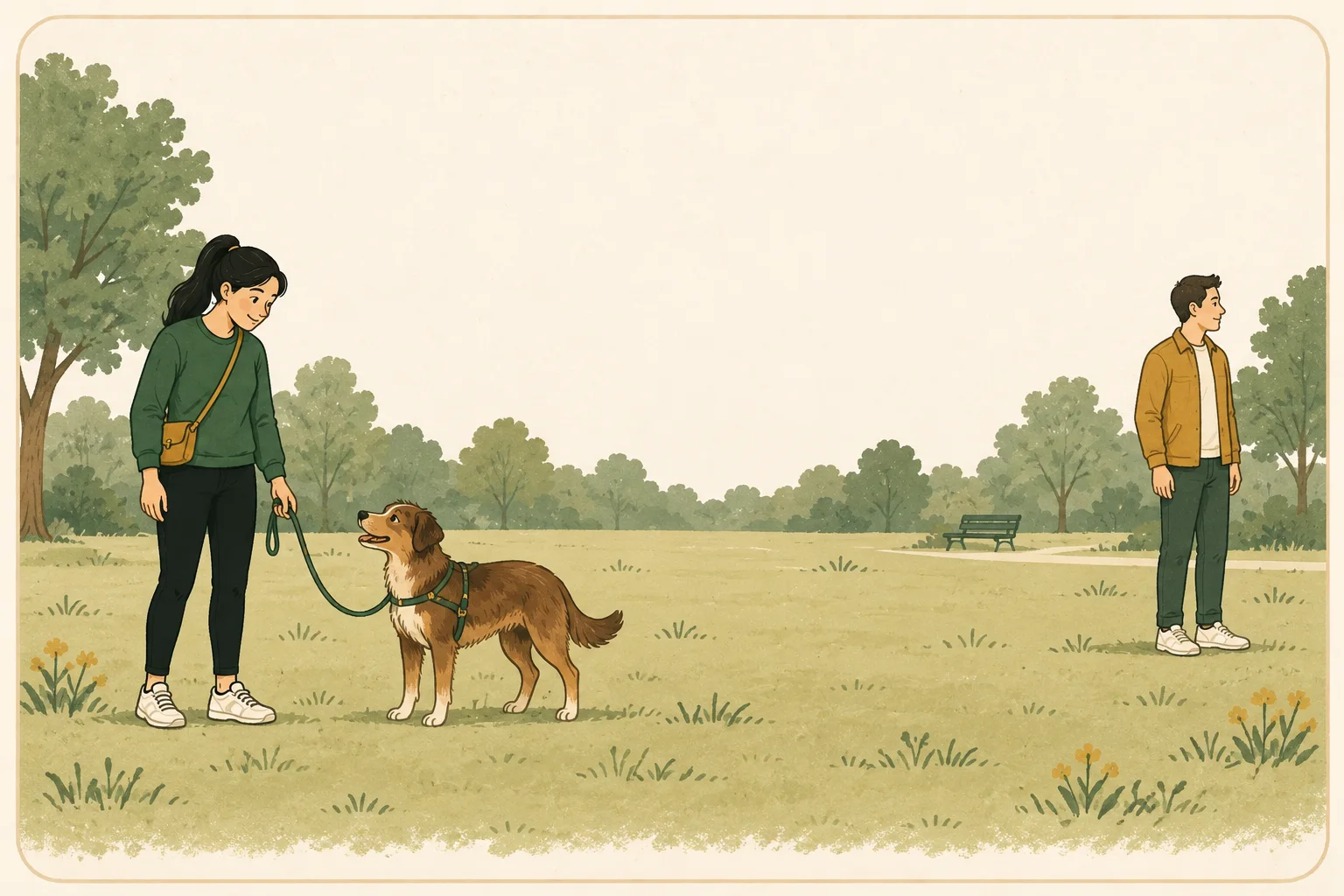
- Observe the details instead of assuming a history.
- Make space and an easy exit part of the route.
- Brief helpers before they approach the dog.
Turn this answer into a walk you can actually track.
GetWalkBuddy is a dog walking app for owners who want a simple route tracker, timer, distance view, and daily walk log without turning the walk into a spreadsheet.
Why might a dog seem afraid of men?
Fear Free explains that appearance, movement, voice and previous exposure can contribute. A fearful response does not establish that a man previously abused the dog.
The useful question is what happens in the actual encounter. Does the dog react when a person is still, when they begin talking, when they stand up or when they reach toward the dog? Those are different observations.
Avoid turning a broad description into a story about your dog’s past. An adopted dog may arrive with incomplete history, and a confident explanation can be less helpful than an accurate note about today.
The goal of this guide is to organize safer everyday walks and better information for professional help. It is not a diagnosis or a promise to make every dog enjoy meeting strangers.
What should you write down before changing the plan?
Use a short observation sheet that separates what the person did, what the dog did and what happened after you created space.
Our practical template has five fields: location; person’s action; dog’s visible response; your response; recovery afterward. Leave a field blank when you did not see what happened rather than filling it with a guess.
An illustrative entry: “Wide park path; person stood from a bench; dog stopped and moved behind me; we took the side path; dog resumed sniffing.” This records a sequence without claiming the bench, the person’s gender or a particular distance caused the reaction.
Keep observations brief enough to complete after the walk. Do not remain close to a worrying situation to get a better recording. If a professional asks for video, agree on a safe way to collect it without provoking the dog.
How do you manage the next walk?
Choose enough room to move away. Fear Free advises avoiding forced contact and increasing distance when the dog is worried; a dog does not need to be touched by people encountered on walks.
Before setting off, identify an alternate path, a wider crossing point and somewhere you can leave the busy section. These are route decisions you can make before anyone approaches.
Use a simple sentence with strangers: “Please give us space; we are moving past.” You do not owe a demonstration that the dog can tolerate petting.
After a difficult encounter, reassess the outing. Finishing a planned loop is less useful than keeping the remaining route manageable. Record where the bottleneck occurred so the next route does not depend on luck.
What should a willing helper be told?
Agree on the helper’s role before the dog arrives. A behavior professional can set the distance and training steps; an unplanned greeting should not become the experiment.
Give the helper a clear briefing: where to wait, whether to remain still, how to avoid approaching and which word means the session is ending. Also explain that a dog coming closer is not an invitation to reach for it.
Keep the handler responsible for the exit. If the plan becomes confusing, stop and regroup without the dog having to remain in the situation. That is easier than negotiating several new instructions while holding the leash.
Ask your professional which variable to change next. Distance, movement and speech are separate changes; recording them separately makes the session easier to discuss afterward. Do not use a fixed daily quota of greetings as the measure of progress.
When is professional help the next step?
Dogs Trust recommends veterinary assessment for concerning behavior changes and explains that emotional problems such as fear may need a behaviorist’s individual plan, rather than obedience lessons alone.
Seek help promptly if the dog snaps, bites, repeatedly lunges or cannot comfortably manage ordinary outings. Tell the professional what has happened, including near misses, so the management plan matches the situation.
Bring the observation sheet and ask what to do while waiting for the appointment. Check qualifications and methods, and choose support that works with your veterinarian when health concerns may contribute.
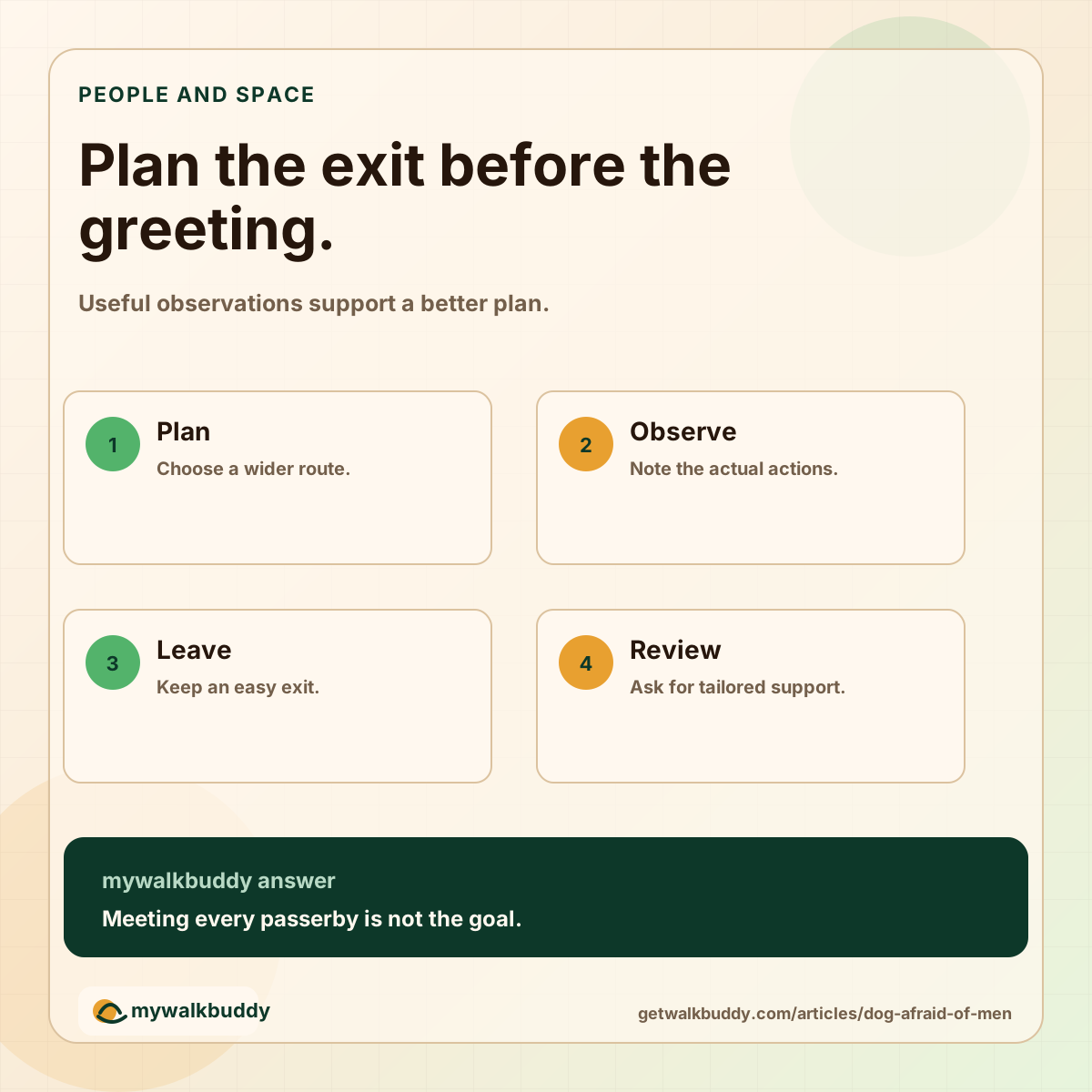
- Before: plan a route with room to leave.
- Observe: record actions rather than assumed motives.
- Manage: decline greetings and create space.
- Review: share the pattern with qualified support.
Questions owners ask when the leash is already in their hand
-
Does fear of men prove my rescue dog was abused?
No. Fear alone cannot establish the dog’s history. Record the circumstances and seek qualified help rather than treating a guess as fact.
-
Should men give my dog treats by hand?
Do not use food to pull the dog into an uncomfortable greeting. Ask your behavior professional how rewards should be delivered in the individual plan.
-
Should my dog sit while a man walks past?
A stationary position is not automatically comfortable. Prioritize enough space and a safe way to move away, following your professional’s advice.
-
How quickly should this improve?
There is no reliable universal timeline. Review comfort in comparable situations with the professional, rather than counting how many strangers touched the dog.
Make calmer routes easier to repeat.
GetWalkBuddy records route, time and distance. Keep behavior observations separately and share useful patterns with your veterinarian or behavior professional.