
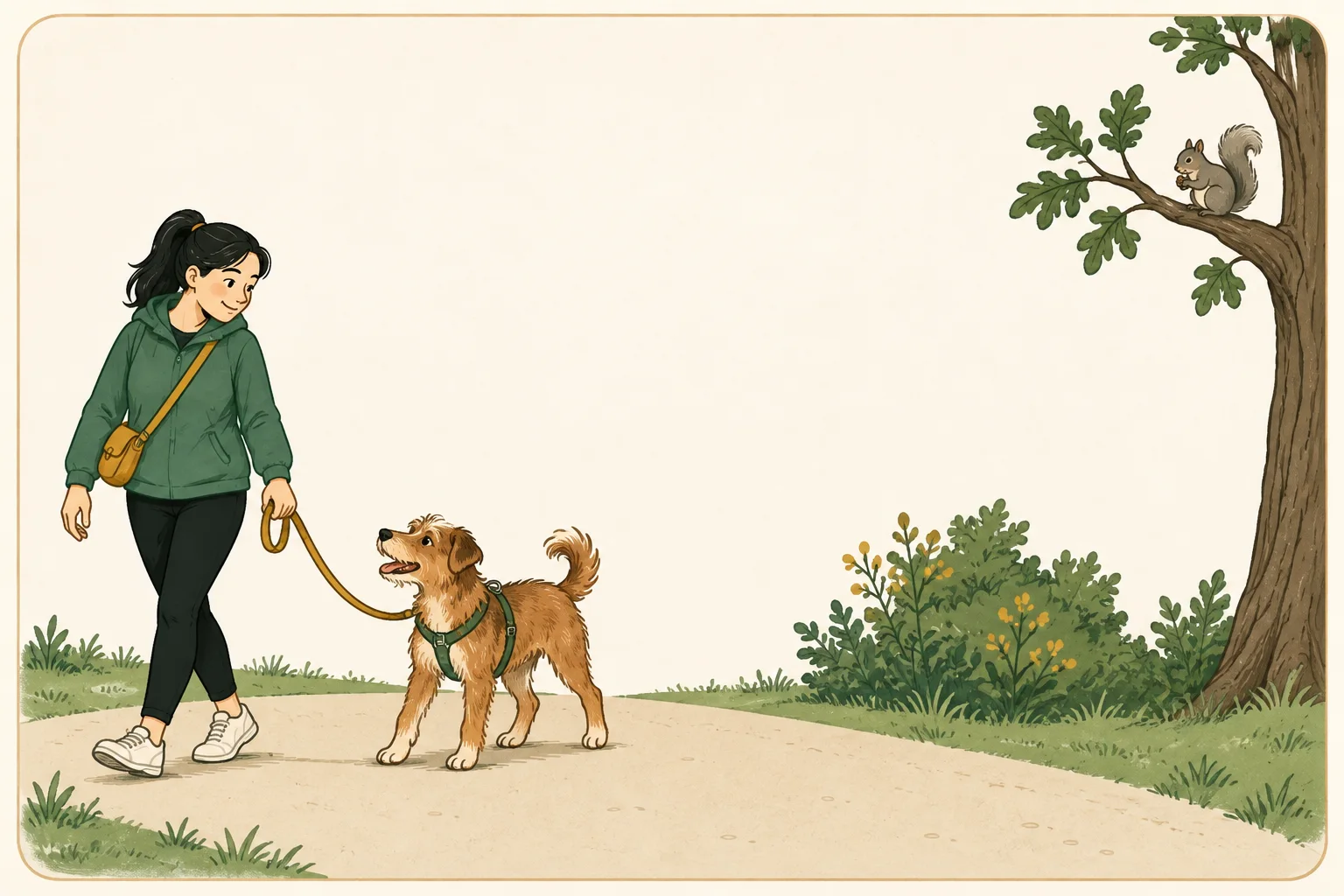
- Keep wildlife out of reach while training develops.
- Choose an escape route before entering a squirrel-heavy area.
- Practice useful responses away from the real chase, then progress gradually.
Turn this answer into a walk you can actually track.
GetWalkBuddy is a dog walking app for owners who want a simple route tracker, timer, distance view, and daily walk log without turning the walk into a spreadsheet.
Why does your dog chase squirrels despite knowing their name?
Chasing can be naturally rewarding, and excitement can make responding to training harder. Dogs Trust notes that recall learned in a quiet setting does not automatically transfer to a highly distracting situation.
Describe the gap in the skill rather than declaring the cue broken. “Returns from the garden but fixes on squirrels at the park” gives you a starting point for training. It does not establish that the dog is choosing to upset you.
Avoid testing the same difficult situation repeatedly to see whether today will be different. The walk needs a workable management plan even while the training is still incomplete.
Sources: Dogs Trust: managing chasing behavior; Dogs Trust: recall training
What should you change before the next walk?
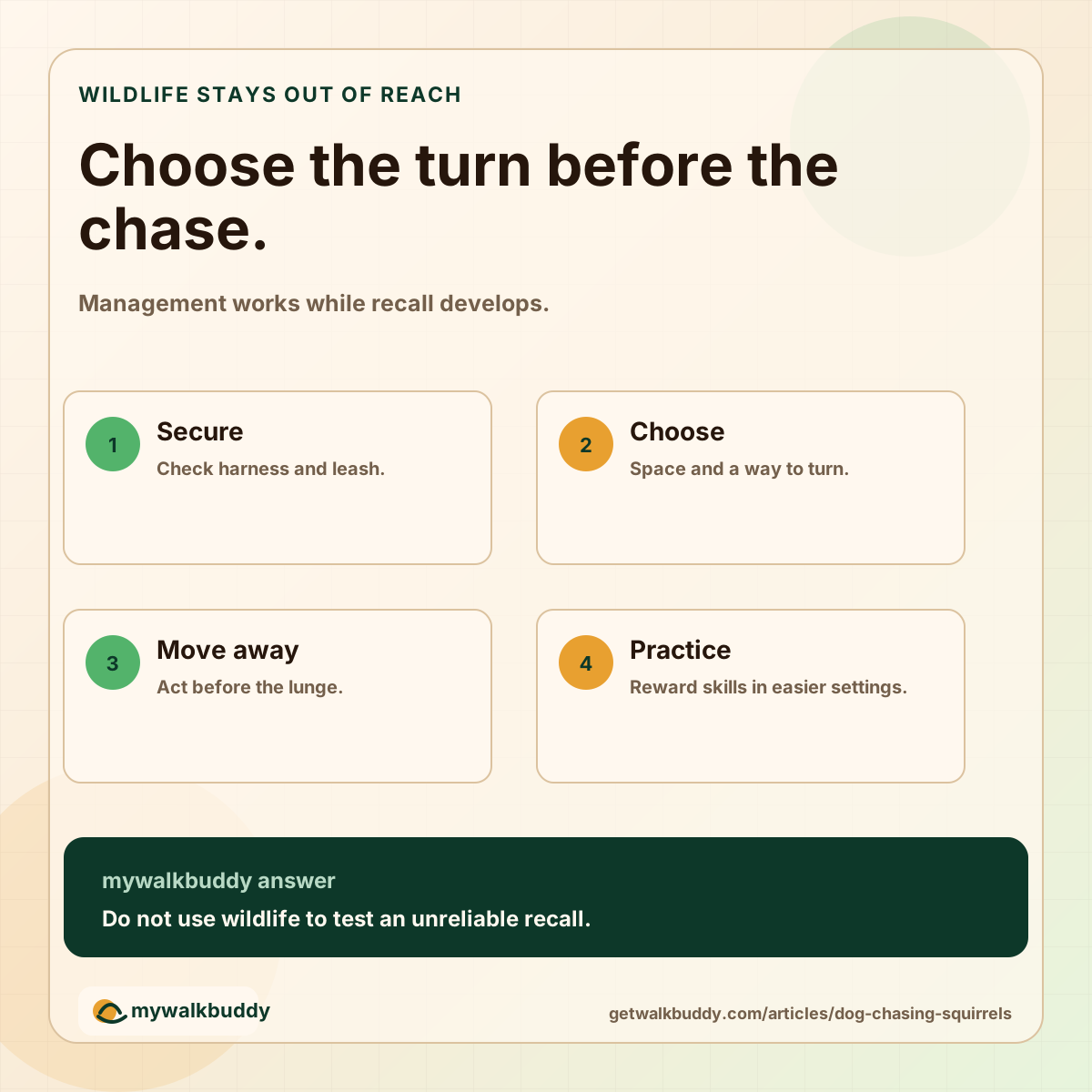
Dogs Trust recommends a secure harness and leash and choosing places where likely chase triggers can be avoided. The aim is to prevent access, not to discover how close you can get before a lunge.
Compare two route options by visibility, room to turn and nearby traffic. A narrow path between trees and a road leaves fewer choices than a broad path with a clear way back. Pick the route that gives the handler useful options.
For a practical example, make the park gate your decision point. If squirrels are already crossing the entrance path, take the quieter loop outside the park. If the entrance is clear, identify the next turn-back point before walking farther. This is a route-planning example, not a guarantee that squirrels will stay elsewhere.
Check the harness and leash before leaving. If you cannot safely manage the dog’s strength, get professional support and arrange a safer outing rather than relying on a new verbal cue.
What do you do when you spot a squirrel?
Create space and prevent the dog reaching the animal. If the dog can respond, use a familiar attention or recall cue and reward the response as you move away. If they are too focused to respond, prioritize leaving the situation safely.
Keep your own next action simple: turn along the clear route already chosen. Do not walk closer to get a better training opportunity, and do not release the dog because the leash is becoming frustrating.
After moving away, consider what you noticed first: the squirrel, a sudden pause, a fixed gaze or the lunge itself. That observation helps identify an earlier point for action next time. It is not a request to recreate the incident for a video.
A successful outing can mean choosing a different path with no chase. Counting only the times the dog obeys beside wildlife misses the value of preventing a difficult encounter altogether.
How do you practice without using wildlife as a training prop?
Start recall in a quiet enclosed setting, reward returns and add distractions and distance gradually. Dogs Trust recommends a long line attached to a harness during suitable outdoor practice and qualified support if progress stalls.
Keep a simple practice ladder: the place your dog already succeeds, a modest change you can control, and the situation that is still too difficult. Work on the middle step. A live squirrel may be several steps beyond it.
For example, an easy garden return can progress to a suitable quiet enclosed field before you expect the same response near a busy park. Choose the actual progression with your trainer; the example does not establish a universal sequence or timetable.
Give the dog enjoyable activity in secure settings too. That can include appropriate toy play or sniffing games. The purpose is to provide something the dog can do safely, not to exhaust them until they stop noticing wildlife.
Sources: Dogs Trust: recall training; Dogs Trust: managing chasing behavior
What should another walker know about your dog?
Give them a route and a response plan, not simply a warning that the dog likes squirrels. The person should know where management is needed before taking the leash.
Use this four-point brief:
- Before: name the squirrel hotspots and the quieter alternative route.
- Equipment: explain the checked harness and leash setup and any professional handling advice.
- Sighting: identify the clear turn-away route and familiar cue the dog already knows.
- Review: record what happened without staging another encounter to test the dog.
Questions owners ask when the leash is already in their hand
-
Will my dog grow out of squirrel chasing?
Do not base safety on that expectation. Continue management and training appropriate to the individual dog; age alone is not a reliable recall plan.
-
Can a long line solve the problem?
It can be a management tool in a suitable open area, but it introduces handling and snagging risks. It is not automatically suitable beside roads, trees or crowded paths.
-
Should I punish the dog when they finally return?
Dogs Trust advises rewarding returns and staying calm. You want coming back to you to remain worthwhile, even if the response took longer than you hoped.
-
Is chasing harmless if the squirrel escapes?
No. The chase can distress wildlife and put the dog or handler in danger. Preventing the attempt matters even when the animal gets away.
Save the route with more room.
Use GetWalkBuddy to record walking routes, time and distance. Keep squirrel sightings and training observations in separate notes.