
- Check fence-line digging and escape risk before protecting flowerbeds.
- Look for the situation around the hole instead of assuming boredom.
- Offer an appropriate alternative and supervise its use.
Turn this answer into a walk you can actually track.
GetWalkBuddy is a dog walking app for owners who want a simple route tracker, timer, distance view, and daily walk log without turning the walk into a spreadsheet.

Why might your dog be digging holes?
AKC describes several possible reasons, including searching for small animals, seeking a sheltered resting place, stress and escape. Some dogs also enjoy the activity itself.
The location can guide your next observation, but it does not prove a cause. A fence-line hole needs an escape check whether the dog was chasing a scent or trying to reach something outside.
Write down three facts: where digging happened, what was nearby and what was happening just before it. If you did not see the event, say so. A hole discovered later cannot tell you everything about the dog’s experience.
Avoid staging a repeat just to obtain a video. Supervision should help prevent another unsafe event, not provide a reason to let one unfold.
Sources: AKC: reasons dogs dig
What should you fix first in the yard?
Address escape opportunities and basic comfort before treating digging as a manners problem. AKC recommends supervision for escape digging and shade, water and limiting exposure on hot days for dogs seeking cooler ground.
Walk the boundary without the dog first. Look for gaps, loose gates and areas that are no longer secure. Until the space is safe, use a different supervised toilet or outdoor arrangement.
Make the resting option obvious and accessible. A dog should not have to choose between direct sun and digging a hole to lie in. Check whether the comfortable area is available at the time the dog actually uses the yard.
Do not add sharp obstacles, irritating substances or improvised traps. A barrier should prevent access safely, not punish contact. If fencing needs structural work, choose an appropriate professional repair.
Could a designated digging area help?
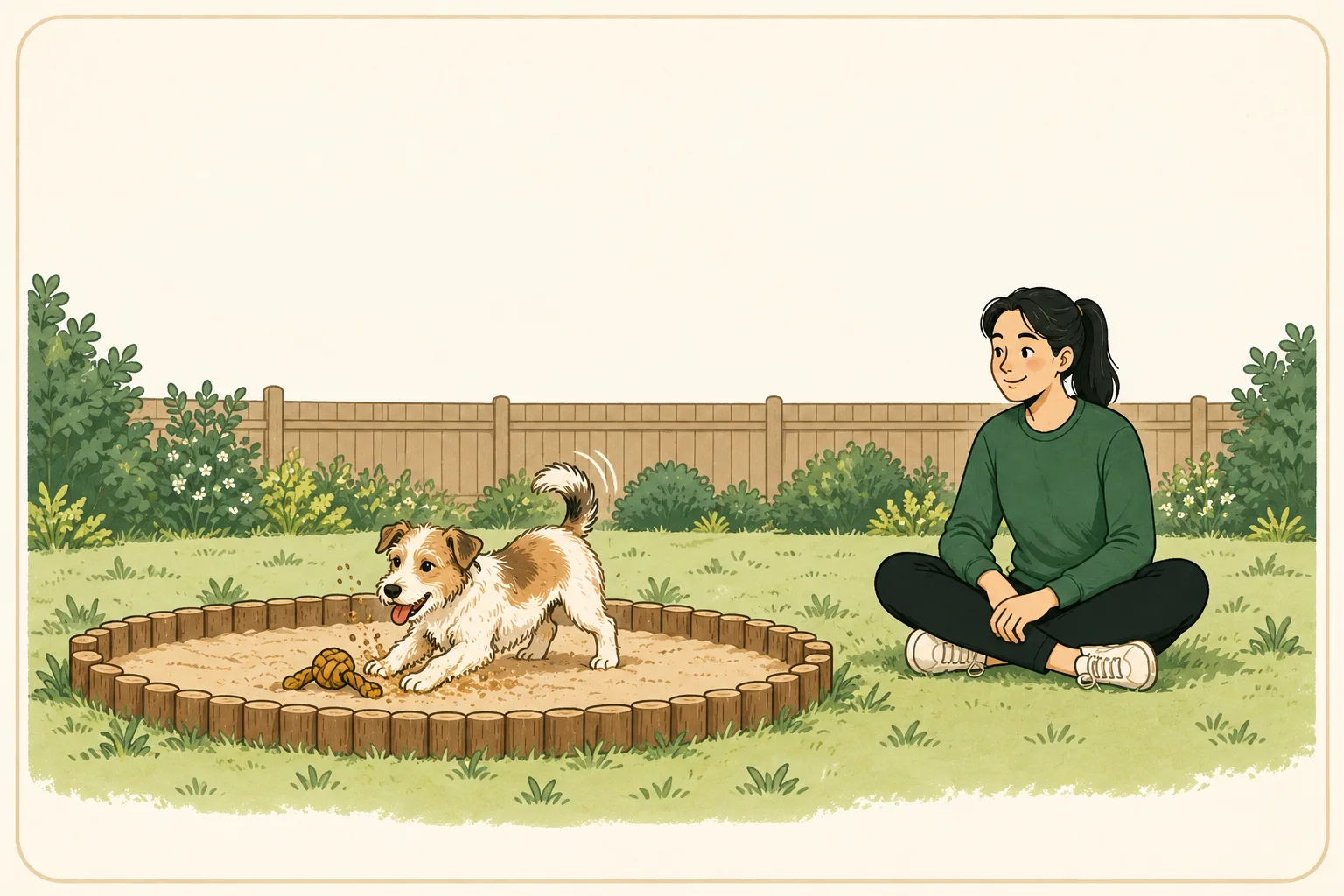
For a dog who enjoys digging, a specific permitted area can provide an outlet. AKC suggests a defined digging space and using a toy to help introduce the activity there.
Place it away from the fence line, planted beds and places people need to walk. Choose a setup you can inspect, maintain and supervise, with no sharp edges or hidden debris. The boundary should be easy for the household to recognize.
Start with the toy visible or only partly covered, and let the dog investigate. You are showing where this activity is available, not testing whether the dog can excavate a deeply buried object.
Supervise and remove damaged toys or unsuitable materials. If the dog eats the substrate or cannot use the area comfortably, stop and reconsider the setup with professional advice. A digging patch is an optional activity, not a universal solution.
Will a longer walk stop the digging?
Not necessarily. The response needs to fit the reason. AKC advises addressing the source of stress when digging is stress-related rather than focusing only on the holes.
Review the daily arrangement: outdoor supervision, opportunities to sniff and interact, appropriate rest and what happens when the dog is left alone. More vigorous exercise does not automatically resolve an unsuitable environment or distress.
If digging is intense, sudden, associated with repeated escape attempts or accompanied by other changes, seek veterinary and qualified behavior advice. Describe the pattern and the management already in place.
Keep the distinction between enrichment and treatment clear. A sniffing walk or permitted dig can be part of ordinary care, while a behavior problem may need an individual plan.
Sources: AKC: reasons dogs dig
How can you tell whether your changes are useful?
Review a small set of observable outcomes instead of expecting every hole to disappear immediately.
For example, note whether the boundary remained secure during supervised use and whether the dog chose the permitted patch. This is a suggested review method, not a measured success claim.
- Before: inspect boundaries, comfort and the intended outdoor area.
- During: supervise and guide the dog toward appropriate activities.
- After: check for damage and remove unsafe materials.
- Review: record new patterns and obtain help for distress or escape attempts.
Questions owners ask when the leash is already in their hand
-
Is digging always caused by boredom?
No. Hunting, comfort, play, stress and escape can all be relevant. Observe the context before choosing a response.
-
Should I punish my dog when I find a hole later?
Avoid punishment. Improve supervision and address the situation that allows or motivates the digging.
-
Can a digging box replace walks?
No. It is one optional activity alongside suitable walks, social contact, toileting and rest.
-
What if the holes are under the fence?
Treat that as an immediate containment concern. Prevent unsupervised access, secure the boundary and seek help with repeated escape behavior.
Keep everyday walks visible.
GetWalkBuddy records route, time and distance. Keep yard observations separately so you can discuss the full daily routine with a professional.