
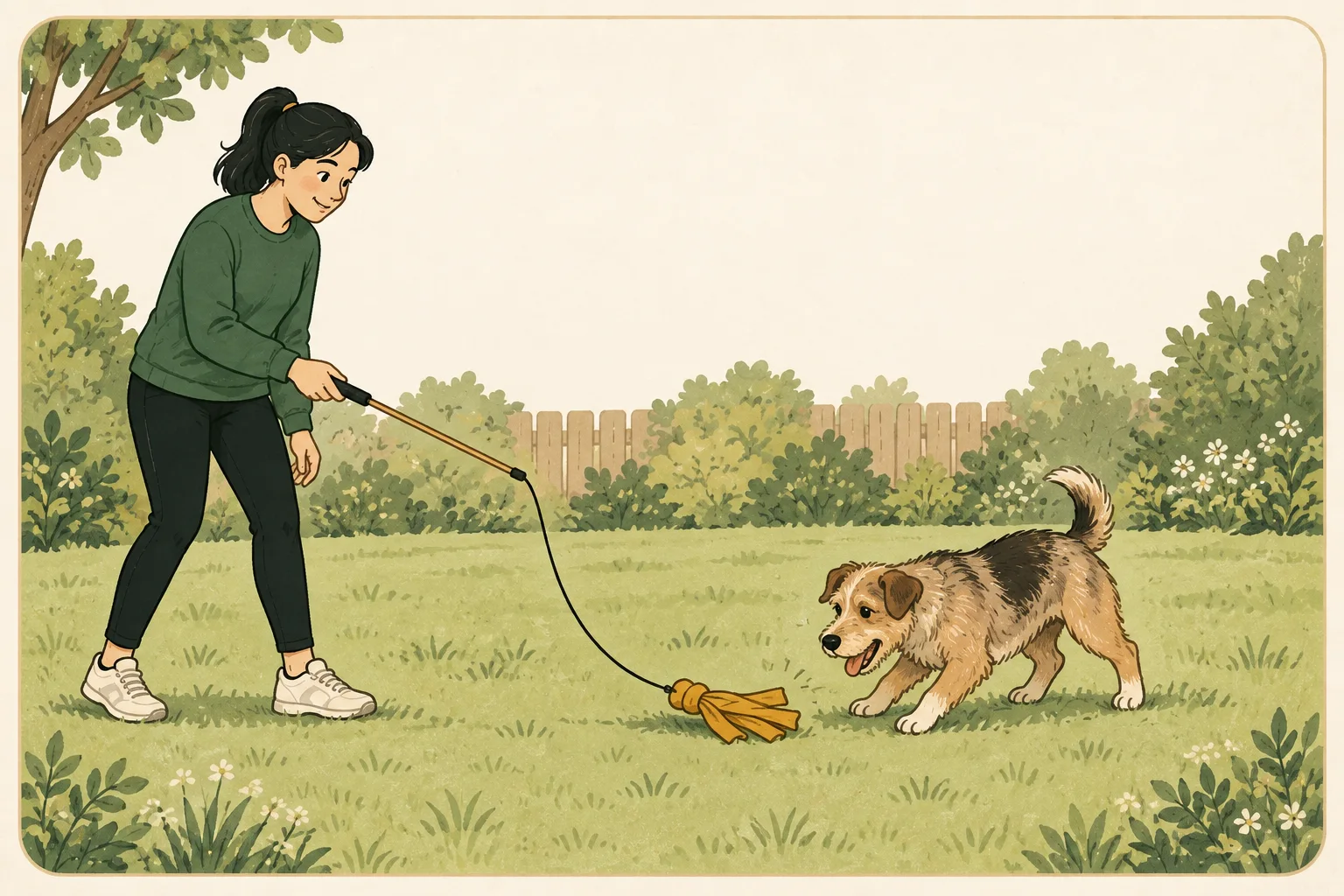
- Check the dog, surface and equipment before inviting play.
- Use controlled low movement and give the dog breaks.
- End through a calm exchange; store the equipment out of reach.
Turn this answer into a walk you can actually track.
GetWalkBuddy is a dog walking app for owners who want a simple route tracker, timer, distance view, and daily walk log without turning the walk into a spreadsheet.
What is a flirt pole for dogs?
It is a toy on a cord attached to a handle, allowing an adult to move a lure for the dog to follow. AKC mentions it as one way to practice a voluntary release during play.
Think of the job you want the activity to do. Shared play with a clear start and finish is a realistic aim. “Fix every problem by tiring the dog out” is not a useful training specification.
This guide covers setting up and managing a game, not choosing a brand or making medical exercise recommendations. The manufacturer guidance cited below applies to that maker’s equipment; read the instructions supplied with your own pole as well.
Sources: AKC: teaching a voluntary drop
What should you check before using one?
Consider physical suitability, footing and equipment limits. Squishy Face Studio warns against use with dogs who have joint or hip problems, discourages jumping and recommends outdoor grass or earth surfaces.
Seek individual veterinary guidance for puppies, dogs recovering from injury or dogs with movement concerns. Do not use a general age label as clearance for vigorous play.
Clear the area of furniture, holes and obstacles. Keep other dogs and bystanders out of the game so the handler can focus on one dog and one lure. Check the entire cord and attachment before use.
A small area is not automatically a suitable area. If there is not enough room for controlled movement without abrupt turns or collisions, choose a calmer activity instead.
Sources: Squishy Face Studio: flirt pole instructions and safety warnings
How do you organize the first game?
Start with a manageable low movement, a catch and a pause. Do not keep the toy permanently out of reach or raise it to encourage spectacular jumps.
Before the lure moves, decide where the dog can safely travel and where you will stand. Keep the movement within that clear area. If the dog becomes too excited for you to manage the equipment comfortably, stop and simplify.
Give yourself a single observation task: can the dog engage and then take a break? That tells you more about whether the session is manageable than counting how many fast circuits you can produce.
Keep the first setup easy to repeat. Do not add a crowd, a new location and a faster lure at once. An ordinary calm practice session is more useful than a dramatic video.
What happens when the dog catches the lure?
Use a practiced voluntary release and follow the pole’s limits. Squishy Face Studio says its flirt pole is not a tug toy and warns against releasing a stretched bungee or attaching hard, heavy lures.
Do not pull harder to win the toy back. AKC’s exchange approach uses a reward for releasing and can return the safe toy during practice. Teach that skill in an easier setting if the moving lure is too exciting.
If the dog guards the lure or you cannot retrieve it safely, stop casual training and seek qualified behavior help. The next step is not a stronger contest.
Keep fingers away from the mouth and avoid wrapping a cord around yourself or the dog. Once the session is finished, inspect the equipment and put it away; a chase toy left out becomes an unsupervised chewing opportunity.
Sources: Squishy Face Studio: flirt pole instructions and safety warnings; AKC: teaching a voluntary drop
What should the session checklist include?
Use a repeatable start, pause and finish rather than an exhaustion target. Manufacturer guidance calls for breaks and water, and a short walk before and after its flirt-pole activity.
There is no universal duration that makes this suitable for every dog. If you are unsure about physical limits, obtain individual advice. Stop for discomfort, damaged equipment or a setup you cannot manage.
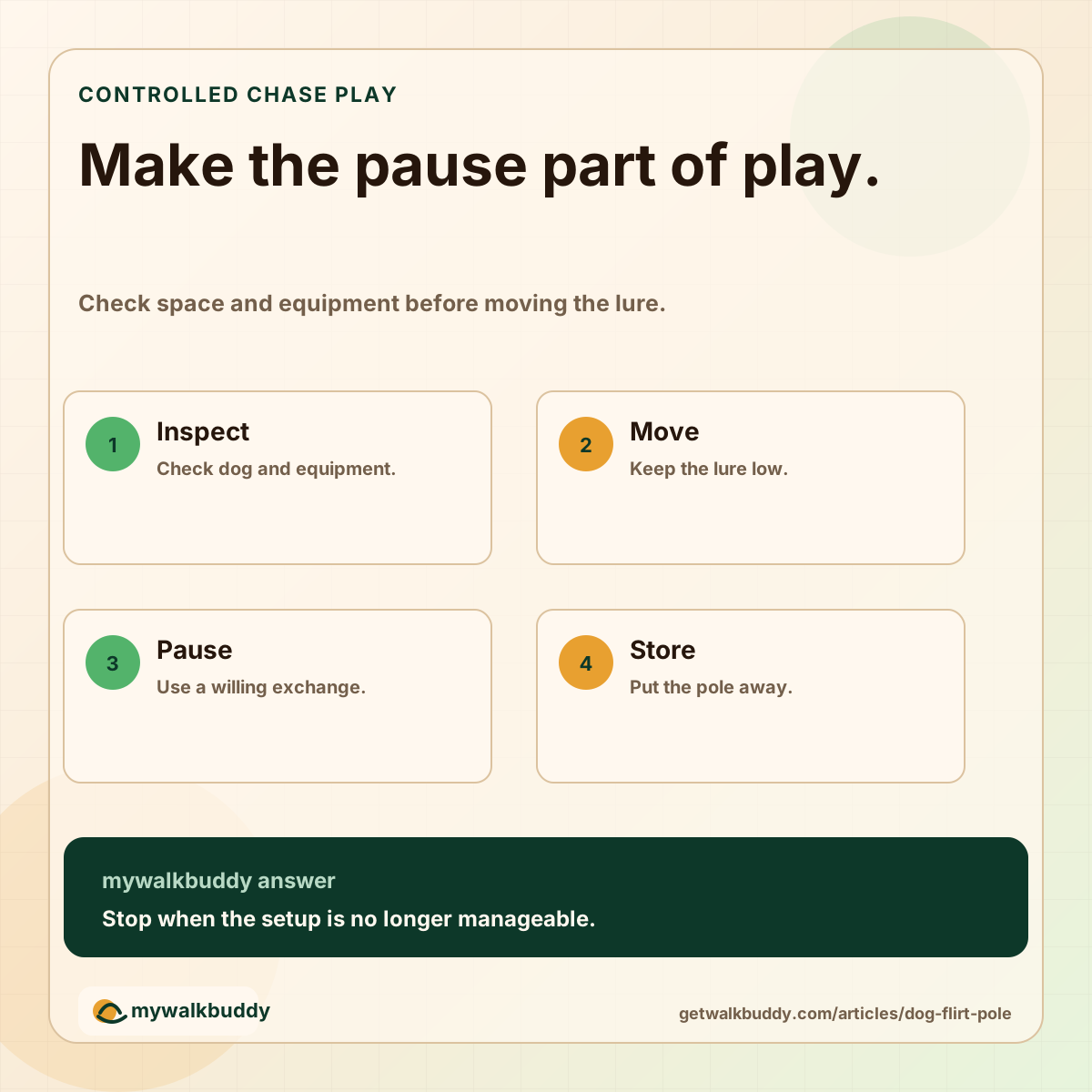
- Before: check suitability, footing, space and equipment condition.
- Play: keep the lure low and the path manageable.
- Pause: allow a catch and use a practiced willing release.
- Finish: inspect the toy, store it safely and offer an appropriate break.
Sources: Squishy Face Studio: flirt pole instructions and safety warnings
Questions owners ask when the leash is already in their hand
-
Can I make my dog jump for the lure?
Avoid encouraging jumps. Keep play controlled and low, and follow individual veterinary and equipment guidance.
-
Can I use the pole for tug?
Check the maker’s instructions. Squishy Face Studio specifically says its flirt pole is not designed as a tug toy.
-
Will a flirt pole stop leash reactivity?
Do not treat it as a guaranteed behavior treatment. Reactivity needs appropriate management and individual training support.
-
What if my dog ignores the lure?
Do not force participation. Choose another activity the dog enjoys or seek help if loss of interest is sudden or accompanied by other changes.
Leave room for an ordinary walk.
GetWalkBuddy records walking route, time and distance. Keep play observations separately; walking statistics do not measure the intensity of chase games.