
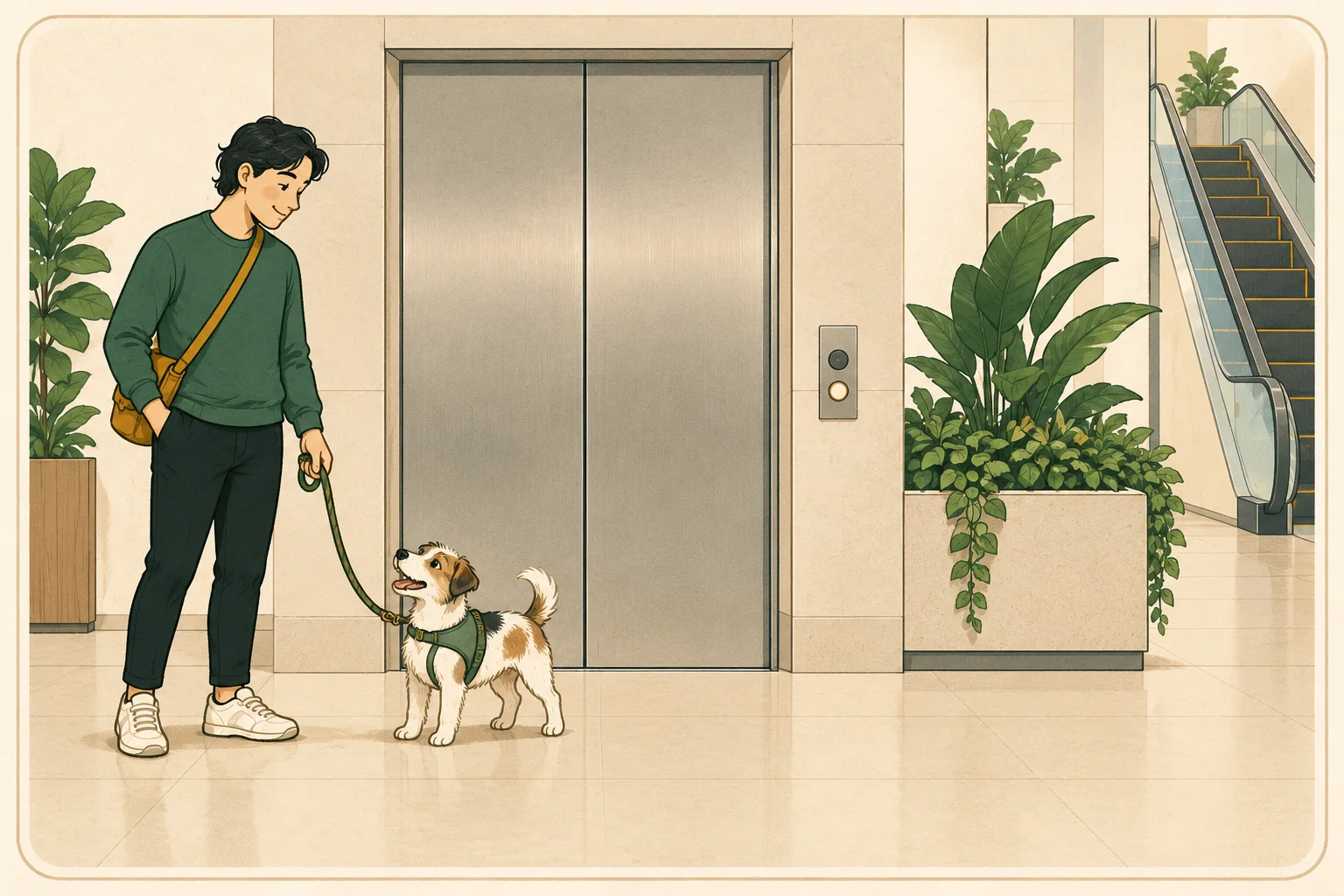
- Find an elevator or suitable fixed stairs before joining the moving queue.
- Keep yourself, your dog and the leash together when passing through elevator doors.
- If the alternative route is unavailable, change the plan instead of improvising at the escalator.
Turn this answer into a walk you can actually track.
GetWalkBuddy is a dog walking app for owners who want a simple route tracker, timer, distance view, and daily walk log without turning the walk into a spreadsheet.
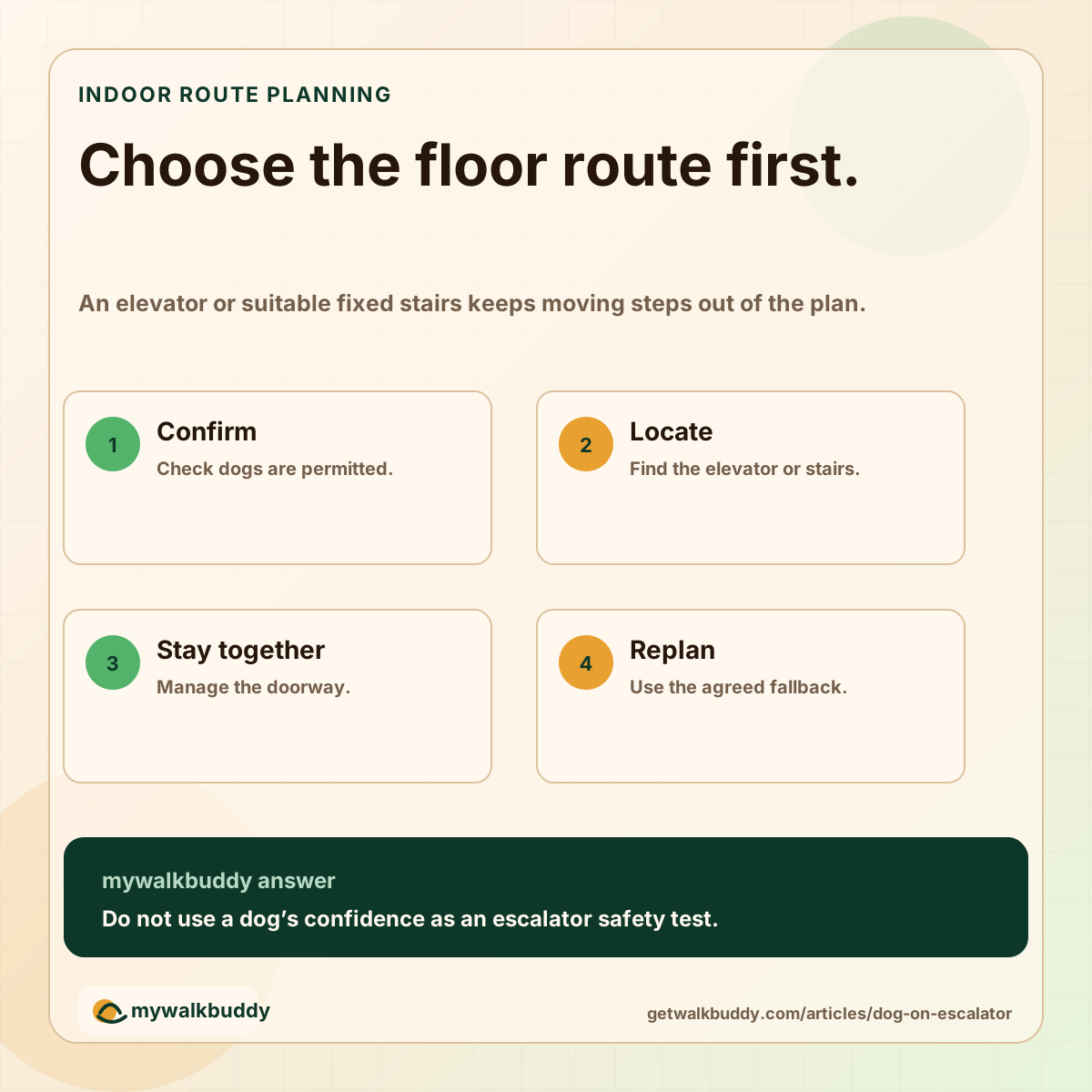
Why are escalators a poor choice for a dog?
The moving steps and gaps can trap a paw or nail. Whole Dog Journal also warns about fur, tails and leashes becoming caught. This is a risk even when the dog does not look frightened.
A calm appearance answers a behavior question: the dog may not be showing distress. It does not answer whether the equipment is safe for that animal. Do not use willingness to step on as the safety test.
Treat videos of dogs riding escalators as videos, not fitting or training instructions. You cannot see all the circumstances, and a successful trip shown on screen does not establish that repeating it is a sensible choice.
Sources: Zoom Room: elevators and escalator risks; Whole Dog Journal: dogs and escalators
What should you check before entering a building?
Identify how you and your dog will reach the destination and return to the exit. Check the building’s pet policy and current access information; do not assume an elevator is available simply because one appears on an old map.
Build a three-part route note: entrance, floor change and exit. For example: “Use the side entrance, take the lift beside reception, return by the same route.” This is a planning format, not a description of a particular building.
If the map shows an elevator but does not make the entrance clear, ask staff for directions before approaching the escalator queue. Include the dog’s size and any difficulty with ordinary stairs when explaining which route you need.
For a time-sensitive journey, allow room for an access change. An out-of-service lift can make a familiar route unsuitable. The useful backup may be a different entrance, a different destination or returning another day.
How can you make the elevator part easier to manage?
Wait clear of the opening so other passengers can leave, then enter with your dog and the leash together. Do not let the dog cross the threshold while you remain behind, or allow the leash to trail through closing doors.
Before the doors open, put away the phone and gather anything that occupies the hand you need for the leash. Position yourself so you can see the dog, the opening and other passengers. A busy doorway is a poor place to adjust bags or untangle equipment.
If the car is crowded, wait for another one or ask staff about another suitable route. Avoid squeezing a worried dog between strangers simply because the lift has arrived.
For a dog who is frightened of elevators, Zoom Room recommends gradual, voluntary practice rather than pulling the dog inside. Arrange that learning separately from a journey that has a hard deadline. AKC’s urban skills test also treats controlled entry, riding and exit as skills; passing that test is not required to make a sensible route plan.
Sources: Zoom Room: elevators and escalator risks; AKC: urban walking skills
What if the elevator is closed or the stairs are unsuitable?
Move away from the traffic flow and ask staff about an alternative. If there is no route you and your dog can use safely, change the outing. Being already inside the building does not oblige you to continue to the next floor.
Use a specific question: “Is there another elevator or level route to this area that is open now?” That is easier to answer than asking whether the building is generally dog friendly.
Do not force a dog with mobility difficulty to tackle fixed stairs as a backup. Likewise, picking up a large or struggling dog at the foot of an escalator is not a reliable access plan. Choose the alternative before reaching that decision point.
If an accident occurs, alert staff immediately and seek urgent veterinary assistance for injury. Do not reach into machinery or try to free a trapped body part by force. This route-planning guide is not a rescue procedure.
What should another walker know about the route?
Give the next walker the usable entrance and the fallback, not merely the destination address.
A short handover can prevent the same access problem on the next outing:
- Before: confirm pets are permitted and check current floor access.
- Route: name the entrance and suitable elevator or fixed stairs.
- Fallback: say what to do if that route is closed or crowded.
- Return: include the way back to the exit, not only the outward trip.
Questions owners ask when the leash is already in their hand
-
Can a confident dog ride an escalator safely?
Confidence does not remove the entrapment risk. Choose an elevator or suitable fixed stairs.
-
Does carrying a small dog solve the problem?
Do not assume it does. Handling, a loose leash, movement and the building’s rules still matter. Plan an elevator or fixed-stair route instead of relying on carrying at the last moment.
-
Are normal stairs the same as escalators?
No. Fixed stairs do not have the same moving mechanism, but they still need to suit your dog’s mobility and comfort.
-
What if my dog is afraid of the elevator too?
Plan an alternative for the immediate trip and seek gradual, reward-based help for the fear. Do not use a rushed public journey as a forced training session.
Plan the practical route.
GetWalkBuddy records outdoor walking routes, time and distance. Keep building access directions separately; the app is not an indoor elevator map.