
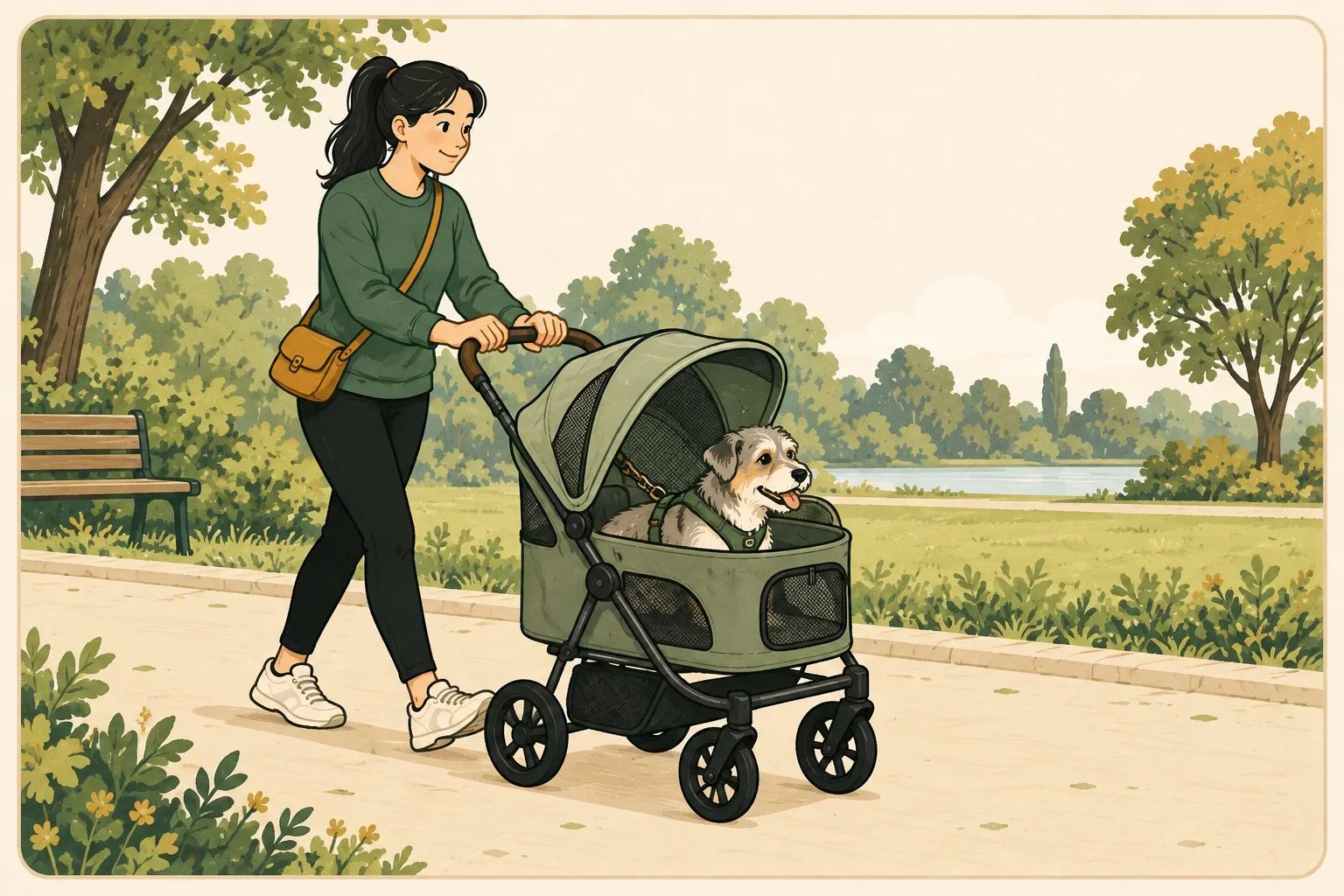
- Check cabin space as well as the manufacturer’s weight limit.
- Introduce a stationary stroller before adding movement.
- Plan walking, riding and the journey home separately.
Turn this answer into a walk you can actually track.
GetWalkBuddy is a dog walking app for owners who want a simple route tracker, timer, distance view, and daily walk log without turning the walk into a spreadsheet.
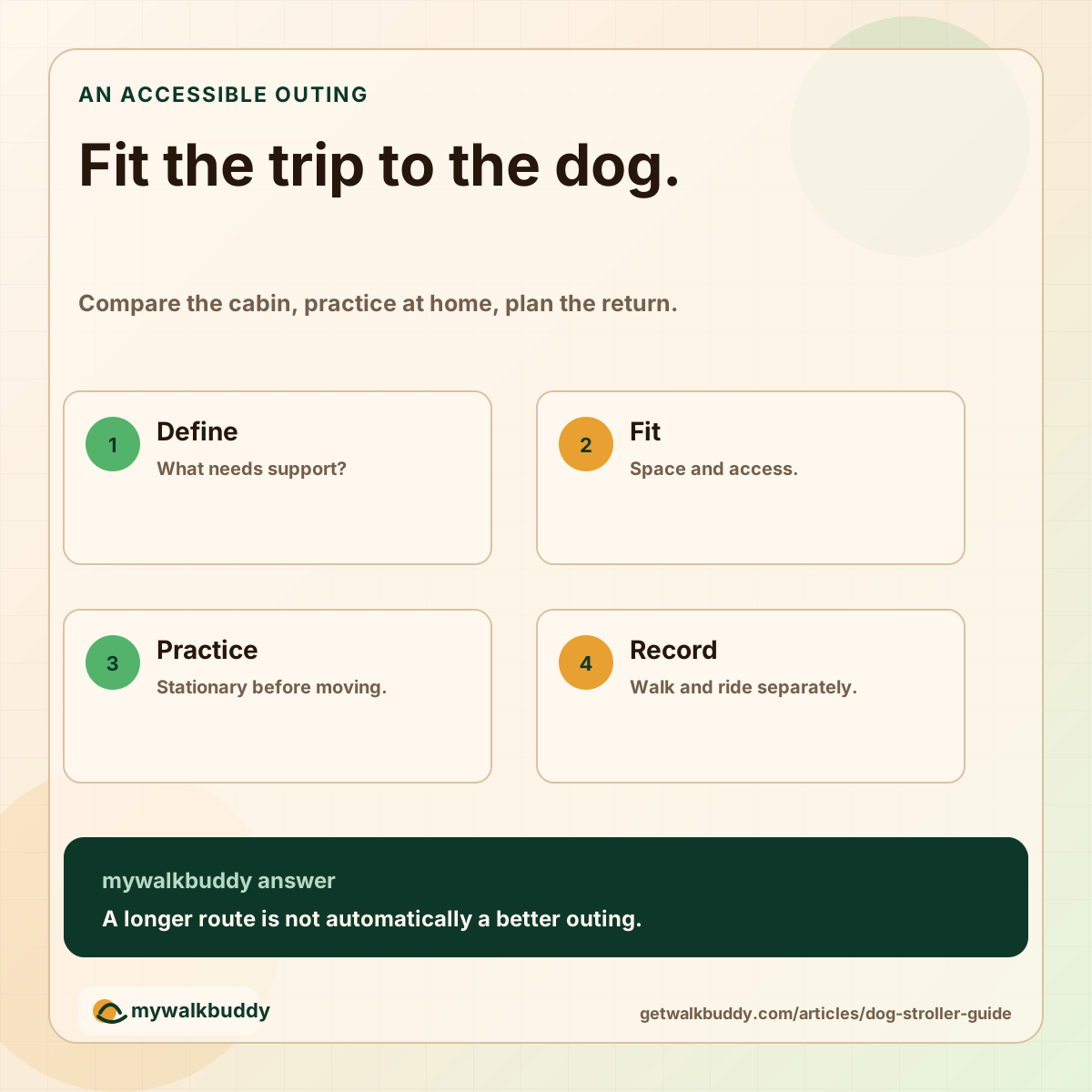
When might a dog stroller help?
AKC describes strollers as an option for dogs with limited mobility to enjoy outdoor stimulation. Suitability depends on the individual dog, including whether it is comfortable riding.
Write down the problem you want the stroller to solve. “Join a family outing with rest opportunities” is a clearer brief than “buy something for a senior dog.” Your brief helps you compare the right features and ask useful questions.
A stroller does not tell you why a dog has stopped enjoying walks. If difficulty walking is new, arrange a veterinary assessment rather than treating the equipment purchase as the diagnosis.
An outing can contain different activities: reaching the park, walking an appropriate section, sitting somewhere quiet and returning home. Decide which parts you want the stroller to support before comparing models.
Sources: AKC: Strollers for Dogs
How do you choose the right size?
AKC recommends enough room for the dog to sit, lie down and turn around comfortably. A weight rating alone does not establish that the cabin fits.
Build a comparison sheet with five headings: permitted load; internal cabin dimensions; entry method; folded dimensions; route surface. Copy measurements from the manufacturer rather than estimating from a photograph.
Compare the cabin with the space your dog occupies in comfortable positions. Include the liner you intend to use. A tall dog and a compact dog of the same weight may need very different cabin shapes.
Check the actual instructions for loading, restraint attachment and braking. Ask the seller to demonstrate anything unclear. Do not assume a pet stroller is approved as a car restraint, bicycle trailer or running stroller just because it has wheels.
If possible, arrange a fitting opportunity or confirm the return policy before purchase. A product that meets a numerical limit can still be awkward for your particular dog or home.
Sources: AKC: Strollers for Dogs
Which features matter on your route?
Match the stroller to the outing you actually take: surfaces, entrances, storage and weather exposure all affect whether it is practical.
Walk your proposed route without the dog first and list the awkward places: a narrow gate, steps without a ramp, a rough section or a crowded entrance. Choose an alternative route where necessary rather than discovering an obstacle with the dog aboard.
AKC highlights terrain, wheels, shade and airflow as selection considerations. A covered cabin still needs appropriate conditions; do not assume a canopy makes a hot outing suitable.
Test the empty stroller at home: can you operate the brakes, fold it, lift it and store it without improvising? Follow its instructions for each operation. Keep the dog clear while learning the folding mechanism.
For a shared family outing, decide who controls the stroller and who carries the other supplies. Avoid loading bags in ways the manufacturer does not permit; convenience should not depend on an unstable handle.
Sources: AKC: Strollers for Dogs
How do you introduce the stroller?
Start with a stationary stroller and reward relaxed investigation. Add movement gradually, without forcing the dog into the cabin.
AKC recommends gradual positive introduction. Treat getting near the stroller, entering it and riding in it as separate tasks. A dog accepting one does not automatically accept the next.
Choose an uncluttered, quiet place. Secure the stroller as directed, make the entry accessible and allow the dog to investigate. If lifting is necessary, ask for handling advice appropriate to the dog rather than pulling it into position.
Our practical progression card has three columns: what the dog chose; what changed; what to repeat. For example: “Entered willingly while stationary; movement is new; repeat the stationary setup.” This is an illustrative planning note, not a training result.
If the dog tries to escape or cannot settle, stop and make the setup easier. Persistent difficulty is a reason to seek suitable training help or reconsider whether this outing suits the dog.
Sources: AKC: Strollers for Dogs
How do you combine walking and riding?
Keep a separate plan for the walking portion and the ride. Use the dog’s individual activity advice rather than counting stroller distance as exercise.
Before leaving, choose an easy return option. A route that only works if the dog walks home defeats the purpose of planning support. Include any loading or access problem in that decision.
Record walking minutes separately from time in the stroller. An illustrative log might say “short walk near home, then a quiet ride”; it should not imply that the whole route was walked.
Review one practical question afterward: what made the outing easier or harder? A difficult curb, an awkward loading point or a noisy stretch can inform the next route without turning every trip into a performance target.
- Before: confirm fit, instructions and the route home.
- Introduce: practice with the stroller stationary.
- During: distinguish riding from appropriate walking.
- After: note comfort and any access problem.
Questions owners ask when the leash is already in their hand
-
Is a dog stroller only for very small dogs?
No. Check the specific model’s load limit, internal space and entry method for your dog. Size labels alone are not enough.
-
Does a stroller replace walks?
It can support an outing, but the walking and other activity appropriate for your dog remain an individual question. Discuss limitations with your veterinarian.
-
Can I use a baby stroller instead?
Do not assume it provides suitable containment, fit or restraint for a dog. Use equipment according to its intended purpose and instructions.
-
How do I fold my dog stroller?
Follow the exact model’s manual or ask the manufacturer for a demonstration. Practice with the dog outside and clear of the folding mechanism.
Keep the walking portion clear.
GetWalkBuddy can record your walking route, time and distance. Keep stroller travel separate so the activity record describes what your dog actually walked.