
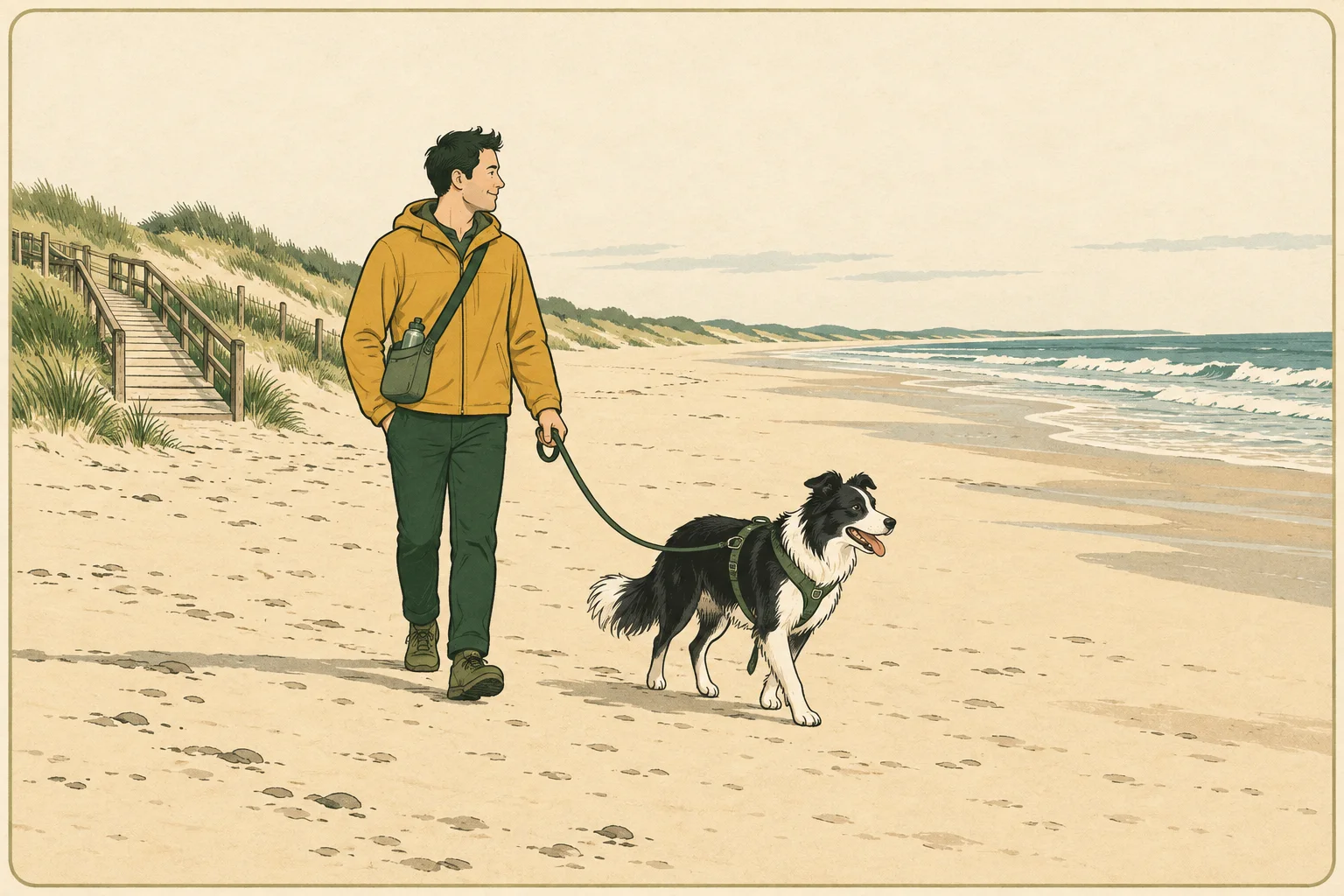
- Check the exact beach, date and access area rather than relying on an old recommendation.
- Choose your return point before committing to a shoreline route.
- Treat walking on sand and entering the water as separate decisions.
Turn this answer into a walk you can actually track.
GetWalkBuddy is a dog walking app for owners who want a simple route tracker, timer, distance view, and daily walk log without turning the walk into a spreadsheet.
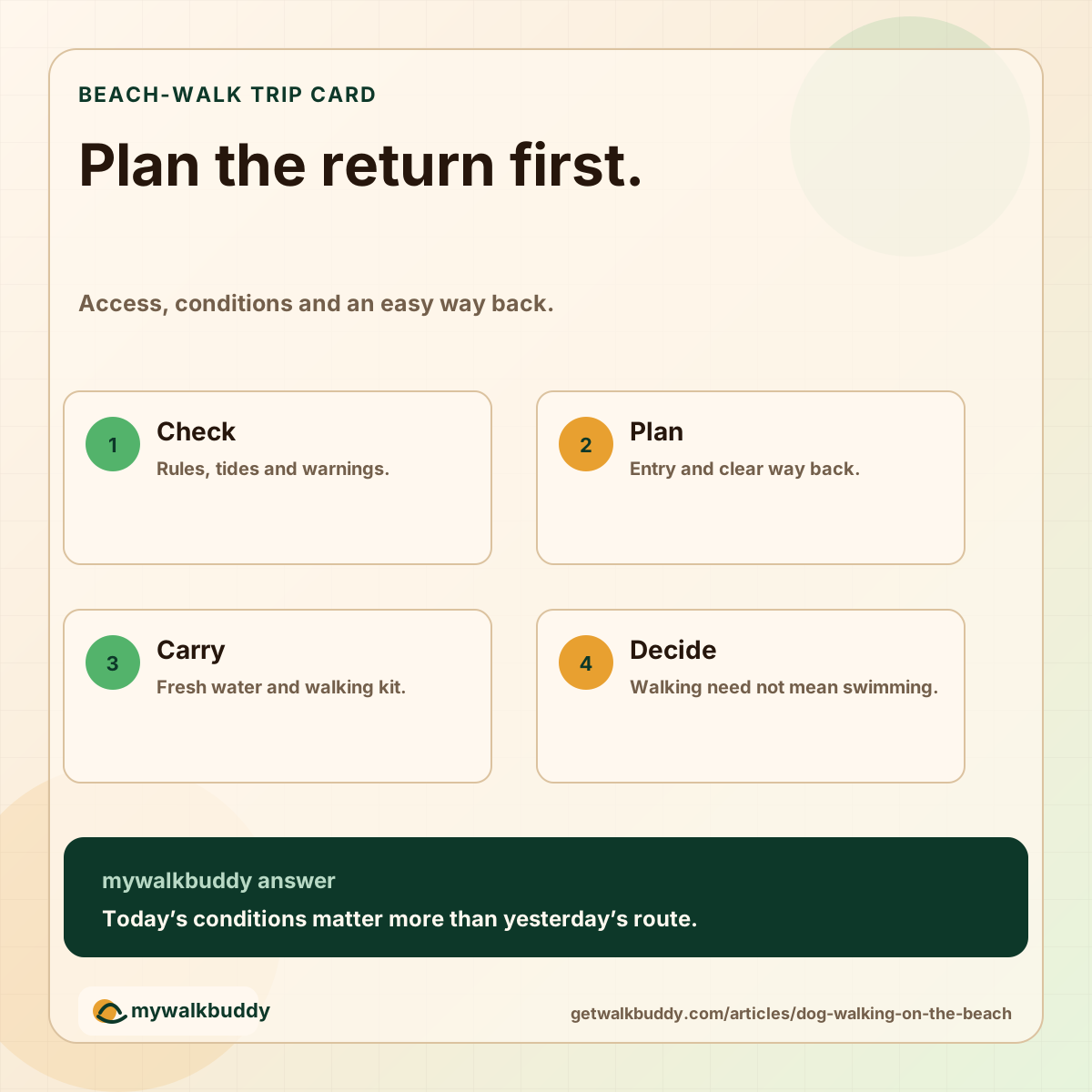
How do you check whether a beach allows dogs?
Look at the current information from the beach operator or relevant local authority, then read the signs at the access point. Dogs Trust notes that restrictions can differ by season and by section of a beach. A dog-friendly label in a travel list is not enough to establish today’s rules.
Create a trip card with the beach name, exact access point, date checked and link to the operator’s guidance. Record any leash or area restrictions in the same place so another person planning the trip can see the practical requirements.
Check the access path as well as the sand. If you need to cross a restricted section to reach the proposed walking area, resolve that before leaving home. When official information and a sign appear to conflict, ask the operator or choose another outing rather than assuming the more convenient rule applies.
Sources: Dogs Trust and RNLI: beach safety
How do you plan a route that stays easy to leave?
Check local tide information and warnings before departure, and identify the exit you will use. Dogs Trust and the RNLI emphasize tide checks for coastal walks. Build the route around the return as well as the outward walk.
Add three fields to the trip card: intended turnaround, main exit and backup outing. A landmark can make the turnaround easier to communicate, but do not use it in place of current conditions or local advice.
An illustrative plan might stay on a broad section near the entry boardwalk instead of continuing around a rocky headland. That decision preserves an obvious return without needing to discover what is beyond the bend.
If conditions are changing faster than you expected, shorten the trip. A recorded route from a previous visit does not establish that the same shoreline is usable today. Do not try to complete an app distance target by crossing an uncertain section.
Sources: Dogs Trust and RNLI: beach safety
What should you pack for the walking part of a beach trip?
Bring fresh drinking water, a bowl, waste bags, a secure walking setup and a way to clean up afterward. Dogs Trust advises checking heat, preventing seawater drinking and rinsing sand and salt from the dog after the visit.
Pack for the point where supplies are needed, not just the car journey. Water left in the car does not help halfway along the beach. Keep the load light enough that you can still handle the dog and pick up waste comfortably.
Decide who carries the water and who manages the lead if two adults are going. At the end, account for the dog before sorting wet towels and bags. That small division of jobs prevents the departure from becoming the least supervised part of the trip.
For a first visit, keep the plan easy to shorten. The beach is a new surface and setting; there is no need to make the first outing a test of the longest distance your dog can cover.
Sources: Dogs Trust and RNLI: beach safety
Does a beach walk need to include swimming?
No. Dogs Trust warns that apparently calm open water can hide currents, debris and other hazards. If you are unsure, keep the dog out. A land-based outing can be the entire plan, with no obligation to add a swim because you traveled to the coast.
Write “walking only” on the trip card if that is your decision. Tell everyone coming along before arrival so nobody throws a toy toward the water or assumes the dog should follow another swimmer.
If you are considering water access, consult current local warnings and appropriate guidance for your dog. Looking at another dog swimming is not a safety check. Keep the departure route and water decision separate so an unsuitable shoreline does not turn into an improvised swimming location.
Know how to summon local rescue help before starting. Do not enter dangerous water to retrieve a dog. Contact the local emergency or coastal rescue service; the Dogs Trust source gives UK-specific numbers, which should not be assumed to apply elsewhere.
Sources: Dogs Trust: water safety
What should the beach-walk trip card contain?
Keep the essential decisions together so you can change plans at the access point. A trip card is useful only if it reflects the current visit.
Copy this departure checklist:
- Before: confirm access rules, local warnings, weather and tide information.
- Route: name the entry, turnaround and return option.
- Pack: carry fresh water, bowl, waste bags and a secure walking setup.
- Return: clean up, check the dog and note what to change before another visit.
Questions owners ask when the leash is already in their hand
-
Can my dog drink seawater during a beach walk?
Do not use seawater as drinking water. Dogs Trust warns that swallowing it can cause illness. Carry fresh water and seek veterinary advice if you are concerned about ingestion or symptoms.
-
Are beaches suitable for an off-leash walk?
That depends on the current local rules, conditions and your ability to keep the dog under control. A beach is not automatically an off-leash area, and a successful recall elsewhere does not remove the need for a safe setup.
-
How long should the first beach walk be?
Choose an outing that is easy to shorten and adapt to your dog and the conditions. There is no universal duration. Plan the turnaround and return before extending the walk.
-
Can we walk if swimming is unsafe?
Possibly, but assess the walking route on its own merits. A water warning does not tell you whether the sand, access or return route is suitable. Follow local advice and choose a different outing if uncertain.
Keep a useful record for the next visit.
Record the walk in GetWalkBuddy and keep the access information and return-route notes alongside your trip plan.