
- Separate dog care from front-door hosting.
- Store all candy where the dog cannot reach it.
- Choose comfort and supervision over a costume or crowded outing.
Turn this answer into a walk you can actually track.
GetWalkBuddy is a dog walking app for owners who want a simple route tracker, timer, distance view, and daily walk log without turning the walk into a spreadsheet.
Should you take your dog trick-or-treating?
Decide from the dog’s comfort with crowds, costumes and noise, not from whether the activity includes the family. ASPCA notes that Halloween street activity can startle pets and lead to escape.
An ordinary earlier walk and a quiet evening at home can be a complete plan. Your dog does not need to attend every part of the celebration.
If considering an outing, inspect the route and choose an easy way home. Keep the dog securely managed and leave if the environment becomes difficult. A route that feels quiet on a normal evening may be very different during trick-or-treating.
Assign a dedicated dog handler. The person managing several children, bags of candy and door-to-door greetings may not be able to give the dog continuous attention.
Keep costume photographs separate from the walking decision. A dog looking comfortable in a brief picture does not establish comfort in a moving crowd.
Sources: ASPCA: A Pet-Safe Halloween
How do you manage repeated doorbell visits?
Prepare a comfortable area away from the front door for a dog that finds visitors or costumes difficult. ASPCA recommends separation from peak trick-or-treat activity for all but very social pets.
Walk through the door routine before the evening: where the dog will be, who opens the door, how household members enter and who checks on the dog.
Use a secure arrangement appropriate for your home and dog. Do not rely on a verbal reminder when a stream of visitors makes accidental openings likely.
Give the dog familiar comfortable options and supervision suited to its needs. A room the dog already enjoys is a better starting point than sudden unfamiliar isolation.
Our household note might say “one adult handles visitors; another stays available to the dog; guests use the agreed entrance.” Adapt the roles to your household rather than leaving everyone to assume someone else is watching.
Sources: ASPCA: Halloween Safety Tips
Where should Halloween candy be kept?
Keep candy bowls, collected bags and discarded packaging inaccessible. ASPCA identifies chocolate and xylitol-containing sweets as particular concerns for pets.
Check the places candy moves through, not only the bowl at the door: coats and pockets, children’s rooms, coffee tables, backpacks and trash. A high-looking surface may still be reachable by your dog.
Choose a closed storage location before the first bag comes home. Ask everyone to use it when sorting or putting candy away.
If you suspect ingestion, contact your veterinarian or ASPCA Poison Control promptly. In the United States the number is (888) 426-4435, and a consultation fee may apply.
Keep the packaging for the professional to review if available. Describe the product, approximate amount, timing and the dog’s condition. Do not delay the call while trying to calculate a safe amount yourself.
How do you decide whether a costume is suitable?
A costume should not restrict movement, sight, breathing or normal behavior. ASPCA advises skipping costumes for pets that do not enjoy wearing them.
Try any garment in an easy familiar setting before the event. Watch ordinary movement and remove it if the dog appears distressed or uncomfortable.
Inspect small pieces, dangling accessories and anything that could catch or be chewed off. The dog’s walking harness and identification still need to work correctly.
Choosing no costume is a practical option. There is no need to keep a headpiece or elaborate outfit simply because it completes a theme.
Keep human costume accessories away from the dog too. Small props can become chew objects when they are left on the floor after the celebration.
Sources: ASPCA: Halloween Safety Tips; ASPCA: A Pet-Safe Halloween
What should you check around the route and home?
Keep the dog away from open flames, accessible wires and small decorations. Check the walking path for dropped food or props before and after busy hours.
ASPCA warns that pets can knock over lit pumpkins and encounter electrical wires. Place decorations with the dog’s normal movement in mind, including the route to its resting area and water.
Before leaving home, check the leash attachment, tag and fit of the usual equipment. Clothing or decorations should not obscure the setup you depend on for the walk.
After the evening, make a quick sweep of the entry area and the next morning’s immediate route. Look for dropped sweets, wrappers, costume parts and other items that were not there during the earlier walk.
Sources: ASPCA: Halloween Safety Tips
What should your household decide in advance?
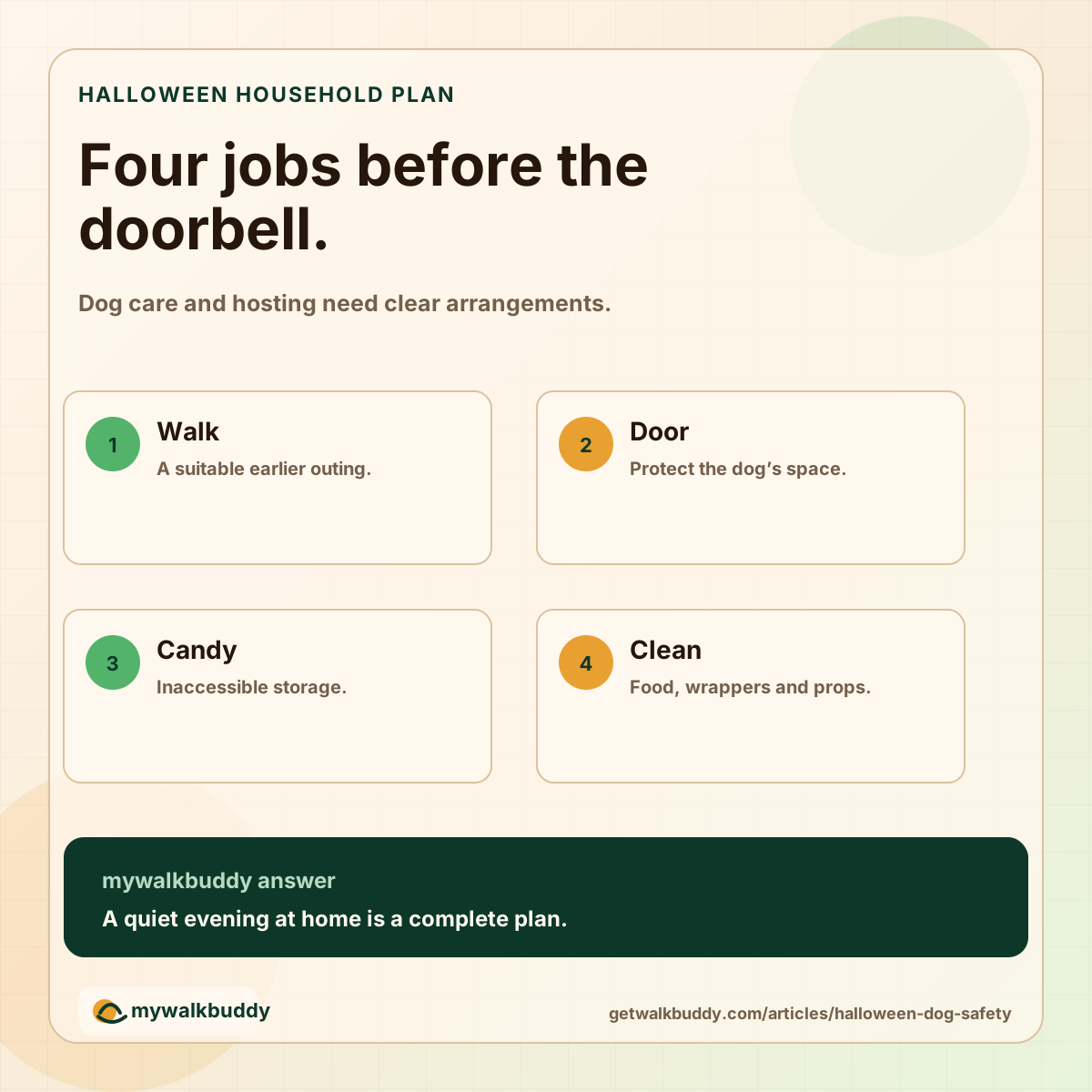
Agree on the walk, the dog’s location, door responsibility and candy storage. A short shared plan prevents several people from making conflicting assumptions.
Use this four-part handover: dog care; visitor handling; food storage; cleanup. Name the person responsible for each, even if one person takes more than one role.
If your neighborhood also has fireworks, use the separate fireworks plan for noise preparation and veterinary support. Keep that issue distinct from candy and door management.
Afterward, note one improvement for next year. A practical observation such as “the chosen room was beside the doorbell” gives you a change to make without labeling the dog as difficult.
- Before: plan the walk and secure candy storage.
- Door: assign responsibility and protect the dog’s space.
- During: supervise and skip stressful costumes.
- After: collect dropped food, wrappers and props.
Questions owners ask when the leash is already in their hand
-
Can my dog eat a small amount of Halloween candy?
Do not offer Halloween candy to the dog. Ingredients vary, and suspected ingestion of a toxic item needs professional advice.
-
Does my dog need a costume?
No. Comfort and unrestricted movement matter more than participating in the theme.
-
Is identification still needed for a dog staying home?
Check identification because repeated door openings create opportunities for escape even when no outing is planned.
-
What if the doorbell upsets my dog?
Arrange a comfortable space away from the busiest entry area and have someone available to support the dog. Prepare before visitors start arriving.
Choose the familiar route.
GetWalkBuddy records walking routes, time and distance. Use a familiar route when planning an earlier outing before neighborhood activity increases.