
- Record the last confirmed location and time.
- Give helpers one reporting contact and a no-chasing instruction.
- Keep sightings, local reports and follow-up actions together.
Turn this answer into a walk you can actually track.
GetWalkBuddy is a dog walking app for owners who want a simple route tracker, timer, distance view, and daily walk log without turning the walk into a spreadsheet.
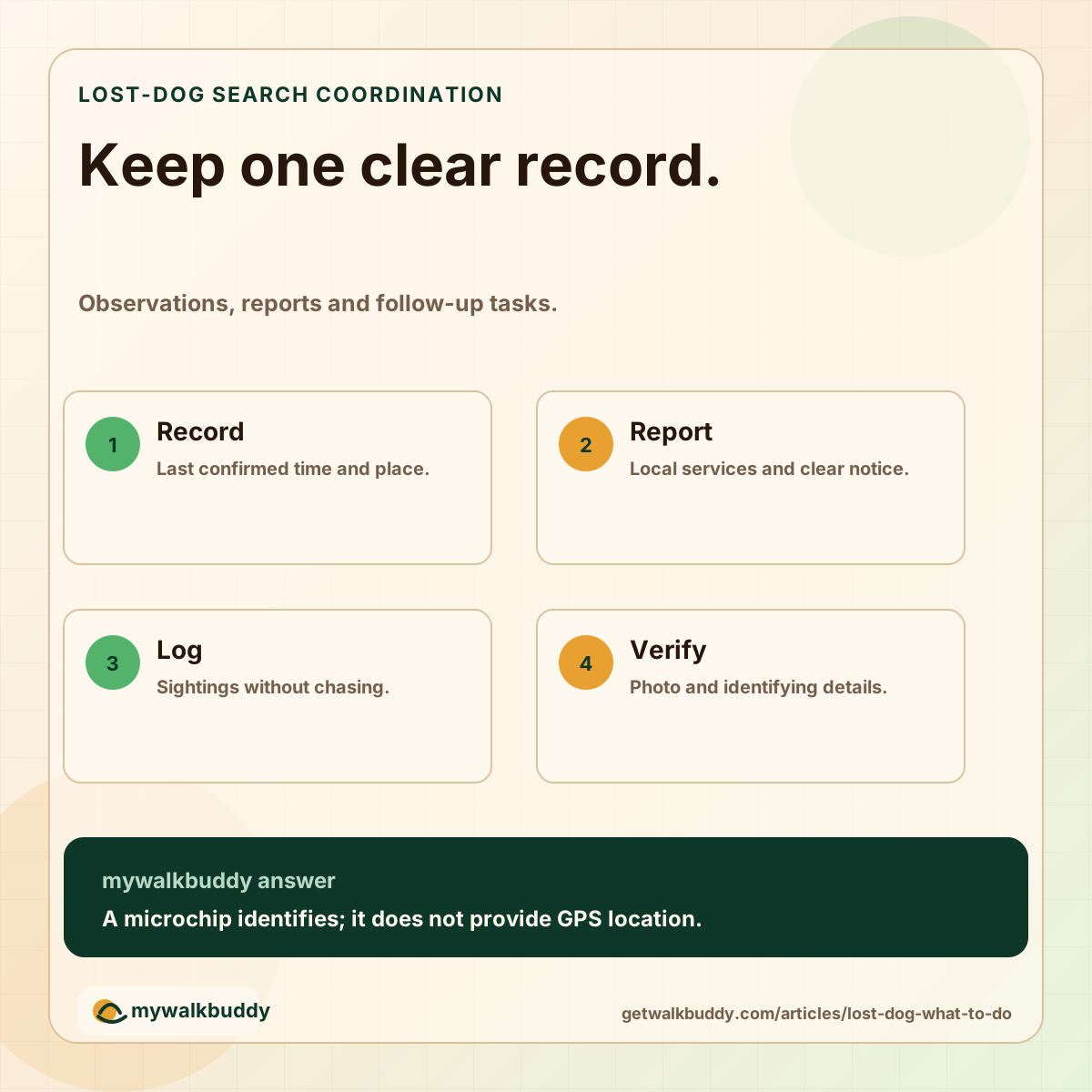
What should you record immediately?
Write the last confirmed location, time, direction of travel and identifying details. Separate what someone saw from what they think may have happened.
Use an exact landmark or intersection rather than “near the park.” Note the collar, harness or clothing present at the time, because those may differ from the photograph you share.
If several people were present, ask each for the observation once and combine the information. Repeatedly discussing different guesses can make the last confirmed point harder to identify.
Keep a current clear photograph ready. If the dog has a distinctive marking, retain a detail for checking claims of a match rather than publishing every identifying feature.
Sources: Humane World: How to Find a Lost Dog
How should helpers search?
Humane World recommends starting in the area where the dog was last seen and asking people to report sightings without chasing. Obtain permission before entering private property.
Assign a coordinator who stays reachable. Other helpers can check defined locations or contact local services, then report back rather than independently redirecting the whole group.
Our sighting log uses five fields: time seen; exact place; direction; observer contact; photo or description. Add a separate “action taken” column so someone else can see whether the report was followed up.
Label reports as confirmed, possible or ruled out. A similar-looking dog is useful information to check, but should not silently replace the last confirmed sighting.
Avoid sending a crowd toward a frightened dog. Ask local animal services or an experienced lost-pet recovery professional how to respond when sightings continue but approach is difficult.
Sources: Humane World: How to Find a Lost Dog
Who should receive a lost-dog report?
Contact the local shelter or animal control service and use the reporting process for the area. Coordinate public notices so people know how to send useful information.
Keep a contact log: organization, time contacted, reference number if given, information submitted and next follow-up. This prevents several helpers from making the same call while another relevant service is missed.
Prepare one consistent notice with a clear image, last-seen area and date, a contact method and the request not to chase. Use the same current version across the places where you choose to post it.
When a detail changes, update the original notice where possible. Repeated unconnected posts can leave people acting on older information.
This article is a planning guide; you must contact the relevant services and publish any notices yourself or through helpers you authorize.
Sources: Humane World: How to Find a Lost Dog; Humane World: Safely Help a Stray Animal
Can a microchip show your dog’s location?
No. AVMA explains that a pet microchip is an identification device, not GPS. A scanner reads a number that connects the finder or professional to the appropriate registry.
Check that the registry has your current contact details and ask about its missing-pet procedure. A number implanted in the dog is only one part of a working identification record.
Keep the chip number and registry information with your private search notes. Do not confuse a walking-history map with a live animal-location service.
If you use a separate tracking device, check its own information and limitations. A last recorded location is one observation to evaluate alongside sightings, not a reason to ignore newer confirmed information.
Sources: AVMA: Microchipping FAQs
How should you handle someone claiming to have found the dog?
Ask for a current photo and identifying details before arranging a handover. Humane World warns about claims that demand money before returning an animal.
Compare the description with details you have not publicly shared. If the report is vague, ask simple factual questions about location, markings and the dog’s equipment.
Do not send account passwords or verification codes to a stranger claiming they need them to prove you are the owner. Keep the conversation focused on the dog and a safe reunion arrangement.
If a shelter or clinic is involved, verify its contact information through its official channel and coordinate with staff. Avoid letting urgency replace basic verification.
Sources: Humane World: How to Find a Lost Dog
How do you keep a longer search organized?
Use a short handover whenever the person coordinating changes. Preserve the latest confirmed information, open tasks and contact history.
Our handover has four lines: latest confirmed sighting; possible reports still being checked; agencies contacted; next scheduled follow-up. Add the name of the current coordinator.
If specialist help is needed, give them this record. Do not improvise trapping or a capture attempt from a short online checklist; discuss the site and dog with experienced local help.
After a reunion, update reports and public notices, then check the escape point and identification details. Arrange veterinary assessment if there are injuries, illness or other concerns.
- Before searching: write the last confirmed sighting.
- During: report observations without chasing.
- Between shifts: hand over open tasks and contacts.
- After reunion: update notices and review escape prevention.
Questions owners ask when the leash is already in their hand
-
Should people chase the dog to catch it?
Ask helpers to report sightings without chasing. A frightened dog may move farther away; get experienced help for a safe recovery plan.
-
Is a microchip a GPS tracker?
No. It identifies the dog when scanned and relies on registry information being current.
-
What if there are conflicting sightings?
Keep each report with its time and location, and label confidence. Do not overwrite a confirmed sighting with an unverified one.
-
Does GetWalkBuddy locate a lost dog?
A recorded walking route is not live dog tracking. Use local reports, identification records and appropriate recovery help for a missing dog.
Know what your route record can tell you.
GetWalkBuddy records walks, time and distance. A previous route can help describe familiar places, but the app is not a live locator for a missing dog.