
- Choose your puppy's age in the interactive chart, then copy or save the cautious starting plan.
- Treat every time range as a testable starting point, not a target the puppy must finish.
- Increase only one variable at a time and let comfort, behavior, and next-day recovery decide what comes next.
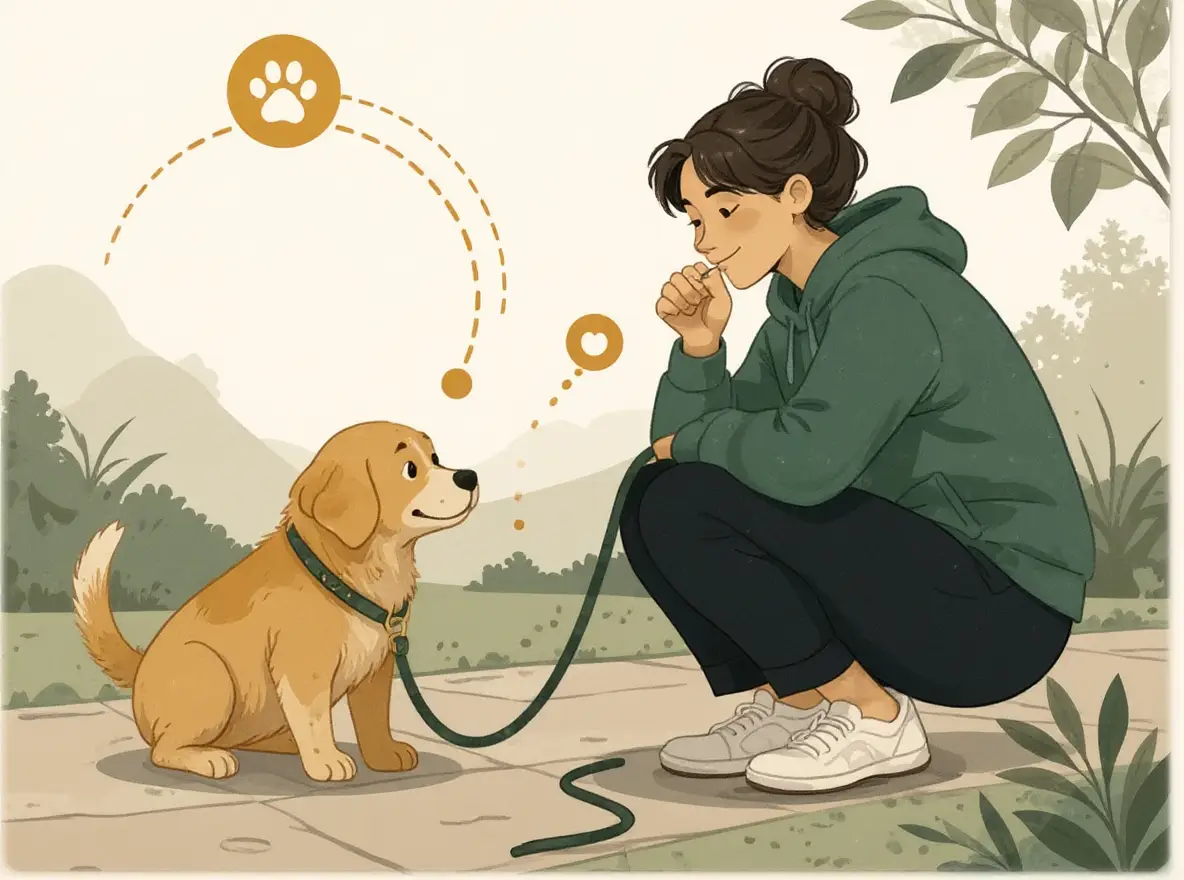
Turn this puppy answer into a tiny repeatable walk.
A puppy walking schedule app should help you repeat short, age-aware outings, log tiny wins, and protect rest instead of pushing a puppy into adult-distance walks before they are ready.
Interactive puppy walking chart by age
Choose an age for a cautious starting range. This is a planning aid, not a quota: PDSA notes that the popular five-minutes-per-month rule lacks scientific evidence, while AKC presents it as a general walking guide. Your puppy's veterinarian, breed, vaccine status, pace, and recovery take priority.
| Age | Cautious walk range | Main focus | Shorten or stop when |
|---|---|---|---|
| 8–10 weeks | 5–10 min practice/exploration | Harness, confidence, safe surfaces | Fear, sitting, frantic biting, fatigue |
| 10–12 weeks | About 10–15 min if vet-cleared | Sniffing and positive exposure | Lagging, reluctance, poor recovery |
| 3–4 months | About 15–20 min | Short walks plus play and training | Soreness or next-day reluctance |
| 4–6 months | About 20–30 min | Varied soft surfaces and calm skills | Gait change or difficulty settling |
| 6–9 months | About 25–40 min | Gradual stamina, not forced running | Repeated refusal or delayed stiffness |
| 9–12 months | About 30–50 min | Breed-aware progression and recovery | Weekend jumps cause poor recovery |
Sources: AKC puppy exercise guidance and PDSA veterinary guidance.
How long should a puppy walk at each age?
Puppy walk length should start short and grow gradually as coordination, confidence, vaccination protection, and recovery improve. An eight-week-old needs tiny safe exploration; an adolescent may manage longer varied walks. Breed size, pace, terrain, heat, play, training, and sleep can make the same number too much or too little.
Use the interactive chart below to choose an age range, then compare the suggestion with the puppy in front of you.
A slow sniffing loop and forced repetitive marching are not the same workload. Count the activity type, not only the clock.
Is the five-minute puppy walking rule reliable?
The five-minute-per-month rule is a memorable conservative guide, not a scientifically proven prescription for every puppy. PDSA advises against relying on a fixed calculation, while AKC presents it as general guidance. Use it only as a prompt to stay cautious, then prioritize veterinary advice, activity type, growth, and recovery.
A formula cannot see a growth spurt, fear response, slippery route, hot pavement, awkward gait, or a puppy who already spent the day learning.
If you use the rule, treat the result as a ceiling to review rather than minutes you are required to complete.
How should you increase a puppy's walking time?
Increase a puppy's walking time by changing one variable—duration, terrain, pace, or distraction—then repeating the easier routine long enough to judge recovery. Keep the next increase small. Lagging, repeated sitting, gait changes, soreness, escalating biting, sleep disruption, or next-day reluctance are reasons to shorten the plan and seek advice when needed.
A simple weekly note is more useful than a perfect-looking schedule: what you did, how the puppy behaved afterward, and how movement looked the next morning.
Vaccination status and local disease risk also affect where a young puppy can explore, so confirm public-ground guidance with your veterinarian.
Questions owners ask when the leash is already in their hand
-
When can puppies start longer walks?
Timing varies by breed, growth and health. Increase gradually after veterinary guidance and good recovery from shorter outings.
-
How quickly should I change a routine for puppy exercise chart by age?
Make one small change, keep it consistent for several sessions, and review comfort and recovery. Slow down or ask a professional when the dog is sore, distressed or changing suddenly.
Save the range, then let your puppy edit the plan.
Use the age chart below, save the starting point on this device, and track the walks and recovery that show what actually fits.