
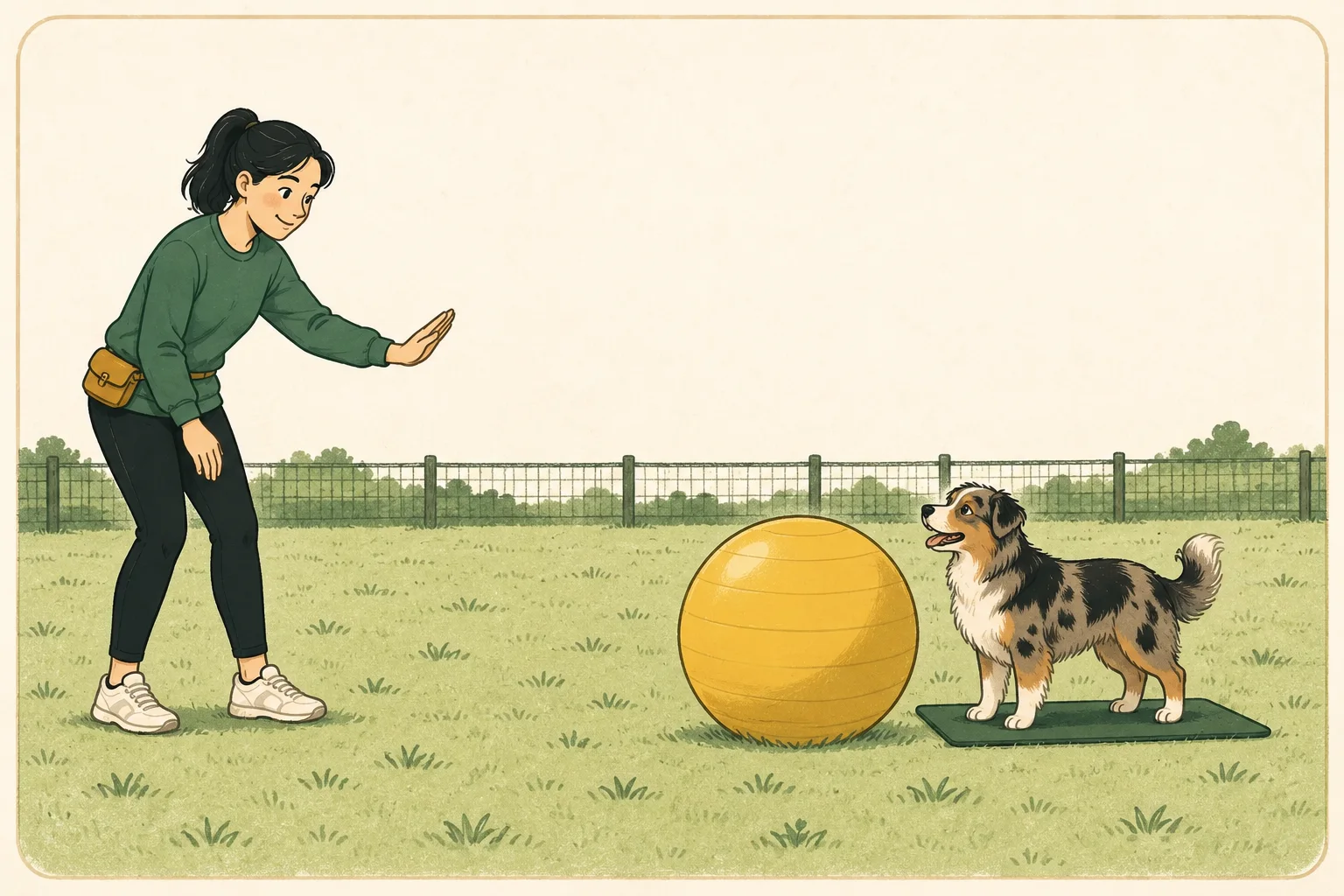
- Teach where to go separately from how to move a ball.
- Use short, clear foundation tasks before adding distance or several balls.
- Choose equipment and difficulty for the individual dog.
Turn this answer into a walk you can actually track.
GetWalkBuddy is a dog walking app for owners who want a simple route tracker, timer, distance view, and daily walk log without turning the walk into a spreadsheet.
What is Treibball, and is it only for herding breeds?
Treibball involves directing a dog to move large balls toward a goal. In AKC’s introduction, trainer Dianna Stearns explains that dogs of several breed types participate and that the pushing skill needs to be taught.
You do not need to select the sport by breed label alone. Consider whether your dog enjoys working with you, what the individual dog can manage physically and whether you have access to suitable instruction.
Distinguish the goal from ordinary ball play. A dog rushing at a moving ball is not necessarily learning to select a direction, line up or bring the ball toward you. Those are separate tasks worth teaching clearly.
This introduction is for exploring the activity. Competition formats vary, so use the current rules of the organization hosting an event if you decide to enter.
Sources: AKC: an introduction to Treibball
What can you learn before bringing out a ball?
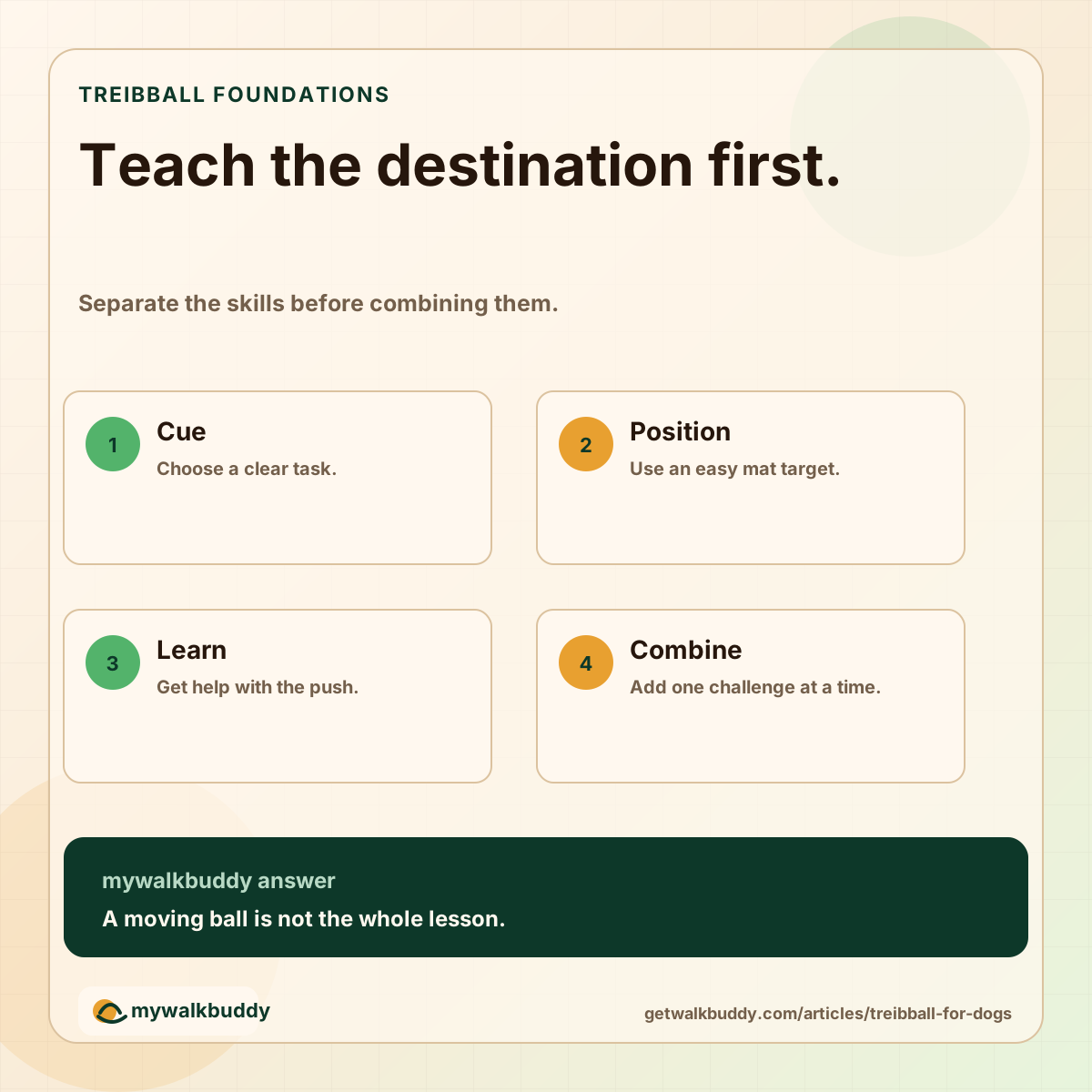
The National Association of Treibball Enthusiasts highlights foundations including attention, going to a mat, recall and thoughtful reward delivery. A mat can show the dog where to go before distance and ball work are added.
Choose an easy position close to you and reward the dog for using the mat voluntarily. The first task is recognizing a destination, not racing across a field. An instructor can help you choose cues that remain distinct from your everyday walking cues.
Keep the target area stable and clear. If the dog is unsure, make the task easier by returning to a familiar placement rather than adding a more exciting ball as a distraction.
NATE notes that a dog can stand, sit or lie on the mat during this foundation work. Choose a comfortable position with your instructor rather than insisting on a posture simply because a video showed it.
Sources: National Association of Treibball Enthusiasts: foundation skills
When should you add the ball?
Add it when the foundation task is understood and you have guidance on appropriate equipment and pushing technique. AKC describes learning the push gradually through targeting rather than assuming the dog knows what to do.
Ask the instructor to show the difference between positioning behind the ball and pushing it. Learning both at once may make it difficult to identify which part is confusing.
Discuss ball size, material, surface and how to prevent uncontrolled rolling in your actual practice space. A large ball bought for another purpose is not automatically the right equipment for your dog.
If the dog bites, paws frantically at or becomes worried by the ball, pause and obtain help with an easier introduction. Do not force contact or increase excitement to make something happen.
Sources: AKC: an introduction to Treibball
How do you organize a beginner practice area?
Use a clear, secure area with enough room for the specific foundation exercise. Start with one task and one dog rather than a full competitive layout.
Separate three locations in your plan: the dog’s target, your position and a place to take a break. This makes it easier to repeat the same task and notice what changed.
An illustrative setup might be a nearby mat on level ground with no ball present. Another session, under instruction, may add a single suitable ball. More equipment does not automatically produce a clearer lesson.
Keep other dogs and people out of the ball’s path. Follow local access rules and your instructor’s management guidance. Ask your veterinarian about suitability when age, injury or health concerns affect activity.
What should you ask before the first class?
Ask about prerequisites, equipment, training methods and how the instructor adjusts a task when the dog is confused or uncomfortable. NATE explicitly promotes force-free methods.
Bring one practical goal, such as understanding mat work or learning how to introduce the push. That gives the instructor a clear starting point.
- Before: explain the dog’s experience and physical limitations.
- Learn: separate destination, orientation and push skills.
- Practice: use one clear task in a secure space.
- Review: record what was comfortable and what needs an easier step.
Sources: National Association of Treibball Enthusiasts: foundation skills
Questions owners ask when the leash is already in their hand
-
Is Treibball only for Border Collies?
No. Several breed types can participate. Interest, comfort and suitable instruction matter more than assuming a breed will automatically understand the sport.
-
Do I need eight balls for the first lesson?
No. You can begin foundation work without a ball and add equipment with your instructor.
-
Is a herding ball the same as Treibball training?
A ball is equipment. Treibball also involves learned positioning, direction and controlled pushing.
-
Can an older dog try it?
Discuss the individual dog’s health and activity limits with your veterinarian and instructor. A low-impact description is not blanket clearance.
Keep walks alongside training.
GetWalkBuddy records walking route, time and distance. Keep Treibball practice notes separately so each activity stays clear in the household plan.