
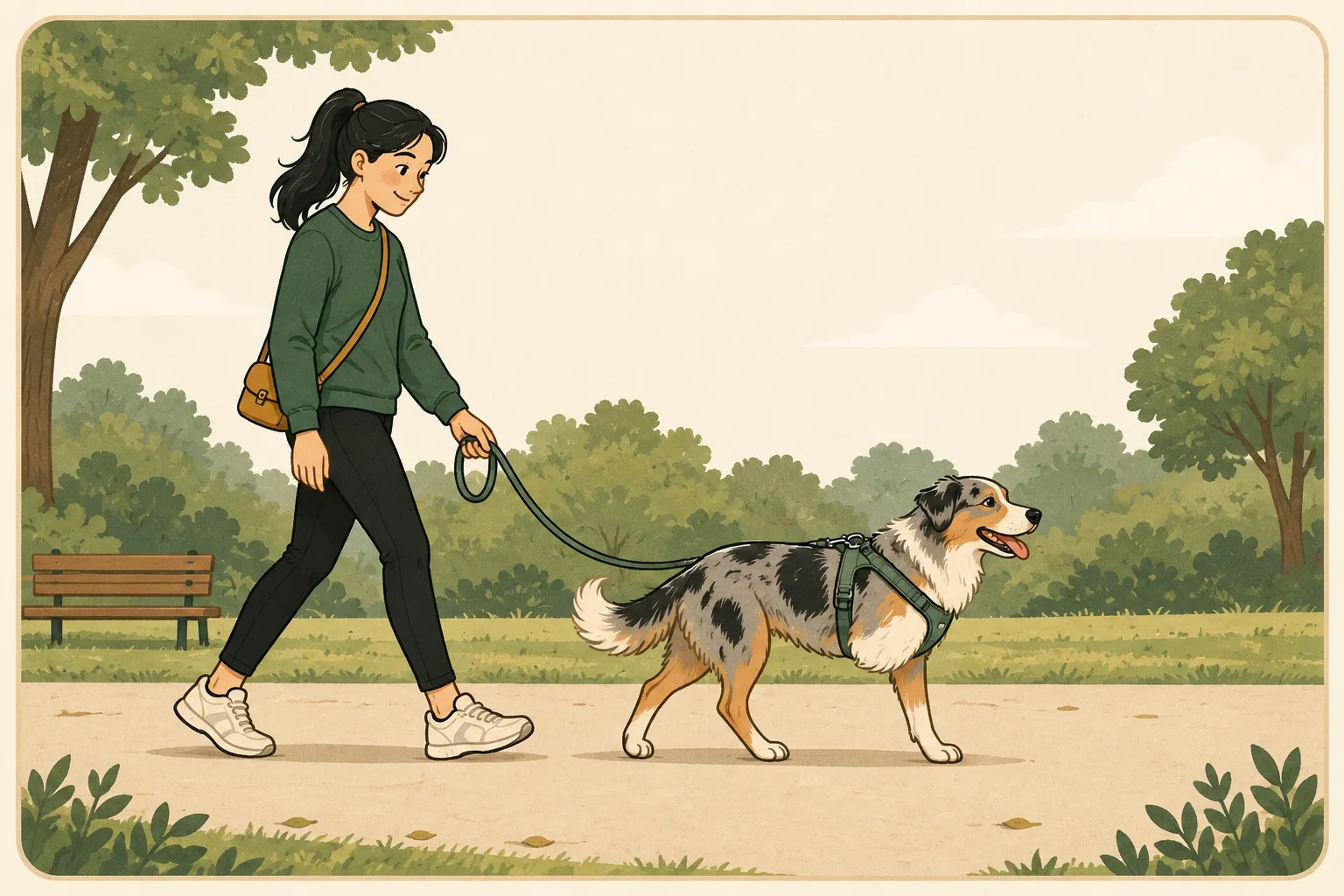
- Get specific instructions for this dog’s current stage.
- Check the whole route, including the return and access points.
- Record observations without using distance as a diagnosis.
Turn this answer into a walk you can actually track.
GetWalkBuddy is a dog walking app for owners who want a simple route tracker, timer, distance view, and daily walk log without turning the walk into a spreadsheet.
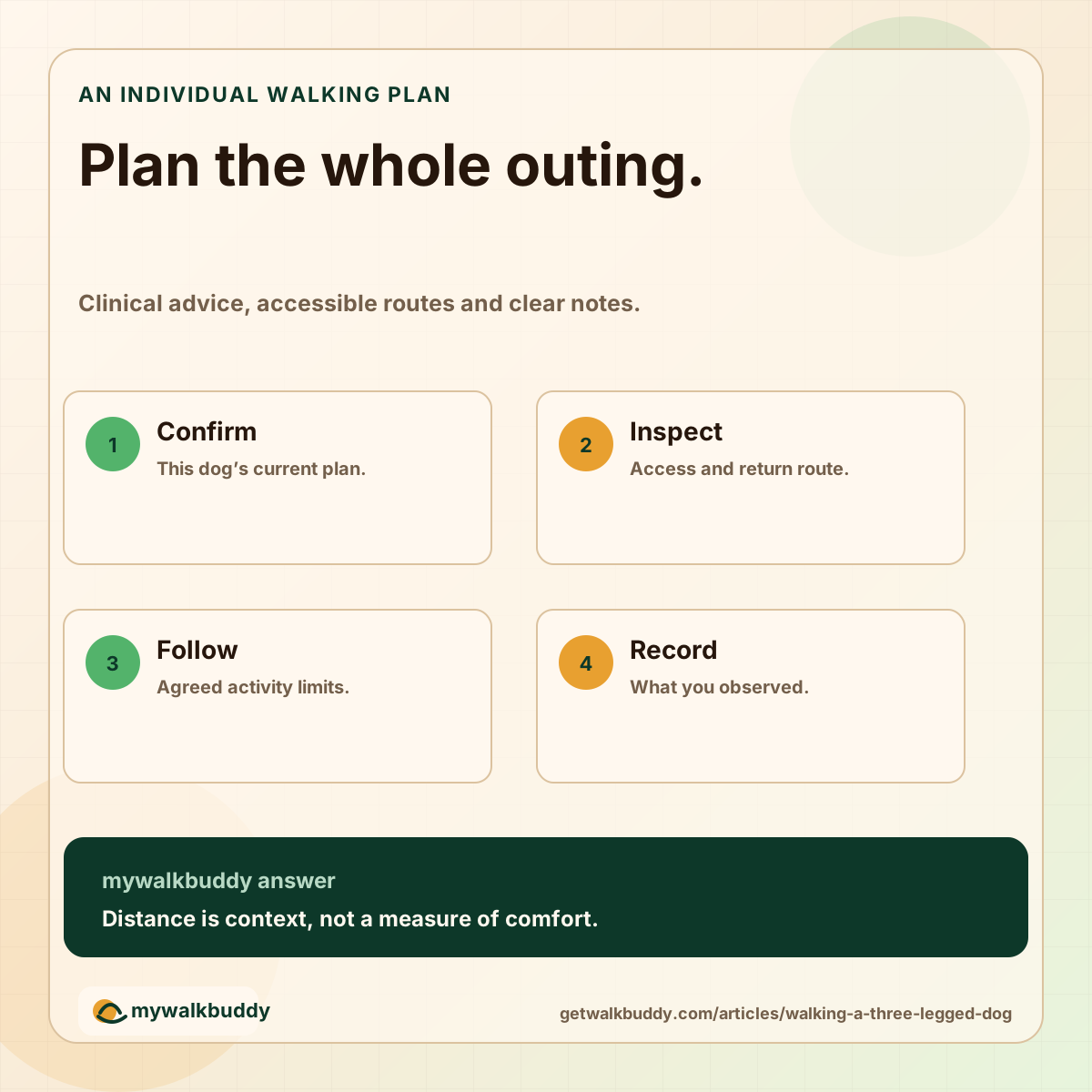
Why is an individual walking plan important?
A dog’s remaining limbs, health history and stage of recovery matter alongside the missing limb. Cornell’s rehabilitation service describes assessment and tailored home activity plans for mobility needs.
“Three-legged dog” describes a visible feature, not a complete activity prescription. Tell your clinician whether the dog was born with a limb difference, recently had surgery or has lived comfortably on three legs for years.
Cornell’s account of Marshall, a dog with a congenital limb difference and additional joint problems, illustrates why the whole dog needs assessment. His treatment story is one case; it does not establish a treatment or walking target for another dog.
Use this guide to prepare questions and organize an agreed routine. It is not a post-operative rehabilitation schedule.
Sources: Cornell: Sports Medicine and Rehabilitation; Cornell: Marshall’s Individual Rehabilitation Story
What should you ask the veterinarian or rehabilitation team?
Ask what activity is appropriate now, what limits apply, how to recognize a problem and when the plan should be reviewed.
Bring a brief description of the current routine: outings per day, approximate walking time, surfaces, steps, changes you have noticed and equipment already used. Include your practical constraints, such as an apartment entrance without a ramp.
Our appointment sheet has five blanks: permitted activity; current limit; assistance needed; stop-and-call signs; review date. Ask the clinician to make the answers concrete enough that every walker can follow them.
If instructions say “short walks,” ask what that means for your dog and whether toilet trips count separately. If progress is allowed, ask what observation should support a change and who should approve it.
For recent surgery, follow the treating team’s discharge instructions and check before making changes. An online story about a rapidly active tripod dog does not override those instructions.
How do you choose a practical route?
Match the route to the agreed plan and inspect the access points as well as the path. Keep a workable return option available.
Make a route sketch with four places marked: departure; the first difficult surface or obstacle; a rest or turning point; and the easiest return. This is an access-planning exercise, not a test of endurance.
Include the journey before the walk: getting through the doorway, reaching the sidewalk and entering a vehicle if used. A manageable park route may still have an unsuitable access step.
Ask the clinician about surfaces and terrain that need particular care for your dog. Then choose a familiar route where you can follow that advice without making a last-minute decision at an obstacle.
If an outing depends on carrying the dog back, discuss a realistic assistance plan in advance. Do not assume every owner can safely lift every dog or that every harness handle is designed for lifting.
Does a tripod dog need a special harness?
Equipment should match the dog’s anatomy and the support task. Ask for a fitting and handling demonstration rather than choosing only from a product label.
Take the harness to an appointment or fitting if possible. Explain whether you need ordinary leash attachment, help at a particular access point or support specified in a rehabilitation plan.
Ask where the equipment should sit, what should remain clear and how to recognize slipping or rubbing. If a device is intended to provide support, ask the professional to demonstrate the exact handling technique.
Cornell lists assistive devices among its rehabilitation options, but availability does not mean every dog needs one. A brace, cart or other aid is an individual decision, not an automatic purchase after amputation.
What should you record during the routine?
Record the outing and the dog’s observable response. A route total is useful context, but it cannot determine pain or prove that the activity was suitable.
Use a compact log: date; route and surface; walking time; assistance used; observations during the outing; observations afterward; questions for the clinician.
An illustrative note could say “turned back at the rough path; paused twice; needed help at the entrance.” Keep that separate from interpretations such as “lazy” or “fully recovered.”
If the clinician asks for video, follow their instructions and keep the dog’s handling safe. Do not recreate a difficult movement just to capture a better clip.
Share the same log with everyone who walks the dog so that one person does not increase activity while another assumes the earlier limit still applies.
When should the plan be reviewed?
Follow the agreed review schedule and seek veterinary advice for new pain, a change in mobility or other concerning changes. Do not push through a new problem to finish the route.
Have the clinic’s contact details available before you need them. Ask in advance what should prompt an urgent call and what can wait for the planned review.
Keep progress broader than mileage. Easier access, comfortable participation and a routine that caregivers can repeat may be meaningful practical goals to discuss with the team.
A walking app can organize time and route information, while the clinical team interprets health and movement. Keep those roles clear when deciding the next step.
- Before: confirm the current individual plan.
- Route: check access, surface and the return.
- During: observe and follow agreed limits.
- Review: share changes with the clinical team.
Questions owners ask when the leash is already in their hand
-
How far can a three-legged dog walk?
There is no universal distance. Ask the treating veterinarian or rehabilitation professional for a plan based on the individual dog and current stage.
-
Can I use another tripod dog’s routine?
Use it as a source of questions, not a prescription. Health history, anatomy and recovery needs can differ.
-
Should I start swimming or a treadmill at home?
Discuss those activities with the clinical team first. Supervised rehabilitation equipment in a case report does not establish a home exercise plan.
-
Does every three-legged dog need a wheelchair?
No automatic equipment choice follows from the label. Ask whether support is needed and which device, if any, fits the individual task.
Keep route information ready.
GetWalkBuddy records walking routes, time and distance. Bring those details alongside your own comfort and assistance notes when reviewing the plan with your veterinarian.