
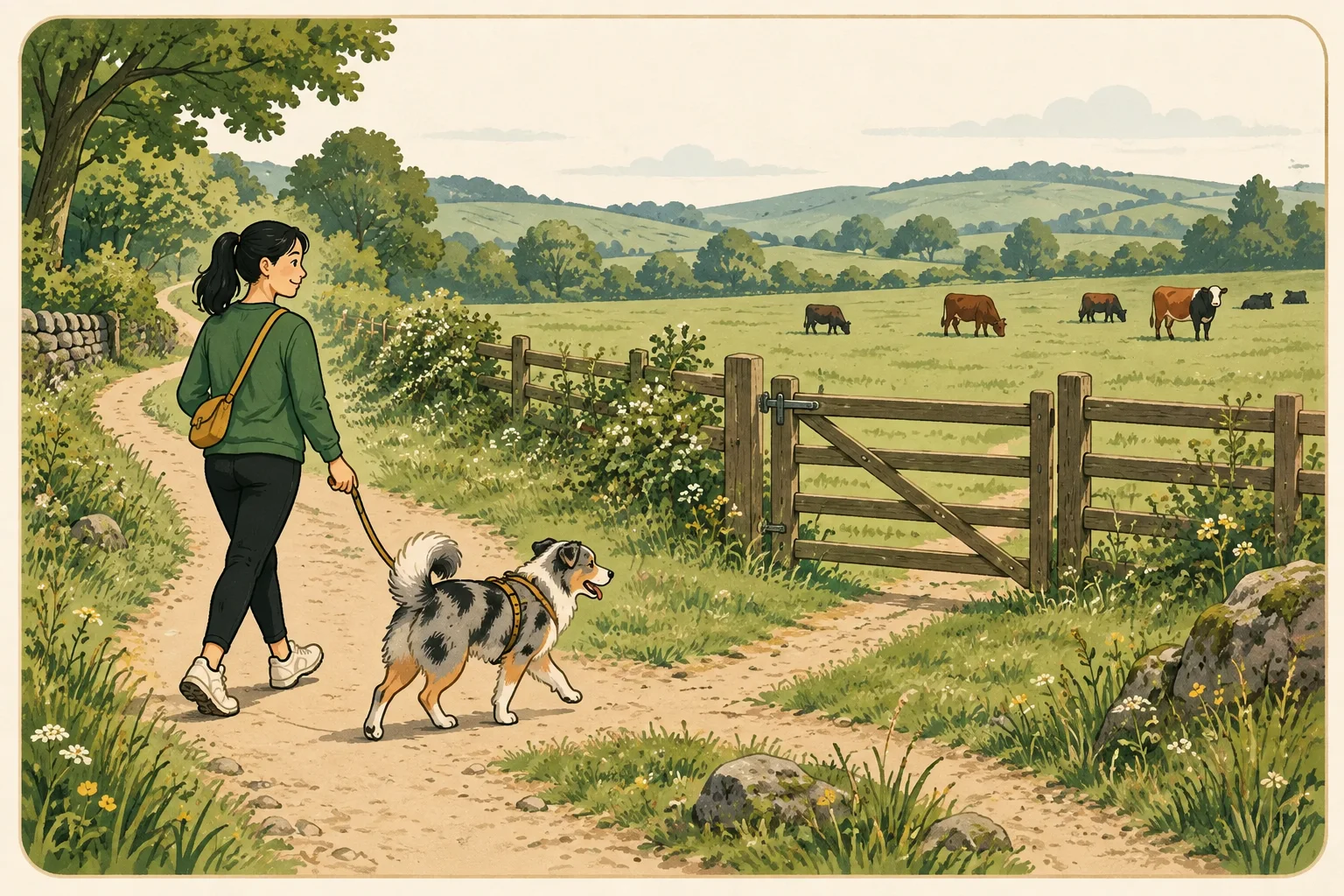
- Check current access and choose an alternative before entering.
- Keep distance, control the dog and never split a cow from its calf.
- Know the emergency guidance for threatened walkers.
Turn this answer into a walk you can actually track.
GetWalkBuddy is a dog walking app for owners who want a simple route tracker, timer, distance view, and daily walk log without turning the walk into a spreadsheet.
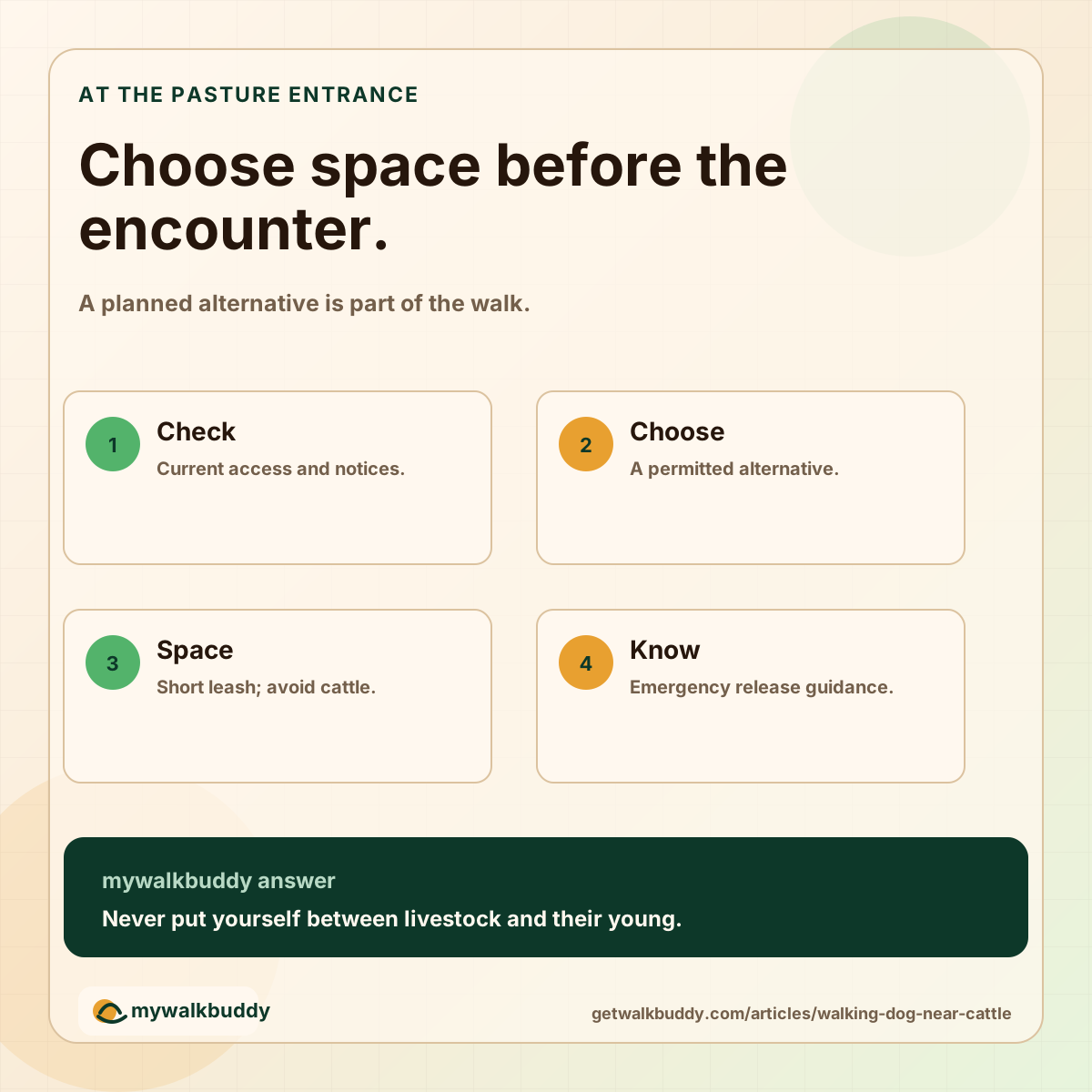
What should you check before choosing a rural route?
Check current local information, dog access and livestock notices. A route you previously walked without cattle may have different conditions today.
Our route card has two options: the planned walk and a permitted alternative that avoids the pasture. Mark the decision point before the field, not halfway across it.
Look at how the route returns to the start. An alternative is only useful if you know where it goes and can manage it with your dog and companions.
The Countryside Code applies to England and Wales. Its published guidance is cited here for livestock safety; it does not establish access rights or dog rules in another country. Check the relevant land manager and local authority for your location.
Sources: Natural England and Natural Resources Wales: Countryside Code
What should you assess at the entrance?
Pause before entering. Look for cattle, calves, the route through the area and a practical way to avoid close contact. Choose another permitted route if the situation is unsuitable.
Do not use the dog’s curiosity as a reason to approach. A friendly dog still needs management around livestock, and a quiet-looking herd does not guarantee how an encounter will develop.
If animals cluster around the gate or the route gives you no comfortable separation, the alternative route is the plan. Avoid turning an ordinary walk into an attempt to move a herd.
Our group check is simple: does everyone understand the route decision, who is holding the dog and where you will go instead? Resolve that before opening a gate.
How should you manage the dog near cattle?
RSPCA recommends a short leash, plenty of space and never walking between animals and their young. Keep the dog from approaching, chasing or disturbing livestock.
Concentrate on the surroundings instead of filming an encounter. If your dog struggles to disengage from animals, choose a walk that avoids this situation and seek suitable training support separately.
Follow local access instructions and the land manager’s directions. Do not assume that a recorded walking route gives permission to use every neighboring field.
Leave gates as instructed or as you found them. Make sure everyone in your group knows the arrangement rather than assuming the last person will guess correctly.
Sources: RSPCA: Responsible Dog Walking; Natural England and Natural Resources Wales: Countryside Code
What if cattle threaten you and your dog?
The Countryside Code advises letting the dog off the leash if you feel threatened by livestock or horses, rather than risking injury while protecting the dog. RSPCA advises leaving calmly and quickly by the nearest exit.
This is an emergency exception to ordinary leash management around livestock. It is not advice to begin a pasture walk with an off-leash dog.
Read the guidance before setting out so this distinction is clear. Do not plan to hold the dog close at all costs if that keeps you in danger.
Once safe, contact emergency services for an injured or endangered person and obtain veterinary care for an injured dog. Report a dangerous incident to the relevant land manager or authority when you can do so safely.
Sources: Natural England and Natural Resources Wales: Countryside Code; RSPCA: Responsible Dog Walking
What belongs in a useful countryside walk note?
Record the date, route decision and relevant conditions so you can plan the next outing more carefully. Treat the note as history, not a live safety report.
Our example format is: “Pasture gate reached; cattle near entrance; used signed alternative; return manageable.” This explains why the recorded distance changed without declaring a route permanently safe or unsafe.
Keep access information separate from your own observations. “Dogs not permitted” is a rule only when confirmed by the relevant authority or notice; “we chose not to enter today” is your decision.
Before repeating the outing, check again. A saved route is useful for orientation, but neither a walking app nor an old note can tell you where livestock are now.
- Before: check local guidance and a permitted alternative.
- At the gate: assess space and choose whether to continue.
- Nearby: short leash, distance and no contact with livestock.
- If threatened: follow emergency guidance and reach safety.
Questions owners ask when the leash is already in their hand
-
Should my dog be off leash near cows?
Ordinarily keep your dog on a short leash around livestock. The Countryside Code’s release advice applies when livestock threaten you, as an emergency measure.
-
Is it safe if my dog is friendly?
Friendliness does not remove the need for distance and control. Avoid close encounters and never allow the dog to approach or chase cattle.
-
Can I walk between a cow and its calf?
No. Keep clear and choose a route that does not separate livestock from their young.
-
Does a saved walking route show whether cattle are present?
No. Check current conditions and local guidance each time; past route records do not show live livestock locations.
Keep the alternative route in your record.
GetWalkBuddy records your walking route, time and distance. Use previous outings to plan alternatives, then check current access and livestock conditions before returning.